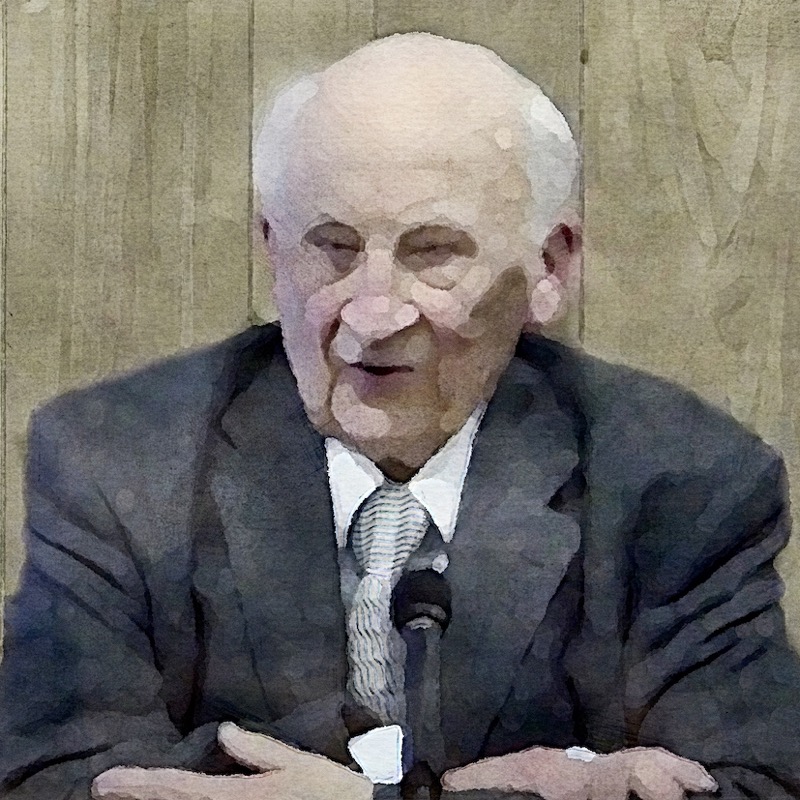
Gooding, David: Why I Believe the Bible
ID mfh_1138393651Date unavailableBefore 3.14Restored 4.68
And a very good evening to you, and thank you for your invitation to come along and speak to you this evening. You have asked me to speak on the topic, why I believe in the Bible. I will point out, therefore, that the reasons that I shall be giving to you this evening why I believe in the Bible are not necessarily the reasons that you would hold for believing in the Bible. They are not necessarily, as you might imagine, the very best reasons why anybody would believe in the Bible. But then you have asked me to come and to give not the very best reasons there are for believing in the Bible, but the reasons why I personally believe in the Bible. Now, as you hear what I have to say, some of you may decide that I am an unnecessarily complicated man, and that I ought to come more quickly to the point and more clearly and decidedly. Others of you, and perhaps the majority of you, will become to think that I am a very simplistic kind of a man. That be as it may, these are the reasons, or some of them, why I personally believe in the Bible. So let me come straight to the point as I may and tell you that I personally believe in the Bible to be God's word and true. I believe in it because I believe in Jesus Christ. I believe that the claims that Jesus Christ made for himself are true, and therefore I believe that Jesus Christ is the Word of God incarnate, God and man. And because Jesus Christ authorizes our New Testament and puts his authority of belief upon the Old Testament. For these reasons, then, I follow him, and I believe both the New Testament and the Old. Now, some of you may say to me at this juncture, but are you not, sir, with all respect, are you not arguing in a circle? You tell us you believe the Bible because you first of all believe in Jesus Christ. That says my critic, how did you come to know about Jesus Christ? And of course, if you ask me how I came to know about Jesus Christ, I've got to say I know of him from the Bible. There you are, you say, you're arguing in circles. You believe in Jesus Christ because the Bible says so, and then you believe in, uh, uh, uh, uh, uh, the Bible because Jesus Christ says so. So first of all, you have to believe in the Bible, and then you believe in Jesus Christ. And when you come to believe in Jesus Christ, then you come to believe in the Bible. You say, sir, you are arguing in a terrible, vicious circle. Well, so it may sound, I beg leave to point out that I'm not really arguing in a vicious circle at all. For when I come in this sense to the Bible, I do not first come presupposing it is the word of God. If you wish to follow me here, you'll have to come to the Bible as you would come, not to the Daily Mirror, that would be too absurd, but maybe to The Times or The Guardian, whichever is your preferred newspaper. And when you come to your favorite newspaper, you do not first of all come to it with the belief that everything in this newspaper is one hundred percent true. No, you are aware that a newspaper can report true things and false things. So you come to the newspaper with an open mind, and if some reporter is telling you a story, you listen to the facts of the story as he records them, and you let your belief be determined by the quality of the evidence. Tonight, if I speak to someone who is not yet a Christian, and you do not believe that the Bible is the word of God, and therefore you do not believe that it is necessarily true, then I suggest you first of all come to scripture as you would to some reliable and sensible newspaper. Oh, let me immediately interject that, of course, to compare Bible with newspaper is, in a sense, nonsense, for millions upon millions of folk in many generations have indeed proved to themselves that that word in scripture is the word of God, and found it living and powerful, and therefore, in one sense, to compare it with anything else is a folly. But for the sake of logical argument, all I'm asking you to do, if you would follow me here, is to come to Holy Scripture as you would to a reliable newspaper and read what it has got to say. You needn't come with any presuppositions that this is inspired and infallible. Just come and read it as you would read, as I say, your newspaper. And let the facts as it reports them, convince you. So that when I say I believe in the Bible because, first of all, I believe in Jesus Christ, I'm not arguing in a circle. I do genuinely come first to Christ. And when I come to the record of his character in Holy Scripture. This is the first thing that I would put in logical order, the first thing that impresses itself upon me. The character of Jesus Christ that I meet in the New Testament, I say to myself, was surely not invented by the human authors of the New Testament. They must be reporting, I say to myself, a real character, whose life they observed, whose deeds they saw, whose character they have faithfully represented, but did not invent. Why do I say that? Well, I follow the line of argument, for it appeals to me as being true, that was put out some many years ago now in that famous book called The Original Jesus. That the character of Jesus that you meet in the New Testament is not such a character as anyone would have invented in the ancient world. The ancient world into which Jesus Christ was born had, amongst its thoughtful members at any rate, some clear ideas of what the human ideal is. Jesus Christ that appears in the New Testament is nobody's ideal. As Paul remarked on one occasion, to the Jew he's a stumbling block, and to the Greek he is folly. The character of Jesus Christ in the New Testament is nobody's ideal. And of course, if you read the story carefully, you will find that even his closest disciples, and they record the fact with scrupulous honesty, even his closest disciples, when they came to one of the critical things in all that Jesus Christ stood for, abandoned him and fled. You will remember the story how in the Garden of Gethsemane, when the troops came to arrest our Lord, Peter asked permission if he might ward off the attack by the sword. Without getting permission, he did draw his sword and attempt to defend the Lord Jesus. And straightway the Lord Jesus forbade him and told him to put his sheath into his sword and said to Peter and the rest, think you not that I could now call to my Father, and he would supply twelve legions of angels? But then, how shall the scripture be fulfilled that thus it must be? Then, says Matthew, then his disciples, all of them, forsook him and fled. It was not that they had of a sudden lost their nerve. Peter had his physical courage in being prepared to draw his lonely sword against the whole squad of soldiers and fight the whole thing out to the death. He didn't flee for lack of physical courage. He and the rest of them fled because to them the whole situation was absurd. And for this reason, that they were Jews, and they were looking for a Messiah that would come to put down evil, remove the oppressor, see that justice was done in the world. Sure, their hope was, as things go, a reasonable hope, was it not? This was their ideal, justice and freedom for the oppressed. And a Messiah who, when it came to the crunch and was about to be arrested by evil and wicked men, just stood there and did nothing, and made no attempt to save himself. That was such a contradiction in terms to the ideal that the Jews held, and amongst those Jews, the early disciples of Jesus. When our Lord finally insisted, would not permit the sword to defend himself, did not take to the sword to put down evil and crush his enemies. Then they forsook him. The thing was too absurd for words. And in that very truthful record, from the pens of the early disciples that at that critical juncture in our Lord's life and ministry, they disagreed with him. And Fred, you will see that Jesus Christ was certainly not the Jewish ideal. He still isn't. I have in this city an elderly Jewish friend who favors me with his company from time to time. He was with me just last week, and he said again what he has said so many times. David, how can your Messiah, how can your Jesus be Messiah? Son of God, you say? And where was God, please, when, when Hitler was gassing six million Jews? Gone on holiday or something? So, my first point that he was not certainly the ideal that his contemporary Jews held, not the ideal of the men who penned the New Testament. That is, before the resurrection totally changed their concepts. He wasn't, of course, as far as anybody could tell, he wasn't the ideal that the Greeks looked forward to. And here I talk of seriously minded, philosophically minded Greeks. Obviously, Jesus Christ was no Stoic. Nor was he the ideal of the Platonists, such as you would find in Socrates. These men sought by their wisdom to understand the universe, that understanding the universe they might behave rightly and rationally in this universe. And it led to some superb characters marked by their tremendous self-control. The Stoic who despised death and despised men who showed any fear or weakness in the face of suffering. Consider Socrates, if you will, and the famous record that Plato has penned of the last hours of Socrates. How faced with the injustice of the death he was about to suffer, how calmly he met it. In the power of his logic and his philosophy, went to his end peacefully, serene, and in a sense majestic. That's your Greek ideal, favored by Platonist and Stoic alike. And Jesus Christ? Oh, the record is that when he faced death, he kneeled in the garden and he groaned and was moved and he sweat. Tormented, you might say. When he died on the cross, his most loyal disciples tell you, he died having cried, my God, why did you forsake me? You no wonder that Paul reports the reaction of many a thinking philosophical Greek to the story of Jesus Christ. To the Greeks, the cross of Christ was foolishness. Contradicted all the ideals that their philosophers had put before. To the Romans, it was laughable. As the imperial governors of the then world empire, they were used to political upstarts who, for one reason and another, patriotism or enthusiasm or religion even, tried to start a rebellion against Rome. Many had attempted it, some had managed it for a little while until Rome crushed them. A man claiming to be the king of the Jews that wouldn't fight. Herod's soldiers thought they'd never met anything so screamingly funny in all their life. They clothed him with a purple robe and put a reed in mockery in his hand and a crown of thorns on his head and had great fun. They never heard anything so absurd. Said others. Himself he cannot say. And I am referring to one particular, surely a central particular, in the life and ministry of Jesus Christ, and my argument is this. As I come to the New Testament and read of him, I say that this character was not invented. He was nobody's ideal. In fact, he went sharply against the ideals of the ancient world, Jewish, Greek, and Roman. And even his closest disciples, I repeat, tell you, at a crucial moment they abandoned him because they disagreed with his policy, and were not changed in their mind until he rose from the dead. So then, I come to the next feature about this character that we find facing us in the New Testament. And I observe a simple fact, that for uncountable, now uncountable millions of people, the Jesus Christ of the New Testament is a living person. And you say that simply because they're Christians. Ah, but just half a moment. Let's proceed on what for me is an impossible, uh, view now, that he is an invention of some ancient people. Well, if he is, they are forthwith to be congratulated as the greatest geniuses the world ever saw. As anybody knows who has a notion of literary things, to create, to invent a character and describe him in a work of fiction in such way as that character lives for people is an exceedingly difficult thing. At that level, it has been achieved but once or twice, perhaps, in the course of literature. Jesus Christ, you not only have a character that many people would claim to know, they know him as a real person who lives. Such a character who not only lives for them, they die for him. Did you ever know another character in history, being fictional, millions of folks were prepared to lay down their lives for him? How did this character, if he were invented, come to have such great power over men? To believe that a few fishermen invented the character. He's asking us to believe in such a miracle that if they did perform it, then I think we should fall down and worship them instead of the Jesus they created. Along that line I come now, as I listen to this Jesus Christ in the New Testament. I come now to the question of his claim to be, in some sense, the Son of God. Which claims made finally when he stood before his judges, aware that in making that claim, he was, humanly speaking, sealing his death warrant. And I must ask myself now what I think of him. If it is true that the writers of the New Testament have not invented this character, but are reporting a real person whom they met, then my next concern is with him, to ask what shall I make of his claim? On my decision here, do you see, will presently rest my further decision. If he is the Son of God in my belief, then what he says about the New Testament and what he says about the old are for me final. Here I start my thinking with our Lord Jesus Christ and his moral teaching. I don't care here whether you believe the Bible, the New Testament is inspired or not. Here I'm merely appealing to your moral sense. A moral sense common to all peoples, in some more refined than in others, admittedly. I'd rather be in Belfast tonight than in the rainforests of Peru. I should feel even in Belfast a little bit safer because of the highly developed moral sense of the people of Belfast. Now, when it comes to questions of morality, of right and wrong. It is, I submit to you, unquestionable that there have been certain experts in the course of human history, certain people that have stood head and shoulders above others. Let me, as a student of the ancient world, cite to you once more my beloved Socrates. And if the record of him in Plato is half true, here you have a man with a burning passion to know the truth. A man who knows, wants to know the truth because of the importance of morality. Man that was prepared to stake his very life on the absolutes of morality as he understood it. Among all those experts that have walked our earth and talked to us about morality, I submit to you that Jesus Christ stands towering, way above them all. Not content to say, love your friends and hate your enemy. Who taught us that love to God, love to our fellow man, love to our enemy. Who taught us that external keeping of a moral code is not enough. That the moral code pertains to our inner thought, our inner being. It is not enough not to have murdered a man, for if we have hated him in our hearts, at one level, our hatred is tantamount to murder. To this very present day, Jesus Christ stands acknowledged the world through at the level of morality. That I take need simply to be stated and not to be proved. Then I observe it was this one... who claimed to be God's son. And I say to myself, one of my reasons for believing that Jesus Christ is the Son of God is precisely because he said so. You wouldn't believe it if I said so, of course you wouldn't. You would consult a psychiatrist for me. But you wouldn't believe it if any great moralist of our own day said it. But Jesus Christ, who stands before us in history as the Mount Everest of all moralists, to think that he should have deliberately deceived men is to think the unthinkable. And you would be left with saying that therefore, great moralist that he was, when he claimed to be God's son, he was simply self-deceived, mentally astray. Then it is common knowledge that this Jesus Christ has been the ceaseless fountain of more mental health and stability than anybody known in history. And millions still maintain their mental equilibrium. By the power of his peace. The man that taught us the love of God as none other taught. The wonder of forgiveness as none other taught it. The man whose life exemplified the peace that he offers us. And And he he in insane? saying. Roll on insanity, I say, if that be true. But then I come at these things from another point of view as well. He claimed to be the Son of God, and I have just indicated reasons that I find compelling for accepting his claim. To them, let me add another. I am impressed by what one of his apostles subsequently said. In talking of the deity of Jesus, he says, this is he who came by water and by blood. And his apostle is pointing to two things. That he came, announced and officially introduced by John the Baptist. And in that very fact is involved the claim that he came as fulfillment of the Old Testament and its prophecies, to which theme I shall recur presently. But in saying that he came not by the water only, but by the water and blood, the apostle is calling our attention to this extraordinary fact that Jesus Christ came into our world, and when at the beginning of his public ministry he was officially introduced, his introducer announced to the world that here was a somebody that had come to die for the sins of the world. He came by blood. The forerunner said, behold the Lamb of God who takes away the sin of the world. Now you are probably more widely read than I. For myself, I know of nobody who came into this world professing to come with a mission, and that mission to die for the sins of the world. There is, of course, a very good reason why there have been exceedingly few of people like that. For, had you made the announcement, being thirty years of age and beginning your public career, that you'd come to die for the sins of the world, once more people would ring for the psychiatrist. Why is it that when we hear Jesus Christ saying these things, we don't feel that somehow he's a lunatic or a schizophrenic? But you say to claim it is one thing, to prove it is another. Uh, a- admittedly so. But here comes the rub of my argument. And in saying this now, I expose myself, but then you asked me to, to put my heart upon my sleeve in front of you tonight. In all this matter, I am not unprejudiced. I am not unbiased. Now, for all I know, you might contrive to be unbiased yourself. I'm not. And here I confess it, even though to your logical mind it destroys all my argument, but I must be honest to the fact. Do you see? I do not come to this question of is Jesus Christ true... as a matter of objective... inconsequence. Well, I don't mind he could be or he couldn't. To me, it's simply an objective logical puzzle that I have to solve. No, I cannot come myself that way for the simple reason I happen to be a sinner. Not a lurid sinner, I hope. Though God's notions of sins and sinners might be different from ours and from mine, but a sinner nonetheless. And here I find Jesus Christ unique among the leaders of thought in the world. In that, according to his own claim, he didn't come primarily to tell us to be good, saying, look, you are a lot of sinners, and I've come to tell you to be good. There have been millions of people who have done that. For all that, I could get up on my hind legs and tell you to be good, not without cause. What's the use? My trouble is not that I, I don't know I ought to be good. I know that. My trouble is I have not been good. And those who come along and simply tell me to be good and raise before me the moral standard higher than I ever thought it could possibly be raised, would but drive me to despair. In this I say I find Jesus Christ unique, that when he came, he came according to his forerunner and himself, not primarily to tell us to be good, but to die as the Lamb of God for men and women that have not been good. And here I find he meets my need, and if I mistake not that basic problem of all humanity. How can we still remain human and not descend to the level of animals, mere brutes, unless we maintain our moral values? And yet we have broken the moral laws and transgressed against our moral values, let alone God's values. Hence our predicament. How can I now turn around and say, but well, so I have, but it ne- never mind, it's done now. There's so much water spilt upon the ground, and what's the good making fuss of spilt milk? To say that is to say, righto, it doesn't matter in the end how you behave. And if in the end you foul life's values and you break the moral law, then in the end it doesn't matter. Well, if it doesn't matter in the end, it didn't matter in the beginning. And if the moral law does not matter, how do we remain human? Yet I have broken it. How can I find release on the plague of real guilt, not psychological guilt, but real guilt, and still maintain my value system. There I find Jesus Christ comes and says that is the prime point of his coming. How do I know he's true? I ask you, how do you know bread is good? And you would reply to me that you get hungry. And getting hungry, you don't regard yourself as biased and prejudiced. Hunger is a fact, and you go looking around for food to see if in this great world there is what matches your need. You would laugh at anybody that said dump is a silly, you see. You think that's bread. Simply because you're prejudiced, you have this funny feeling inside that people call hunger. You're prejudiced as to whether the thing is bread or isn't. All right, be prejudiced then. But you know that bread is good because you have hunger and you search around, and in this world you find there is such a thing as bread that feeds you. I come with a hunger that is equally universal amongst mankind. Deals with things more important than bread. Our quest for moral integrity. Made by us men and women who are sinners. And Jesus Christ is the only one that answers the need. And this I remark that religion has as its feature, and all of them without exception will tell you that salvation is by your effort and exhort you to be good. By your meditation, by your exercise, by your meritorious acts, by your spiritual discipline. Jesus Christ says, but when you've done it all, you are a sinner. The basic problem is sin, and I come to die for you. In this sense, ladies and gentlemen, allow me to observe that if you should come round to seeing things like this, you only have to make the decision once. There is only one person in the whole of history that will, so to speak, come by your side and say, I am your creator. You, my child, have sinned. I came to die for you. How do I know it's true? Friend, it meets my need, like bread need meets my hunger. You say so far, however, you have been talking of the claims of Christ. Is there no objective validation of that claim? Of course there is. And I refer to the resurrection of Jesus Christ, our Lord. And that's all I do. Tonight I do not discuss with you the evidence for that great event. I take it that you are aware of the vast amount of exceedingly powerful and potent evidence that Jesus Christ rose again the third day. And so I leave it there. I ask you not to allow the brevity of my reference to obscure the weight of the evidence. It's simply that I have not now the time, nor you the patience, to examine it in detail. You may at this juncture then be surprised that I base my faith on i- in scripture on these things. Let me sum up where we have got so far. Reading the Bible as I might read any book, without presuppositions, simply asking myself, is it true? I am confronted by the character of Jesus Christ, and I'm convinced that it is impossible to think that that character was the fictional invention of those who wrote the New Testament. Secondly, I have listened to his claim to be God incarnate, and I have found reasons to believe it is true. At the level it meets my need. At the level of his own moral integrity. And finally, at the level, the great event of the resurrection on the third day demonstrates the truth of all he claimed. Jesus Christ then be the Son of God and risen from the dead, then it is by his authority that we have the New Testament, and I receive it so. If he is the Son of God risen from the dead, then he himself indicated that the Old Testament was indeed God's word, and claimed even more than that, as we shall see in a moment. They are the grounds upon which I believe a Bible. Maybe you are surprised that I have not placed more emphasis on believing the Bible because of, say, archaeology, or historical research, or philosophical apologetics. So let me say, quite frankly, I don't believe the Bible because archaeology has proved it. And I don't believe the Bible because accurate historians have in many cases demonstrated that it, the Bible record is accurate. Nor do I believe the Bible because philosophers have shown that in spite of what many say, it is not philosophically invalid to believe in the miraculous. Those reasons that I believe the Bible. Now, let me make myself clear on this point. I am not saying that archaeological research, historical research, philosophical apologetics are valueless. Of course not. They are exceedingly valuable disciplines. And I'm grateful for those who have labored in these fields, because what they can do for us is to remove some of the stumbling blocks that lie sometimes in the path towards faith. Here is a young woman, for instance, and she is being told by her teachers that you cannot believe the Bible because it's full of miracles, and scientifically we know that miracles are impossible. Philosophically, miracles aren't respectable. And therefore, the dear young lady concerned never gets round to even examining the claims or the evidence for Christianity because she has this, uh, roadblock in her way. She thinks it would be intellectually dishonest even to contemplate believing the Bible because it's full of miracles. Sure it is. And the very center of the Christian faith is that tremendous miracle that is the resurrection of Jesus Christ our Lord. And if resurrection is philosophically, uh, disrespectful, disrespectable, unrespectable, so to speak, and you can't believe it without committing intellectual suicide, well, then my good young lady is not going to believe it. But that, of course, is quite false. I have here taken at random from my bookshelves a book by Norman L. Geisler, Miracles and Modern Thought, in which he demonstrates how unfair is that claim by ancient and more modern philosophers, that it is intellectually invalid to believe in miracle. And if you are interested in those things, it is a very helpful book to read. Or here again, I have a book known to many of you, surely, by our much beloved professor F. F. Bruce on the reliability of the New Testament documents, in which he makes the same point. It has so commonly been advertised by many that the New Testament writers are supposed to be inaccurate historically, and many a young man and, uh, and woman have not even considered reading scripture seriously because they suppose it is full of all kinds of historical mistakes and inaccuracies. And the learned professor here labors to show that where the New Testament historians can be tested, they show up as exceedingly reliable and knowledgeable historians. Nor am I forgetting that archaeology has served us well in talking to, uh, in by, uh, in digging the earth and by its discoveries, vindicating many a point in Old and New Testaments. To go back into the dimmer past for a moment, we all perhaps have read of times when critics of Holy Writ scorned the Old Testament because it talked of people like Sargon. And they said there was no record anywhere of Sargon. But then the archaeologists got busy. And now, of course, it is Charles and we have steles with Sargon's name on it. Or in the New Testament, how people derided the Acts of the Apostles, and in particular the mention of Gallio, Roman magistrate in Corinth. Nothing was ever known about Gallio in secular records, and they said he was a non-existent person that Luke had unfortunately, uh, manufactured and put into his Acts of the Apostles. But then, sure enough, old Gallio turned up in the archaeological records, relative of the famous Seneca. So I am not despising the help that archaeology and these other sciences can give us as they go about their task of understanding the past, finding the truth about it, and thinking to the best of our logical abilities about what is rational and what is not rational to believe. Having said all that, let me now repeat that I do not believe the Bible is the word of God because archaeology has proved it reliable, or because the philosophers have shown it is philosophically respectable to believe in miracle. I believe it because I first believe in Jesus Christ. You may ask why I regard that distinction as important. Well, for a whole host of reasons. When I get home to heaven at last, I shall not say, God, you're real. And he say, my child, how did you know? Because the archaeologist told me. No, no. Some God he'd be, wouldn't he? If I could only believe him real. And personally get to know him and find him true. By dint of an archaeologist's spade. When I meet my Lord and Redeemer, and I say to him, Lord, I believe. If you were to inquire why, I shouldn't say because the philosopher said it was, uh, philosophically respectable to believe you, and Mr. Geisler gave me permission. Some redeemer he would be, wouldn't he? I have regard to what our blessed Lord himself said when he was here on earth. Talking to his contemporaries, he said, I sent you to John the Baptist, and he acted as a pointer towards me, a very valuable pointer. But actually, gentlemen, he said, I do not receive testimony from men. And of course, that must logically be true, if the claim of Jesus Christ be true. If Jesus Christ be God incarnate, then ultimately there is no evidence outside of Jesus Christ. He made it all. You will never be able to find a little rock ledge in the whole universe were you to travel to its remotest bounds. You'll never be able to find a foothold in this universe where you can ta- take an independent stand of God and say, there you are, God, over there in your world, and here am I in my world, separate from you, and I'm going independently to make up my mind about you. There is no such place. Or in that sense, all come from God, archaeologists included, they are but his creatures. And if they have any wit in their head, or validity in their spade, or logic in their pens, it all derives from the Creator. God is his own evidence. And it must be so. Jesus Christ showed his truthfulness. When he said, yes, in a certain sense, it's useful for you as human beings to consult other human beings, and I have commissioned them. I have commissioned John Baptist and others to be testimonies to me. It is helpful that we as one another should point one another to Jesus Christ. And you, sir, with your experience, say to me, ah yes, I have proved Jesus Christ to be true. Look, I was a rotten gambler in the chains of evil habit. I know Jesus Christ is true because his power saved me, and you point me to him. That is valid. And this woman over here says, yes, and I was burdened with guilt, and I found in Jesus Christ relief. I've proved him true. Go to Christ. And this young man say, yes, and I have proved Jesus Christ to be true because he claimed to be God's son, but not merely so, because he claimed to be able to impart to us eternal life, with that life to give us the faculty of knowing God. And I do know God. For if I know nothing else, this I know, that once I was blind, now I see. And Jesus Christ it was that gave me that faculty of sight. Your argument would be the thought of the man that you would find as you went into an art museum. And as you were looking at some great painting, he came gently to your side and says, do you know what that painting's about? You say, no, I can't make head and tail of it. He says, let me tell you. You know, I was blind like you once. I saw nothing in it. There came a marvelous expert in art, and he gave me an understanding that I might see it. And when your eyes are open to see it, how supremely marvelous it is. Yes, you say to me, I was blind to God. God meant nothing to me whatsoever. Of course he didn't. You are but human, and God is spirit. And Jesus Christ, you say, came along, and he gave me the faculty of sight. He opened my eyes. He gave me eternal life that I might know God. And this I know, this one thing I know, that whereas I was blind, now I see. Go to Christ, you say. Very helpful of you, sir. So to argue. That said, I shall answer you back like the Samaritans, who when their fellow town's woman had said to them, I've just found a man that told me all things, whatever I did. This couldn't be the Christ, could it? She said with feminine tact to those male men. This couldn't be the Christ, would you think? And they came out to see, and they came to believe, and being men, they said, oh, how arrogant men are, now we believe him. Not because of what you said, my dear good woman, they said. No, no, no. We've heard him for ourselves. Ah, but then that was an important point. For if you point me to Christ because of your experience, and you rightly so do, then I shall say, but yes, they got their experience from Christ. They're not independent. And our Lord's sovereign words remain, I receive not, in that ultimate sense, I receive not testimony from men. Jesus Christ is his own evidence. And if you think that is hard to swallow, then let me ask you on what grounds you believe your mother loved you, if ever she did. Because the social sciences have given you permission to believe. Or the philosophers have shown it is not illogical to believe that your mother loved you. Oh no. You say I know it by direct experience of mother. So may we know God in Christ. And therefore, on that grounds, I believe what he said and believe what he said about Holy Scripture. For that reason, I expect Scripture to be accurate. And I'm interested, of course, to find that archaeology and history and philosophy can be used to demonstrate the accuracy of many things in scripture. There are other things, other problems in history and geography that archaeology cannot, to this moment, solve, and problems remain, of course they do. Why do I keep on believing the Bible? Because there are problems that archaeology cannot solve. Because I believe in Jesus Christ, that's why. Therefore, if I cannot solve a problem in Bible, how it relates to external history or external geography, I reserve my judgment because the reason upon which I believed Bible to start with was not because I'd solved every archaeological puzzle or every historical difficulty. If I did that, I wouldn't yet believe, would I? Because in the nature of things, if you were believing on grounds of archaeology, you would have to prove every particular case before you could come to belief. Now I believe it because I believe Jesus Christ. Therefore, let us do all we can in our own studies, in our own disciplines, then fearlessly to investigate the evidence, be it archaeological, historical, textual, or whatever it is. And I myself have tried to do my little part in some of those fields. Finally, one other strand of evidence. I have taught largely of o- o- of New Testament, let me say a concluding word about Old Testament. Why do I believe Bible? Believe it to be the word of God. I believe that because of the evidence of Old Testament fulfilled in Jesus Christ. It is the claim of Christ and of his apostles that Jesus was born of the seed of David according to the flesh and the son of Abraham. That he was the fulfilling of the prophecies of Old Testament. And here we are introduced to a vast topic. It is easily demonstrable that the Old Testament was in existence before Jesus Christ was born. Its character is declared by the fact that it stands unique amongst all the holy books of the world. And its people stand unique among the nations of the world still. I refer to those that we now call Jews or Israelis, but in the ancient world, Hebrews. They stand to this present distinguished. A special nation in history. Marked in the ancient world, in their Old Testament, not only by their separateness from the other nations, but by their extraordinary belief in monotheism, one God, when the whole of the world was wallowing in idolatry. How did this nation get this, uh, tremendous insight? Well, again, it is obvious they didn't invent it. Because the fact is that the very nation whose Old Testament proclaims everywhere that God is one and preaches the transcendent Lord as distinct from the crude idolatries of their contemporaries who deified the, uh, powers of nature or the psychological lo- psychological powers of the human being. While the Jews preach monotheism, their history is they- they were forever departing from it and slipping back into the idolatries of the ancient world. And I say to myself, well, that's evidence enough that they didn't invent the idea of monotheism. If I tried to tell you that Luther invented the doctrine of justification by faith, you would smile benignly, wouldn't you, at me? You'd say, not so. It goes back to the beginnings of the New Testament era. Christ and his apostles taught it, and what happened is that Christendom slipped away from it. It is not that Christianity gradually evolved until at last, in the time of Luther, it came to the high doctrine of justification by faith. Justification by faith was taught to the very first, and being human, Christendom slipped from it and had to be recalled to it. So it was with monotheism in Israel. It's not a late phenomenon. It's there at the very beginning. And Israel always slipping back from it and having to be drawn back to it, because they didn't invent it. They were given it. They stand as the nation that taught us morality, that religion must be joined with morality. And by and large, the ancient world looked upon religion as a way of currying favor with the gods. Morality largely being irrelevant. And Israel's God said that religion must be joined with morality. This was a nation that alone pointed to the future and to a reasonable hope for the future. When all the other ancients looked back to a time of paradise at the beginning and onward to destruction, or else to a cycle, an endless cycle going nowhere. Like our Buddhist and Hindu friends to this very present day. The Jews stood prophetically pointing onward to the coming of a Messiah, they said. They said this was God's world, and God would not abandon it to its sin and hopelessness, but God had a plan and a purpose for the world. That purpose would be filled- fulfilled in the coming of a savior of the world, and they said it for centuries. Jesus Christ came of that nation, the only one who ever credibly claimed to be the savior of the world. And finally, it is not merely that as you read that Old Testament, you will suddenly find that they're written by men of different ages and different, uh, backgrounds. You will find that the whole thing points solidly to one person. By that I mean this. That the seed of the woman promised to Eve in the garden, that seed is Christ. The great Passover that delivered Israel from Egypt becomes a finger pointing to Christ, the Passover Lamb. The suffering servant that Isaiah proclaimed as God gave him to see the secrets of what must be. The characteristic of a universal ruler. That suffering servant is Christ. Not only is it thus on the surface, it is in the very watermark of Holy Scripture. I suspect you are like me. You have a bank card. Mine is solely limited. But there's so much fraud that, uh, the bank card I notice when you look at it is very cunningly made. Look at it one way and it says, um, uh, Ulster Bank. Tip it just a few little bit, oh, there's another design underneath the thing. You couldn't counterfeit that the bank. It's exceedingly cunning. Looks one thing on the surface, another thing just below. Not a question is one true or the other true, both are true. When I look at Old Testament scripture, time and time again, I find it thus. There on the surface is one lesson. Tip it a little bit, you'll see another. So it was that the great patriarch Abram was asked to surrender his son to God. And in obedience to God, Abram walked to the hill of Moriah, and in obedience to God, his son allowed himself to be sacrificed. And therein Abram had experience of the God who provides for man's need, and called the place Jehovah Jireh, and found there his security. The re- re- lesson is written on its face. Tip it a little bit. And what now do you see? Why, from that remote part of Old Testament, a watermark in the story of another and greater father and another and a greater son, who came together to the hill called Calvary, that God might prove himself Jehovah Jireh indeed, the provider of all that man needs. So that we now read, he that spared not his own son, but delivered him up for us all, how shall he not with him also freely give us all things? And like my bank card, Old Testament proves to have beneath it a watermark. This is the kind of thing, I say it without sentiment, I hope, and without shame, that over many years has kept my mind entranced. And the beautiful accuracy of God's holy word, the stunning wisdom of it. When one looks at it and stays with it, that Old Testament becomes self-evidently inspired, as on the surface and behind it, and behind the valid history and the real history, one sees ever and again the watermark of God's Holy Spirit pointing on to the coming Savior of the world, that is Jesus Christ. I say to myself, how ever could it have been thus? I find only one explanation, that beyond Moses and beyond Jeremiah, beyond Isaiah and Samuel, was the wisdom of God and the inspiration of his Holy Spirit. For these reasons, primarily, I believe that the Bible is the word of God. And you will have other reasons as well, I hope. But if I talk to a non-Christian, do not allow yourself, if I may advise you, to be stumbled by the opposition of men who do not really know what the Bible is saying. Come and prove it. God requires no prime belief of you, save the sincerity to believe that he is and is the reward of diligently seek him. And if you will thus seek him, Jesus Christ goes guaranteed that if, when you know God's will, you are prepared to do it, you shall know, for God will tell you whether Jesus Christ's teaching is of God or is not. And so may God bless these humble remarks and this feeble but genuine testimony to faith in him and in his word.