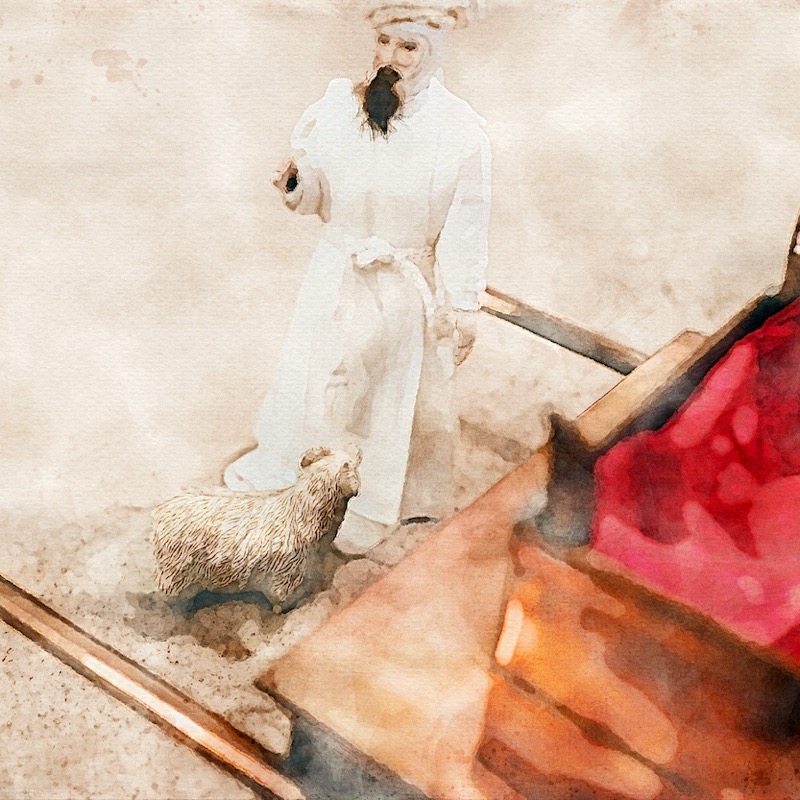
Gooding, David: 7 - The Court Pillars
ID mfh_1087390720Date unavailableBefore 1.99Restored 4.49
The book of Exodus and chapter thirty eight, beginning at verse nine. And he made the court. For the south side southward, the hangings of the court were of fine twined linen and hundred cubits. Their pillars were twenty, and their sockets twenty of copper. I ought perhaps to pause there to explain that translation in your authorized version and in the revised, it says brass, which, as far as we know, was a metal that the ancients of that time did not have. More than that, uh, it would have been unsuitable to be a, uh, a covering for that altar that had to endure quite fierce temperatures. The metal in question was not brass, which is an alloy, it was copper, uh, able to withstand the fire as your common and garden copper kettles are able to withstand the fire. The hooks of the pillars and their fillets were of silver. Once more, I may pause just there, if you will allow me, uh, to discuss a technical point. The term here translated fillet is a Hebrew word that the experts disagree about. Some think it, uh, means a connecting rod that ran between the pillars. If you like, a connecting rod like these kind of things that I have here. Only I don't regard my, I myself do not regard these as fillets. They are merely there for our convenience to hold up what are the otherwise, uh, very, uh, delicate pillars indeed. But there are those who think the fillets here mentioned were connecting rods going from pillar to pillar to help the pillars in their task of holding up the screen and the gate. Others would interpret the word as an ornamental band of silver that ran round the neck of the pillar just underneath the capital. An architectural term, uh, and you will see on many pillars, whether in stone or otherwise, that they do have a sort of a band, uh, round about the neck of the, uh, pillar where the capital joins the pillar proper. I myself take that last view, and in the exposition subsequently I shall be so expounding it. If you can see that I'm altogether wrong, well, you'll have to forgive me and shut your ears to the lessons that I deduce from, uh, the fact that the pillars, according to me, had an ornamental band around the neck. And with that, let's, uh, proceed. Uh, and for the north side, an hundred cubits, their pillars twenty, and their sockets twenty of copper, the hooks of the pillars and their fillets of silver. And for the west side were hangings of fifty cubits, their pillars ten, and their sockets ten, the hooks of the pillars and their fillets of silver. And for the east side, eastward, fifty cubits. The hangings for the one side of the gate were fifteen cubits, their pillars three, and their sockets three. And so for the other side, on this hand and that hand, by the gate of the court, were hangings of fifteen cubits, their pillars three, and their sockets three. All the hangings of the court round about were of fine, fine linen, and the sockets for the pillars were of copper, the hooks of the pillars and their fillets of silver, and the overlaying of their chapters of silver, and all the pillars of the court were filleted with silver. And the screen for the gate of the court was the work of the embroiderer of blue and purple and scarlet and fine twined linen. And twenty cubits was the length, and the height and the breadth was five cubits, answerable to the hangings of the court. Their pillars were four, and their sockets four, of copper, their hooks of silver, and the overlaying of their chapiters and their fillets of silver. And all the pins of the tabernacle and of the court round about were of copper. Verse twenty five: And the silver of them that were numbered of the congregation was an hundred talents and a thousand seven hundred and three score and fifteen shekels after the shekel of the sanctuary, a beaker ahead, that is, half a shekel after the shekel of the sanctuary, for every one that passed over to them that were numbered from twenty years old and upward, for six hundred thousand and three thousand and five hundred and fifty men. Verse, um, twenty eight: and of the one thousand seven hundred seventy and five shekels, he made hooks for the pillars and overlaid their chapiters and made fillets for them. One more verse in the next chapter, thirty nine and verse forty, We break into a list of materials, just to give you biblical authority for one more item in our study this evening. Verse forty: the hangings of the court, its pillars and its sockets, and the screen for the gate of the court, the cords thereof. And may the Lord himself interpret this God-given parable to us. In our first study of the tabernacle, we found New Testament authority for thinking that the whole thing was designed as a parable. And we further found it was a parable of our Lord Jesus in the first instance, telling us of his great glory. And in the second instance, we found authority for thinking that the tabernacle is a parable of believers who together form him a house in which he may dwell. Not a material house, but a spiritual house, but nevertheless a house that stands nowadays as the counterpart of what this tabernacle was in Old Testament times. It is as a picture of believers that we are to study the tabernacle this evening. Only let us just resume a little. On Sunday, we were thinking of this court wall that goes all the way round the tabernacle, and also of the gate here at this end. We found that the wall was made of fine-tined linen, and we further found in the book of the Revelation that linen is a symbol in the Bible for righteousness. The Revelation actually says so in so many words. We noticed that it was five cubits high and was of a height that no normal man could attain to or reach over or look over the top. We found it represented a standard of righteousness which we ourselves can never attain to. A standard that only one man has ever attained to, and he, our blessed Lord himself. Then we found, in spite of the fact that there was a wall here, a wall of a standard of righteousness that we could not attain to, and therefore a wall which kept us out of the presence of God, there was a way in, by God's gracious provision, a gate. That gate, we soon discovered, was a parable of our Lord, of whom we read these words in the New Testament, that we have access by him, by whom we have access into this grace wherein we stand. We notice the colors on the door, the blue telling us of our Lord's heavenly origin and his divinity, the purple telling us of his kingship, his lordship, the scarlet telling us of his blood that has made the way in for us into the presence of God, the linen reminding us that he was perfectly righteous, but that he died the righteous, the just, for us the unjust, that he might bring us to God. And it is an interesting thing to notice that the text goes out of its way to point out that the height of that gate was five cubits and was answerable to the hangings of the court. That is, the gate was exactly as high as the court. Uh, the standards here were not let down. You'll see, if I might immediately go to the parable, it wasn't a question of God letting down his standards to make a gate so that people could come in. The gate is just as high as the rest. Only it proclaims to us thereby that in admitting sinners to his presence, God is not lowering the standards of righteousness that his law requires, but he has found a righteous way of admitting sinners. To put it in New Testament terminology, God is both just and the justifier of him that believeth in Jesus, because the death of Christ has answered all the questions of God's holy law on the topic of the guilt of our sin, and makes it possible, therefore, for God to forgive us and to receive us, in spite of the fact that in ourselves we are sinners, because his Son's sacrifice has met the claims of his law. Now we come in. By this gate we have access. And I pray God that as we come in in thought this evening, we can honestly say that our spiritual experience is keeping pace with our study. What we are to think about tonight all supposes and is built on this, that in our experience we have come to the Lord. We have heard him say, I am the door by me, if any man enter in, he shall be saved. And we have come, and we have entered in. And we can say with our children, one door and only one, yet its sides are two, inside and outside. On which side are you? One door and only one, but its sides are two. I'm on the inside. Can you say that, my friend? We should, none of us rest until by God's grace, not of our attainment, but of God's grace, we can honestly say I'm on the inside. But supposing that now, let's come in and have a look at this court from the inside. We shall observe that it is held in place by a large number of pillars that stand behind the, uh, wall, almost hidden themselves, stand there, so to speak, shoulder to shoulder, sharing the task of holding up this wall to the world at large and holding up that gate to the world at large. To come at once to the point, I'm going to suggest that these pillars are a parable of believers, people that have come in, so to speak, that are saved, that now begin to form God a habitation through the spirit. It is their honor, as it is their duty, to stand shoulder to shoulder together with all the others of God's people, that they might perform the task of holding up before the world the screen and the gate. We said that screen was a parable of righteousness, God's righteous requirements. And we further said that its height was high, a, a, a, a righteous requirement, a life of such holiness that, in fact, only our Lord himself ever truly attained to it. Then some- says somebody, how shall we hold that up before men? But the fact is, the New Testament says that it is our bound and responsibility so to do. Is it not obvious to us all that as Christian men and women, and particularly as Christian men and women, uh, who stand together as, uh, as the house of God, it is our responsibility to hold up before the eyes of the world a Christ-like life? And dare we set our standards any lower than a Christ-like life? Of course not. But let us begin to, uh, ferret out some of the secrets of the New Testament in this regard. I want to quote to you two verses that at first might seem contradictory, but are exceedingly important in this connection. The first one occurs in the Epistle to the Galatians, chapter three, for those of you who are taking notes, and, uh, it is found in verse twenty seven of that third chapter of the Epistle to the Galatians. It reads, for as many of you as were baptized into Christ did put on Christ. There can be neither Jew nor Greek. There can be neither bond nor free. There can be no male and female, for ye are all one man in Christ Jesus. Let us pause there a moment to get this side of the story. As many of you as were baptized into Christ, says Paul the Apostle, have put on Christ. We are to notice that this is stated as a fact, not as an exhortation here. It is stated as a fact, a fact of the past, as something that happened when we were baptized into Christ, when we trusted Christ. For ye are all sons of God, says the previous verse, through faith in Christ Jesus. The moment a man believes in Christ Jesus, he is baptized into Christ Jesus by God's Holy Spirit, and the moment he is baptized into Christ Jesus, to change the metaphor, he puts on Christ like a garment. That is, in God's sight he does. The result is that all believers looked at from this angle look alike. As the next verse goes on to say, there can be neither Jew nor Greek, there can be neither bond nor free, there can be no male and female, for ye are all one in Christ. In this sense, all believers look exactly alike. In the ancient world, it was possible to distinguish these several pairs of people that are here mentioned by the dress they wore. You could tell who was a Jew and who was a Greek by the different kind of dress they wore, and you could tell who was a slave and who was a free man by the different kind of dress they wore. And in those days, you could tell who was a man and who was a woman by the different kind of dress they wore. But you see, when it comes to believing the Savior, says God, that very moment you believe, I clothe you, so to speak, with a garment that covers all other distinctions. I clothe you with the garment of my Son, and to my way of looking at it, says God, I see you clothed in Christ, and I welcome you in my home on that condition. Don't welcome you because you're a man or a woman. I don't welcome you because you're a Jew and you think yourself better than a Greek, and I don't welcome you because you are a free man and better than a slave man. When it's a question of receiving you into my family, says God, I receive you solely because you have, uh, trusted my son and you have put on Christ. That is a fact. While we rejoice in that fact, let us now notice that on the practical level of daily living, we are exhorted to do in practice what God has done about our legal standing. Let me read to you a verse from the Epistle to the Romans now. This is chapter thirteen and verse fourteen, for those of you who take notes. Romans thirteen fourteen, and this verse says, but put ye on the Lord Jesus Christ, and make not provision for the flesh to fulfill the lusts thereof. Put you on. We must be honest and notice that this is not a statement of fact. This is an exhortation of something that we are asked to do as Christian men and women. We are to put on the Lord Jesus, not in any artificial sense that we pretend to be what we're not, but when it comes to daily living and the thousand and one choices that we must make in life, we are not to give careless rein to our fleshly indulgences. We are in each circumstances to say, now what would Christ have me do, and how would Christ have acted? And deliberately, by an act of the will, we are to seek God's grace and help to act as Christ acts, to put on the Lord Jesus, and not to make provision for the flesh. We ought then to try and get those two things clear. So far as God's acceptance is concerned, every believer has put on the Lord Jesus. As far as our responsibility goes, it is all too possible for me to forget in daily life to put him on and to give way to the standards of the world and to the unconverted in my daily living. We are to put up the screen as pillars, so to speak, in the house of God. We are to show to the world outside a life of Christian standard, and not let the standard down to the miserable and wretched standards of this ungodly world. And along with that, we are to do another thing. We are to hold up this gate, are we not? The church we know is not the doorway to salvation. There's no salvation in the church. You can join a thousand churches if you like, and that won't save you. Our Lord is the doorway, and only by our Lord do men enter in. But have we not a job as Christians to hold up our Lord to the world at large? That they might see him as the door to God's salvation. I warrant you that even in this civilized and much preached city, there are many people who still have no clear notion of where the door to salvation is. I was lecturing just recently, lecturing on the conditions of salvation, how that salvation is, uh, uh, not by works, not by our effort, not by our attainment, but salvation is a gift that is freely given to bankrupt men and women who come in faith to the Savior. And had you been me, you would have been very interested afterwards in the comments I received as I, uh, uh, moved around over a cup of tea amongst the people. I suppose four or five people that very night said the same thing, some of them confessing to be very loyal, uh, attenders at a- at various kinds of churches. They said, you know, we'd never heard that before. We always thought it was by our good efforts that we gained God's favor. We never heard it before that it was a gift and not by our striving. And my good Christian brethren and sisters, there is great need that we stand prominently among men, as prominently as we get, can get them, hold up before them what is the true and only door to salvation, and that is our blessed Lord himself. But just a word in our collective ear, so to speak. What would you have thought if you had come to this building and there were four good pillars here standing, holding up the screen there? But the rest of the pillars had let the court curtains down. You'd have said, that's a funny thing. What is that thing there? Well, they say solemnly, that's a doorway in, you know. You don't see there's much need of a door, is there? No, it was the fact that there was a screen there that gave significance to the door. It is the fact that God's standards of righteousness, uh, he never lets them down. Whatever the church does, however poorly the church behaves, God never lets his standards down. But from a practical angle, my friend, if the unconverted folks see me living just as they live, enjoying the same dirt, cheating the same way, will they see any sense in it when I then go to them and say that they need to be saved and that there's a doorway for folks to enter? What? No. We must first hold up the, the screen and then hold up the door, if we would be effective in our testimony for the Lord. But as you can see at once, that is no small task. It was no small task for those pillars. It will be no small task for us who are Christians. And the chief practical difficulty that these actual pillars encountered was how to stand firm enough to do the job. You see, all around here was desert land. It would have been quite an achievement for a pillar to stand up all by its lone self. But, uh, that would be nothing compared to the responsibility and task of holding up that long screen. Why, the moment these pillars joined hands, so to speak, and they held up a screen seven foot six high, to all and sundry, why, the wind would come past this side and the wind would come past that side. Immediately, the strain on the pillar would be considerable. And the pillar had got to be, uh, furnished so as to be able to stand mentally to do its task, whatever the strain, however the wind blew. Which thing is a parable, surely easy to be understood. There was a man once, he got saved, he received the Lord. Weeks or later, he met the good man that had been, uh, God's chosen instrument to lead him to a knowledge of the Savior. Said his friend to him, and and how you've been getting on? Uh, we said, very well. I guess. And how you've been getting on at work since you've been a Christian? We said, very well. He said, what did the other chap say? We said, I didn't tell him. Well, of course, that's one way of doing it. As you see, if nobody knows, if you don't make any profession and keep it dark, well, you'll find the pressures are much easier. But then we're not supposed to keep it dark. And if you try and keep it dark, said our Lord, you won't be able to because, uh, there's nothing hidden, but what will be revealed, it'll come out sooner or later, you might as well let it come out sooner than later. And of course, as soon as we let it be known, as soon as we set up Christian standards and announce that we are going by God's grace to live by them, then the pressure will be on. So that our main lesson tonight is to learn from the parable the secret of standing. And, uh, in a way it can be told very briefly. The secret, uh, those pillars had, uh, of standing wasn't really a secret at all. It's one that every Boy Scout has known for a long, long time. Um, the pillar had a socket on the bottom in which it stood. Then on each side there was, uh, a pin, you know, a stake, if you like, went into the ground, and there was a guy rope, there was a hook at the top of the pillar, and a rope fastened from the hook down to the stake in the ground, and the stake was driven in on in into the ground at an angle, and uh, so the pillar stood. But of course, it's the meaning of the parable that we want to get at now. So first and foremost then, each, uh, pillar stood in a socket of copper. What for? Why, for very good reason. That copper socket would doubtless have been a very, very weighty object, and the idea was to get some ballast at the bottom of the old, uh, pillar, you see, uh, so that, uh, there being a very heavy weight at the bottom, it would keep the center of gravity low, uh, uh, and help the pillar to stand there, um, solidly. Weight, big, heavy, strong weight at the bottom. So that it is once obvious that that pillar did not stand in its own strength, did it? It stood, so to speak, in something else. It stood in a strength and a weight that wasn't its own. It belonged to the socket. It stood, uh, in that socket by a strength that wasn't its own. You don't need me to interpret the parable. The secret of a Christian standing fast and having done all to stand still. Why it is this that no Christian man is asked to stand in his own small little strength. In fact, it cannot be done. Remember what a terrible mess of things the Apostle Peter himself made when counting on the strength of his own human devotion to the Lord. He said, and really meant it genuinely as far as he knew, that he was ready for anything. He would follow the Lord anywhere. But then, you see, Peter hadn't reckoned on the spiritual forces that were up against him, hadn't reckoned on this, that it was not merely human opposition he stood against, but that Satan himself had desired to have him. And trusting in his own strength, Peter fell most lamentably. And if Peter fell, you may be sure we will, if we attempt to stand in our own strength. We must learn to stand in the strength of another. What should we say represents the copper socket? Well, I'm going to cut the Gordian knot, so to speak, and go to the New Testament at once and and point out that when the New Testament talks of our standing, as it often talks about our standing and our being established and our being rooted and grounded, it is first of all, stand fast in the Lord, surely. We stand in him, in his strength, not merely in his strength, but in him. For our Lord is able to make us. He is able to support us, for he and we are no longer, so to speak, separate. He that is joined to the Lord is one spirit, we stand in him. Would you allow me a little, uh, uh, notion of my own? If you don't like this next bit, you can leave it out. But, uh, if I were asked to to close more closely to define the meaning of that copper socket, I should take my bearings from this largest of all object of furniture here, which, God willing, we shall study on Sunday, the copper altar. And I should notice that that is a parable of our Lord, for instance, who died for our sins. And, uh, I should notice that it is made of two materials. It is made of wood, and it's made of copper. It's made of copper on the outside because the wood by itself wouldn't be able to resist the fire. It would get burned up, so it had to be copper, covered with copper on the outside so it could resist the heat. And I should say that that copper then was a parable of our Lord, who was more than humanly strong, for no human could have survived the fires of Calvary. But our Lord was strong with the strength of divinity. He endured the cross. Oh, what a mighty saying it is. The wrath of men, their taunts, their sneers, and their sadistic punishment. He endured the cross. Physical anguish, the mental, spiritual torture, and above it all, the weight of the wrath of God. And it is said he endured the cross, despising the shame. It doesn't say he despised the cross, he despised the shame, the curled lip, the terrible shame of being crucified naked. He counted it all up, and he said it didn't count that. Oh, we count it a lot, don't we, when we're asked to endure that sort of thing, just a sneer and a tear of the lip, we count it a tremendous lot, don't you? Well, he despised it. He didn't count for anything with him. He didn't despise the cost, though. He endured the cost. That same person is able to make every single man and woman who trusts him strong to stand in the task of testimony to the world. Why not saying that the moment a man takes his stand upon Christ and receives Christ as his savior, he'll be perfect? You know, I'm not saying that, but the work will be begun. And as he learns more and more of the provision that there is in our Lord to make a stand, as he becomes rooted and grounded in the faith, he will increasingly be effective in his tasks. But there is need, you know, to stand fast. Let a believer, no matter how old and experienced, get careless and forget the Lord, get overconfident and thinks he stands. Oh, let him be careful. Let him that thinketh he stands take heed lest he fall. We constantly need the exhortations which abound in the epistles. Stand fast in the Lord. Or again, with liberty did Christ make us free. Stand fast therein. Be not moved away from the hope of the gospel. Let us then consider two things involved in standing fast in the Lord. There is that matter which Romans five, uh, uh, in its early verses mentions. It talks about our Lord, by whom we have access, by whom we have access. Access into what, you say? Well, says Romans five, by whom we have access into this grace wherein we stand. You say, why all the emphasis there? Well, because this is exceedingly important. We ought to get it well down into our hearts, what our standing is. Huh. If we're going to stand firmly before the world, we stand in In grace. grace. I say we need to get it because the false teachers that came to Galatia and elsewhere tried to get the believers to move off that position and stand somewhere else. And the apostle appealed to them not to be moved away and get entangled in all sorts of bondages, but to stand fast where God had put them, that is in grace. You see, God wants us to know that our standing here as members of his house is not dependent upon our attainment. It's not dependent upon our efficiency. Our standing as members of his house is a standing that is in grace. That is to say, grace in the technical sense. If it be grace, then it's no more works, and if it be works, it's no more grace. Our standing is in grace. Lovely comfort, that. It tells me, you see, that, uh, even if I fail, as fail I do, if sometimes I'm a bit wonky, I don't get thrown out. I may get disciplined by God, but I never get thrown out. My standing is in his grave. That's God's way. Some people there are, you know, who like to teach the doctrines of law and tell us that our standing in God's presence all depends on us. And they think that if they preach it that way round, it will encourage people to to toe the line, so to speak, and do their job better, but it doesn't, you know. In the end, it saps their spiritual energies. For if I thought my only qualification to stand with the rest of the Lord's people in this task, my qualification was that I should be a hundred percent perfect, well, I should give up right now. Though I am to know, God wants me to know that I stand in his grace. And he wants me to be rooted and grounded therein, or as another passage puts it, he wants me to be rooted and grounded in love, that is, in his love. There were all the security of God around me, with his promise that he is by me and with me and underneath me and all around me. Having found a home and an anchor in God, I may stand secure and so find strength to get on with my job. Let me recur to the fact that every pillar had a, had a socket. Every pillar had to have a socket, one individually, you know. You see, if this pillar here had been on a socket and that pillar there had been on a socket, and that pillar there had been on a socket, but that pillar there hadn't got a socket, well, you know what would have happened, don't you? With all the goodwill in the world, this old pillar would have gone wonky in time, and instead of helping the others to hold up the thing, it would started to drag down on the others, wouldn't it? Might be very pointed. It has been the calamity of the Christian church down the ages, that it has lightly accepted people into church fellowship who were not, in fact, standing on the socket. Good-intentioned people wanting to please God, but people who had never understood the necessity of coming to Christ and receiving the Savior. People who knew nothing about their standing in Christ, of the glorious gift of God's salvation. People whom, if you ask them, would honestly say, but I'm not sure whether I'm saved or not. Alas. Alas. The church has reaped the fruit of such indiscriminate, uh, behavior, inviting people who are not sure of salvation to stand with them. How could the poor folk, with even the best will in the world, maintain a Christian standard of living? And I ask you, how can a man who is himself not saved or doesn't know he is and isn't standing on the socket, how will he possibly hold up the gate to other people? Why, when a person comes to the gate and they say, now pillar, here, tell me, is this in fact the way in? Well, the pillar wants to be able to say, yes, that's right, and how do you know? Well, I came in myself. And, uh, those who would hold up Christ to the people as a way of salvation, they need to know themselves that they're saved, surely. Yes, every single pillar has to know for itself what it means to stand in the sun. And as we hurry by that lesson, we ought to ask ourselves, am I pillar? Am I standing in the socket? In other words, am I a believer? Am I standing in Christ? But to pass on, that wasn't the only, uh, provision that was made for them, good as it was. The next provision was this matter of, uh, stakes and guy ropes. The stakes being put in the ground and the guy ropes attached to the top and attached to the stake. These great stakes down the bottom here have an unfortunate translation in our version. They're called pins, so long as you won't imagine them as being those things that ladies put into pin cushions, but you imagine them as being sizable objects like tent pegs put in the ground, all will be well. Now, you know, they who lecture on the tabernacle have their critics. There are theologians who will tell us that there isn't any parable, really, in this tabernacle, or at least if there is, it shouldn't go too far. I was informed once of a terrible man. He used to lecture on the tabernacle, and his chief vice was this: he could even tell you what the pins represented. Well, well, if it be a vice, then I'm vicious, because I propose to, uh, suggest what the pins represent. In far, far from thinking that they are unimportant, I want to say that they are exceedingly important, and I must ask you to do a little biblical research. How shall we determine what the pins are? Let me read to you from the prophecy of Isaiah chapter twenty two and verse twenty two and, uh, we will collect a little evidence. Isaiah uh twenty two and twenty two, it says this, talking of a certain, certain person, it says, and the key of the house of David will I lay upon his shoulder, and he shall open, and none shall shut, and he shall shut and none shall open, and I will fasten him as a nail. So here translated in a sure place. Only the word for nail is the Hebrew word yafez, which means a pin. It is the same word as these, uh, tent pegs here, these pins here. I will fasten him as a pin then, if you like. I will fasten him as a tent peg. I will fasten him as a stake in a sure place. So, uh, let's, uh, collect that evidence. There's somebody here who's going to have the key of David. He opens and nobody shuts, and shuts and nobody opens, and then he's going to be fastened like a nail, like a pin. And, uh, just one little more word, he's going to be fastened in a sure. Now, all of you here present, uh, know just a little Hebrew. I'm certain of this, that all of you know just one word of Hebrew. If you don't know any more, you probably know, uh, more Hebrew words than that, more than you recognize anyway. Uh, but this Hebrew word is the Hebrew word that occurs here, or at least a cognate thereof occurs here. The Hebrew word you know is amen. Amen. It comes basically from a word that means to be solid, firm, immovable. And though we cannot, uh, go all the way with etymologies, yet for our interest this evening, let's notice that when that word there says, I will fasten him as a nail in a sure place, it's using that word that is cognate to amen, something that's absolute reliable, so that when you put the old, um, pin in, uh, then it will stay put and won't come down. You know, when I try on the few occasions I have tried to put in raw plugs, I find they're most difficult things. You make a hole, and then you put the thing in, and oh, the hole is a bit too, too small, so you gouge a bit more out and then put it in the hole's a bit too big. You know the difficulties. This is an amen place, a a sure solid place that the pin will grip, and when you hang something on it or you pull on it, it won't give way in your hands. And with that in mind, let's go over to the New Testament to find out who this person really is. For the prophecy was of ancient times spoken of a human, but is transferred in the New Testament. Let's read in the book of the Revelation, chapter three and verse, um, seven first. These things saith he that is holy, he that is true, he that hath the key of David, he that openeth and none shall shut, and that shutteth and none openeth. Is that not our Lord? Ah. And let us read the caption to the next letter, verse fourteen of that same chapter. These things saith the Amen. Why, of course, and if he has the key of David, if he's the one that does the opening and the shutting, if he is the Amen, I'm going to say he's the pin as well. Yes, indeed. The pin fastened in a sure place. Now, the technique, as I say, is easy to see with the old, uh, pillar. The pin goes in the ground, fastened in a sure place, so that when the, uh, the, uh, the pillar is under some pressure from the wind from that direction and the t- the pillar would go over, then the rope pulls against the stake, and the stake being in the ground in a sure place doesn't give way, and so the pillar stands. What that pin was for the pillar, that our Lord proposes to be for us. A pin fastened in a sure place, in an amen place. These things saith the amen. The New Testament takes, you see, that very term amen and uses it as a title of our Lord. It wants to represent him as one who is utterly reliable, that whatever he says, he means and means a hundred percent, and that if he says a thing, he will never then change his mind and alter it. He will say it and mean it, and it's finished. It's absolutely sure. Amen. It occurs far more often in the Bible than our modern translations let us realize. For instance, that lovely verse, verily, verily, I say unto you, is in its original amen, amen, I say unto you. It's our Lord speaking to us. He's representing himself as the amen, the man that is utterly reliable. You may put all your weight on him and he won't budge. You may hang everything you've got, you may hang your soul on him for eternity, and he'll never let you down. The amen fastened in a sure place, and we are to get hold of him. What a lovely thing it is to do. Let's do a bit of it now. Getting hold of the stake and pulling on it and feeling its weight. Are you frightened, my dear friend, about the next world? About what death will mean? About the coming judgment? When the winds of life begin to blow upon the screen, when our tent that we live in begins to get a little bit flappity, you know, and we think that the end is drawing near, what about the great beyond, and what about the final judgment? Oh, watch a believer get hold of the pins. Verily, verily, I say unto you, amen, amen, I say unto you, he that heareth my word and believeth on him that sent me hath everlasting life and shall not come into judgment, but is passed from death unto life. Oh, the eternal security there is in that. Amen. Verily, verily. I need not at this juncture go over all the promises of God, how many they are, but the second letter to the Corinthians assures us that howsoever many be the promises of God, in him is the yea, and in him the amen. We should be wise people as Christians to get to know those promises. And I was on the boats, day's holiday in Scotland. They told me that, um, what you want to know if the boat is in rough seas, what you want to know is, uh, where to grab hold. You'll see if you're fishing and pulling the net in or something and the sea gives a sudden unexpected lurch, uh, you want to know the boat so well that you can grab hold of something even without looking. Said the old salt, you know, the trouble is if you're on a boat that you don't know, you've only been on it a day or two, uh, the sea lurches, and while you're looking around for a place to get hold of, you're over the side. Ah. You know, I think we should stand better in our times of trouble if we knew where to get hold. This mother has a son, and she has it in her mind that God will never let anything terrible happen to her son. God will never let him be in an accident and get killed. And then it happens, of course. And the poor woman's faith is shattered. And my dear sister, God never promised anybody that he would deliver them permanently from accidents. He does indeed guard us very often, but he's made no outright promise that we shall not meet our end in an accident. If we're trying to get hold that of that, what can we get hold of? Oh, well, he said, I'll never let you down and I'll never forsake you. He said that whatever happens underneath will be the everlasting arms. He's told us that not one sparrow falleth without your father. Oh, how many are his gracious promises that would strengthen our faith if we know how to get hold of the right promises. And all you businessmen, as the world is constantly driving at you, trying to give you, get you to, um, become materialistically minded, trying to get you perhaps to descend to some of the, uh, rather shady methods of the world, because the competition is so fierce. Oh, what a lovely state this is. Let your mind be, your turn of mind be without the love of money, for himself hath said in things business, I will never leave you, and I will never let you down. And of course, as you see, just as the pillar got hold of the stake by that cause, so we get hold of God's gracious promises. I say, I just hurry on. I, I do my best every night sincerely to defeat that cock, but I must just finish this bit now. As well as, uh, that, these pillars were at the top, uh, supplied with hooks. I haven't got any hooks on my pillars because my pillars were too thin to put hooks into. So we made a very cunning device to put the, uh, guy ropes in, and they do also for hooks. But the real pillars had hooks, and the hooks were made of silver, and the hooks were there, of course, for hanging the curtains on, like little hands that stuck out, sto- stood out to grip the curtain and hold it. Only they were made of silver. I hadn't time tonight to discuss that matter at length, but I did read you the verses that tell us where that silver came from. It came from the ransom money, from the redemption money. Now that suffice. You all know how the New Testament tells us Christians that we are ransomed too, just like those Israelites were. But we are not ransomed with, uh, corruptible things like silver. They were, of course, but we're not. We are ransomed, we are redeemed with the precious blood of Christ. So once more we find the lesson, it was by those hooks of silver that they held up the curtains. It tells us that the qualifications needed in a man who would hold up the curtain, so to speak, of Christian testimony to the world is the qualification of having been redeemed. That's it. We need every single redeemed person. It's a hefty job. We can't allow, we can't afford, I mean, some people that are redeemed to, to shirk their responsibility, and we can't afford to exclude people that are redeemed, can we? Not unless they're grievously under discipline or something. We need everyone that's redeemed standing solidly side by side in the task. For once more, let it be seen that a person that's not redeemed will in the end let the standard down. They must be redeemed. And then, as I say, according to my interpretation, and here is where you've got to exercise your judgment and discrimination, I say that they had an ornamental fillet round the top here, just where the, um, capital joined on, sort of decoration purposes to make them look nice, of course. God is a great architect, you know, got great ideas on house decor, if I may say it reverently, has God. And when he put these pillars here, he made them look lovely. Of course he did. Uh, myself, I think you know that the capital stood above the, uh, uh, uh, the linen court screen. That's why the head capitals all lovely and beautiful. And, uh, that was all that was seen of them, you see, from the outside. And just where that capital came down, a lovely band of silver around the top. What for, you say? What practical purpose? No practical purpose whatsoever. Just to make them look nice. That's why. You see, when God wa- had people coming up to have a look at his house, that lovely pure white dazzling screen, and then that gleam of silver around the top. What a lovely adornment. It's the reason why ladies wear necklaces around their necks, you know, to make them look nice. Yes. So those pillars proved a lovely adornment to adorn what the world saw, that screen. So must we. The New Testament exhausts Christian slaves and Christian people in general, that they are to adorn the doctrine of our Lord and Savior in all things. Are they not? So that the things should look attractive to the world outside. And how shall it be done? By the secret, says this ensuing verse, is found in this, that our Lord gave himself that he might redeem us and get for himself a people zealous of good work. The costly price of our redemption wasn't given us just to make us feel comfortable. It was paid that Christ might purchase to himself a people zealous of good works. Oh God, give us the grace to go about our good works in such fashion as redemption shall find its end, that there might be in us an adornment of the testimony that we hold up before the world. And finally, on the capitals, on the heads of the pillars, there was silver. There, of course, I suppose again to be an adornment, there also to be a protection to the pillar that would save the pillar cracking under the intense heat of the sun, that would save it from cracking and going soft and splitting under the rain, a metal covering of silver, and it looked nice as well on the head, didn't it? It too came from that ransom money, that redemption money, redemption on the head as a covering. The New Testament uses that, that idea, it, it changes the metaphor, so to speak. But in speaking to the, uh, people at Thessalonica, Paul said to them that they were to put on their heads for a protecting helmet. What? Why, the hope of salvation. Not hope in the sense that they weren't sure, and they daily lived in hope that they might be saved, that they couldn't be sure, but hope in the biblical sense of the sure and certain hope of salvation. Salvation, this, uh, in this context, not forgiveness of sins that we've already got, and what a man hath, why does he yet hope for? But hoping for salvation in the sense of our adoption to wit the redemption of our body. For there is a part of our redemption that's been paid for, but which we have not yet received. When the Lord comes again, it will be to completely give us all the redemption that he has purchased. He's going to give us new bodies. He's going to make us like himself. He's coming in that sense for our salvation. And oh, what a blessed hope it is. The Lord is coming. Says Paul, take that hope of salvation, that hope of redemption in the coming day, and put it on your head, particularly when you start to think about the future. And you who are Bible students, please, please, please, when you get started studying prophecy, as I hope you do and will, please make sure, before you get lost in the intricacies of prophecy, that first of all you put the helmet on your head. The helmet? The certain hope of salvation when the Lord comes. So you will read your prophecy and be unharmed. And what a helmet it is, my dear good friend, in a world that's a little bit crazy, in a world that at heart is frightened, wondering whether it's going to be a hydrogen bomb or, or missile that's going to send them up into smoke, in a world that begins to tremble for the things that are coming upon the earth. Oh, what a stabilizing thing it is that the le- the believer has upon his head a certain knowledge that soon the Lord is coming again, literally coming again, and coming to save him and to give him a glorified body. Oh, what a lovely thing it is. Then, seeing it is so, let us read what follows upon that glorious, uh, expectation. And I close this lecture by quoting the end of the Epistle to the Philippians, chapter three and the beginning of chapter four. For we had the pillars, each one founded upon the socket, which is the strong Son of God, pulling by its ropes on the pins, which are the sacred promises, the unbreakable promises of him that is the amen, decorated with God's redemption that they might adorn his doctrine. The hope of salvation and redemption upon their heads, looking for the Lord's coming. And what do people do who are thus blessed? Well, says the verse, our citizenship is in heaven, from whence also we wait for a savior, the Lord Jesus Christ, who shall fashion anew the body of our humiliation, that it may be conformed to the body of his glory, according to the working whereby he is able even to subject all things unto himself. Wherefore, my brethren, beloved and longed for, my joy and crown, so stand fast in the Lord.