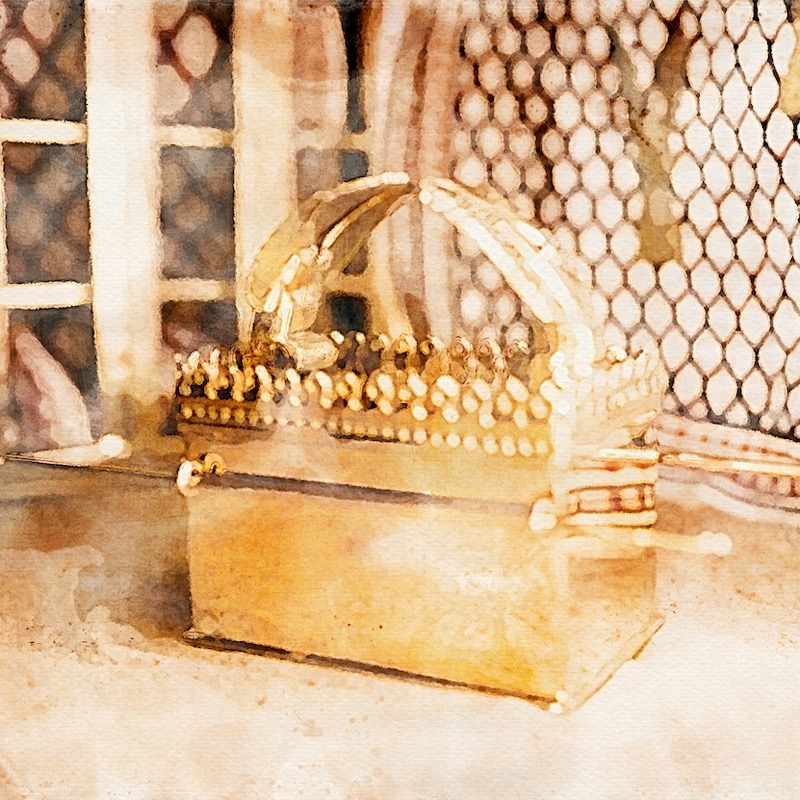
Gooding, David: 3 - The Golden Altar of Incense
ID mfh_1087364776Date unavailableBefore 4.00Restored 4.50
Once more then, a very warm welcome to this, the third of our series of talks on the ancient Jewish tabernacle. Now, there are many ways of looking at this tabernacle, and it is quite impossible, in the limit of a few lectures, to cover them all. The overall title, therefore, that we have given to this particular set of lectures is the approach to God, as God laid it down in this, his dwelling place among the ancient Israelites. We've noticed, but let us notice again, that when God ordered Moses to make this tabernacle that he might dwell among his people, God marked out the road of approach towards his presence by having various sacred vessels stationed along that road. There was the, in the first place, the big bronze altar at which sacrifices were offered and the blood of animals was shed. After that, and before the door of the tabernacle was placed a laver that was filled with water. Then, when you came through the door, which normally hung there at the front, there were two articles of furniture, one on the right hand side and the other on the left. But for the moment, we shall ignore them and come straight on the road that leads us in towards the presence of God. In front of us there is the veil. It is sometimes in scripture called the second veil to distinguish it from this curtain that hung at the front. But in the Hebrew, the language that describes that curtain is different from the language, the term that is used to describe what we call nowadays the veil. That veil hung there to hide the presence of God. For this first part of the tabernacle called in scripture the first tabernacle, was the holy place. After that veil was the most holy place of the immediate presence of God. In there was God's symbolic throne, the ark with the so-called mercy seat, the propitiatory, uh, as a lid upon it, with the cherubim coming from both ends of that propitiatory. So then we are tonight to follow the road in once more. And so far we have noticed that these sacred vessels that mark the road in towards the presence of God were not merely, uh, uh, road markers. Each of them involved, for those that took them seriously, an experience. An An experience. experience of the actual provision that God had made for humans to come and approach his presence. And in our first two studies, we have observed that the altar and the laver, both of them offered cleansing. The altar offered cleansing by blood. The laver offered cleansing by water. And we have been busy these past two lectures in thinking what their application is for us. Because the New Testament tells us that the ancient tabernacle had two functions. For Israelites living in those days, it was a shadow and copy of the heavenly things. It was God in his mercy in the days of Israel's spiritual infancy, of bringing down the great eternal truths of heaven in symbols that the people of that day could begin to understand. But then the New Testament says that in addition to being copies, a copy and shadow of the heavenly things, the tabernacle served another function. It was a shadow of the good things to come. For when God gave Moses the plan of this building, God, of course, had already in mind the great reality of which this was but a faint picture and parable. It was a shadow of the good things to come, the good things that will be brought to us by the birth, the person, and the work of Jesus Christ, our Lord and Savior. And so in these past two lectures, we have observed what in the Christian gospel, uh, corresponds to that altar. For the altar offered cleansing by blood. It is a faint picture, a foreshadowing of the cleansing that our blessed Lord offers to us. The blood of Jesus Christ, God's son, says the New Testament, cleanses us from all sin. And then scripture precises what is meant by that cleansing. Says the Epistle to the Hebrews, the blood of Christ cleanses the conscience from dead works. It cleanses our conscience from the guilt of the sins that we have committed. And it does us, does it, not as a sort of a washing. It is a legal concept. When we have sinned, our conscience register our guilt. We know that we deserve the indignation of God against our sin. The blood of Christ can cleanse our conscience from the guilt of our sin by pointing us to our Lord's death at Calvary. He died that we might be forgiven. Because his death was not just a martyr's death. He died for the ungodly. He bore our sins in his body on the tree and suffered the wrath of a thrice holy God for our sins. When we see, by coming to Christ, repenting of sin, and receiving him as savior, when we see that God counts his death as paying for the guilt of our sin. Our conscience finds relief and cleansing. All precious is the flow that makes me white as snow. None other song I know, nothing but the blood of Jesus. The blood cleanses, therefore, from the guilt of sin. But we noticed last night, and we emphasized it to ourselves, that the laver offered cleansing by water. Originally, the priests who served this tabernacle, when they were inducted, were brought to the door, the door was here, and they were bathed all over, of course, in the water supplied by that laver. That was a once and for all bathing in water. Not, of course, but what they privately bathed in their bathrooms, if they had any. Do you see? Um, we're talking about ceremonial washings and bathings. But whereas the priests at their induction were bathed all over once and for all, whenever they came to minister in the holy place or to attend those sacred vessels, then they had to rinse their hands and feet at the laver. So that was a constant application of the cleansing water. And we reminded ourselves last night how that our Lord preached his apostles a lesson and illustrated it by a practical gesture in the upper room before he died. As they sat at meat, he divested himself of his outer garments, girded himself with a towel, filled a basin with water, and began to wash his apostles' feet. And when he came to Peter, Peter at first protested, you'll never wash my feet. He said, Peter, if I don't wash you, you have no part with me. Then Peter went to the other extreme and said, if that be so, Lord, not my feet only, but my hands and my head and every all over. Now, calm down, said Christ. He that has been bathed all over needs not except to rinse his feet, but is otherwise completely clean. And you are clean through the word that I have spoken to you. Thus did our Lord sum up what is to be the experience of every believer. There is a bathing all over in water. That is where we begin. Hebrews chapter ten, citing the basis of our welcome into the presence of God, says we have boldness to enter the holiest of all through the blood of Jesus, by the way that he is cr- c- sanctified for us. Let us draw near, therefore, with boldness, our hearts Hearts sprinkled. sprinkled. That's the verb you use with blood. Sprinkled, that is, with blood from an evil conscience. Then it adds, our bodies bathed with pure water. I would like to pose you the question and ask you when it happened to you, but I can't do that publicly, of course not. But I'd like to ask the question, when were you bathed all over? What is it talking about? It's talking about what Paul mentions in his letter to Titus. We were ugly in our personalities, says Paul to Titus. But when the mercy of God appeared, not by works of righteousness which we have done, but by his mercy he saved us by the washing of regeneration and the renewing of the Holy Spirit. All the wonder of God's great salvation, it not only deals with the guilt of sin, it deals also with the defects of our personalities. And its answer to them is, first and foremost, not our striving to correct ourselves, not by works done in righteousness which we ourselves have done, but by the washing of regeneration. Perhaps you prefer the doctrine expressed in the words of John chapter three. That might even be more usual to you. So let's hear what our Lord said to Nicodemus. Except a man be born of water and the spirit. When Nicodemus protested he couldn't understand it, our Lord gently chided him. Are you the rabbi, the teacher of Israel, and you don't know? Well, you say, where does the Old Testament talk about it? Why, in the prophecy of Ze- of Ezekiel, about the restoration of Israel, where the prophet saw a valley of dry bones, and the dry bones were filthy, and God said, I will sprinkle clean water on them, and they shall be clean. But the bones being cleansed were still lifeless. Then the prophet in God's name spoke to the wind, the spirit, the ruach. And this mighty divine wind assembled the bones and put life into the bodies. Thus will Israel one day be restored. Our Lord was citing it to Nicodemus. All of us have to be not only pardoned for the guilt of our sin, we have to be born from above, regenerated. And let me not make it as though it were an arduous task we have to attain to. It's the glorious gift of the gospel. We can be given new life by the Savior. Cleansing, new life, born again, that never to re- be repeated experience at the beginning of our Christian life. Thereafter, we need, as our Lord pointed out, constantly to wash our feet. A symbol, of course, of the fact that living in this godless world, we are very often defiled by it. Very often we allow our defects of personality to get the mastery of us, and we speak unadvisably, and we show the unpretty sides of our personalities. We need to be cleansed, don't we? I certainly constantly need it. All believers need it. The constant rinsing of the feet, as our Lord described it. With that, of course, tonight we carry on that road of approach. And we come through the, uh, door there on the direct line of approach, and we come to this little piece, this little sacred vessel called the golden altar of incense. So let us read now, shall we, in the Old Testament, a description of that altar about which we are to think this evening. This is the book of Exodus and chapter thirty. Exodus thirty, verse one. And thou shalt make an altar to burn incense upon. Of acacia wood shalt thou make it. A cubit shall be the length thereof, and a cubit the breadth thereof. Four square shall it be, and two cubits shall be the height of it. The horns thereof shall be of one piece with it. And thou shalt overlay it with pure gold, the top of it, the sides of it round about, and the horns of it. And thou shalt make unto it a crown of gold round about. And two golden rings shalt thou make for it under the crown there- uh, thereof, upon the two s- ribs thereof, upon the two sides of it shalt thou make them, and they shall be for places for staves to bear it withal. And thou shalt make the staves of acacia wood and overlay them with gold. And thou shalt put it before the veil, that is by the ark of the testimony, before the mercy seat that is over the testimony, where I will meet with thee. And Aaron shall burn thereon incense of sweet spices. Every morning when he dresses the lamps, he shall burn it. And when Aaron lights the lamps at even, he shall burn it, a perpetual incense before the Lord throughout your generations. You shall offer no strange incense thereon, nor burnt offering, nor meal offering, and you shall pour no drink offering thereon. And Aaron shall make atonement upon the horns of it once in the year, with the blood of the sin offering of atonement, once in the year, shall he make atonement for it throughout your generations. It is most holy unto the Lord. Let us notice just one or two things about the directions here given. We shall notice that on the four corners at the top, there were horns, four horns projecting from the four corners. They are significant because in Hebrew, uh, emblemology, they speak of the power of this altar. Then we notice the direction to Aaron, that once in the year, at the great festival of the atonement, when Aaron was allowed to go into the immediate presence of God, as he retired from the most holy place and came back in the holy place, he had first to stop at the incense altar, and with the blood of atonement, the blood of propitiation, he had to smear the four horns of the altar. The combination, therefore, of the horns and the blood of the atonement on those horns will give us the secret of the power of this altar and the intercessions that went thereon. It is a remarkable feature of the God of heaven. That when he graciously deigned to presence himself in the Shekinah glory over the ark in the most holy place, being enthroned, as the Old Testament put it, above the cherubim on the mercy seat of the ark, then he provided for ordinary men of flesh and blood to come and talk to him and to suggest to him that he should do this or that or the next thing. As the high priest came to plead for the people. What a staggering exhibition of the grace of the creator of the whole universe. It remains true to this very present day. A little child can bend its knee at its bedside prayers, and the God of heaven, the whole creator of the universe, will bend his ear to listen to the suggestions and the pleas of the little child. The New Testament, likewise, in using the symbolism of this altar, encourages us believers to pray, to pray what to us are bigger things than the child would know to ask for. But we can come and make suggestions to the living God. You'd think our prayer meetings would be overcrowded, wouldn't you? When Israel prayed, they had to offer incense, as we read, so that their prayers came up within the incense. Mercifully, when we pray to God nowadays, we don't have to offer incense, or we shouldn't anyway. What gives our prayers their value, their audience with the God of heaven. Why we pray, don't we? Meaningfully so. We pray in the name of the Lord Jesus Christ. That name that never loses its fragrance or its power to move the very heart of God. But tonight I want to concentrate on this symbol as a foreshadowing of the good things that come by Christ. I'm aware that I overlook a lot of things, significant things, in the course of Israel's history. But with the New Testament's authority, these were shadows of the good things to come. I'm going to take this, therefore, as a shadow of our Lord's present ministry of prayer. First, we have to think a little bit about history. In the regulations that we read in Exodus thirty, there was no reference, did you notice, to prayer at all. It was simply that Aaron had to come evening and morning to burn incense before the Lord. He had to do it especially when he, uh, uh, cleansed the lamps in the morning and when he dressed them at even. Why he did that, I must leave for time's sake. But the habit grew up in Israel to associate this altar with prayer, and that for this simple reason, that the, uh, uh, incense had to be burned morning and evening. Outside, in the court and with the people around, the morning sacrifice had to be offered every day without exception, the continual burnt offering. And similarly, in the evening, the tarmid, the continual burnt offering, had to be offered, and the people would come in their throngs to attend the morning and the evening offering of the tamiz, the daily demanded sacrifice on the behalf of the nation. And at that time, the people would pray, of course, as well as sing their praises to God. So that there came to be associated in Israel's mind the offering of the incense upon the altar with the occupation of prayer. So we're told in the first chapter of the gospel by Luke that John the Baptist's father was a priest. He'd been married for several years, but he and his wife were childless, and doubtless they had prayed many a time that God would give them a child, but nothing had happened. Now they were very old. But, uh, Zechariah was on duty this particular morning, and he had been chosen as a priest to come in and burn the incense on that altar. And as he burned it, an angel of the Lord appeared to him and said to Zechariah, your prayer is heard. Not only his prayer for the people in general, but his lifelong prayer, he and his wife, that God would grant them a son. Which tells us God stores up our prayers, even those he doesn't immediately answer. So we have right, therefore, to take this, this incense altar as a reminder, a foreshadowing of our Lord's priestly activity of interceding and praying for his people. And I propose now to examine a number of passages in the New Testament that talk about our Lord's intercession. And before we are finished, we shall see it quite clearly stated that it is part of our very salvation that our blessed Lord intercedes for us. There is a very famous verse in the Epistles to the Hebrews, chapter seven and verse twenty five, that runs like this: Wherefore he is able to save to the uttermost all that come unto God by him, seeing he ever lives to make intercession for them. And I should be a very unwise man if I thought to myself that I could be completely saved without the intercession of Christ. Let us mark how important this matter is. He ever lives to make intercession for us. Why does he need to do it? He is able to save to the uttermost all that come unto God by him, seeing he ever lives to make intercession for us. Oh, my dear folks, prepare your hearts to start rejoicing, if you care. For these are most glorious things. Our Lord's intercession is an integral part of our salvation, and is quoted in the New Testament as being part of the solid foundation that we may know ourselves accepted by God and shall never be rejected by him. So it is, is it not, as Paul comes to the climax of his exposition of the gospel in Romans chapter eight. Romans chapter eight. Where Paul says in verse thirty one, what then shall we say to these things? If God is for us, who is against us? If God Almighty is for us, who shall dare oppose him? Who then can be against us when God is for us? Then the logic of Calvary. He that spared not his own son, but delivered him up for us all. How shall he not also with him freely give us all things? A question of logical proportions. If he gave the utmost in giving us his son, how would it be logical for him not to give us all things in addition. Who shall lay anything to the charge of God's elect? When it is God who justifies. And if God has given the sentence justified on everyone he who, uh, anyone who, everyone who believes in Jesus. Who will have the impertinence or the power to contradict God and lay a charge when it is God who justifies? Who is he that shall condemn? You see, suppose someone did have the boldness to contradict God, and in spite of, um, God's justifying us, brought a charge against us and, and appeared to prove it. But then, who would be, who would condemn us? The jury may convict a prisoner in the criminal courts of some grievous offense. It's not left to the jury or the prosecution to set the sentence. That is for the judge to do. And suppose a charge were laid against us. Who is he that shall condemn? When it is Christ that died, yea, rather that was raised from the dead, who is at the right hand of God, who also makes intercession for us. Oh, glorious picture, isn't it? If it is indeed picture language. We can almost hear the charge laid out. As our hymn says, I know them well, and thousands more. Easily proved against us. But who shall rise up and pronounce the condemnation. You say that's God's thing to do. Oh, but wait a minute. Our Lord has told us that the Father judges no man. He has committed all judgment to the Son. And did you, did you see the, the judge on the great white throne? It will be our blessed Lord. Who is he that shall condemn those that have put their trust in Christ, when it is the judge himself who died for us. May rather that he's risen again. Oh, and listen to him, will you? He makes, constantly makes intercession for us. Oh, who shall shout him down? When the judge himself is he who died for us, is risen again, is at the right hand of God, who makes intercession for us. An integral part of the certainty and of acceptance with God and the assurance of God's heaven at last. But then Hebrews chapter seven has things to add to this. Hebrews chapter seven from verse twenty onwards. Hebrews chapter seven verse twenty says, and in as much as it is not without the taking of an oath, for they, Israelites priests, have indeed been made priests without an oath. But he that is our Lord was made a priest with an oath by him that saith unto him, the Lord swear and will not repent himself, thou art a priest forever. By so much also hath Jesus become the surety of a better covenant. And what that involves is then explained to us in verse twenty five. Wherefore also he is able to save to the uttermost them that draw near unto God through him, seeing he ever liveth to make intercession for them. We notice the exact term. Elsewhere it is said that our Lord is the mediator of the New Covenant, and that, thank God, he is. But this place tells us he is the surety, not just the mediator, he is the surety, the guarantee, the guarantor, in fact, of this new covenant. Let me try and illustrate it to you. I'm no man of business, as you will see, but I've got my eye on a field, and I can see possibilities in it. So I get myself down to the bank manager, and he has a very big bonus, so why shouldn't he look with mercy upon me, do you see? And I put my scheme before him, and I say, now, bank manager, listen to this. I have a very good scheme. Now there is this plot of land, do you see, and uh, I, I, uh, propose to buy it, do you see, and then I'm going to erect some very good, stylish upgrade apartments, do you see, and you can get a lot of money for them, you see. So this is my scheme, you see, and I want you, bank manager, to lend me the money. He says, yes, well, it may be a good scheme. We'll have to investigate that. And how many million is this going to cost? You think about ten million or so? Mm, that's a very small figure, but ten million? Yes? Mm-hmm. Now, uh, what, uh, what sort of collateral have you got? I, I say I don't quite mean, know what you mean. What, what, what is this collateral thing? Well, what, what resources have you got? So if your scheme went bust, the bank could, um, get hold of your resources and pay themselves back the money. Oh. Well, uh, well, no, I ha- I haven't got a lot, uh, Josie. Of course I got a decent wage. Well, have you any relative has got some money then? Well, my dad is is quite rich. Oh yes. What has he got? Well, he's got, uh, two thousand pounds in the post office saving bank. That's very good, says the bank manager, but that won't do quite as collateral for your scheme. What the bank manager is looking for is someone that can go surety for it. And if the thing collapses, he can afford to pay. Oh, my dear brothers, God has a scheme. It's a scheme no less than getting the likes of me and ten million million times more, mere humans, and sinful at that, and bringing them home to glory and conforming them to the image of his dear son. What a scheme it is. What happens if the scheme goes wrong? Who's going to stand the cost of the covenant? Oh, what magnificent thing is this, that our blessed Lord has not only mediated the covenant, he has become the surety of the covenant and is prepared to pay the expenses all the way through until we are found in glory like God's son. Oh, it's magnificent. The trouble with my father, you'll see, was that not only he didn't have very much money, really, dear poor chap, not enough to satisfy the bank manager, but then he went and died, and all sorts of people claimed his riches. Gone. Israel's priests, however well-intentioned they were, died and passed away. All but this man. He has an enduring priesthood. He lives by the power of an endless life. And he can afford to be the surety of the covenant that will bring us home to glory. Because he ever lives. And now we come to our subject again. He ever lives to make intercession for us. The guarantor that the gracious promises of the new covenant that God has made shall be fulfilled. Oh, that I could hear him making intercession for me. You say, yes, that's all very well. But you seem to paint too rosy a picture. What if, as a believer, I'm tempted? You see. Well, God has the answer to that. Hebrews chapter two tells us that our great high priest, who makes intercession for us, was tempted in all points as we are, without sinning, of course. And he knows what it feels like to be tempted, and has endured temptation more than us because he never gave in. And God has appointed him who knows what it means to be tempted. He's able to succor them that are tempted. Because he is a- a tempted himself and to become a faithful and merciful high priest. Yes, you say, but sometimes when I'm tempted, I give in. What happens to my salvation then? One John chapter two gives us the answer. Says John, one John chapter two and verse one, my little children, these things write I unto you that you may not sin. Don't get me wrong, says John. This is not a liberty to sin, go on sinning and it doesn't matter. I'm writing these things so that you should not sin. But if any man sin, if anyone sins, what then? We have an advocate with the Father, Jesus Christ, the righteous. Now some people make a distinction between the language of Hebrews that talks of Christ as high priest and the language here that talks of him as advocate and deduce various things from it. We shall not do that tonight, we haven't the time. It amounts to the same thing anyway. What happens if a believer sins, we have an advocate with the Father to plead our cause. As the high priest of Israel prayed for his people, so this advocate prays for us if and when we sin. We have an advocate with the Father, Jesus Christ, the righteous. Notice the significance of the term here. He doesn't need to pretend that we're better than we are. He can admit the sins we've done, as black as they may be, and admit them for what they are. He is Jesus Christ, the righteous. His advocacy is based on what? Verse two, and he is the propitiation for our sins. Please notice that word. It's a highly technical word, and at this time of night I must stop and try to explain it. This is the word you would use of the sacrifices on the great day of atonement. Recorded in Leviticus sixteen. Once a year, the nation came and they confessed their sins before God, and sacrifices were offered. And then the high priest took the blood into the most holy place and sprinkled it on the mercy seat and before the mercy seat. Then when he turned round, he came out through that veil and stopped for a moment at that incense altar and took the blood of propitiation and smeared it on the horns of the altar. You'll remember the suggestion, won't you? The horns tell us of the power of the altar. The horns smeared with blood tells us of the power of the intercession based on propitiation. And what does propitiation mean? To put it simply, propitiation is that part of the work of Christ done at Calvary that answers to the indignation of God against our sin and satisfies the indignation of God. That God can then forgive and accept us. It is described vividly in the revela- in the Le- Leviticus chapter, uh, sixteen. The blood of propitiation was to cleanse the tabernacle that still remained amongst the people in all their uncleannesses. Some people's behavior sometimes disgusts even us. Extreme cases of sin amongst believers can disgust us, can it not? And God dwelling among the Israelites for three hundred and sixty five days a year, and the taint of their sin defiling the tabernacle. It's a wonder God didn't say, I can't stick them. The Day of Atonement was to cleanse the tabernacle, says God, that dwell, that that dwell, that that dwells among the people in all their uncleannesses. And if a man sinned, if a woman sinned, if a believer sins, we have an advocate with the Father. You'll notice it doesn't say if a believer sins and then repents, or if a believer sins and then says I'm sorry or something. If anyone sin. Immediately, the advocate pleads before God, that great sacrifice that holds back the indignation of God against our sin. What a magnificent salvation we have. Holding back the wrath of God. Giving us time to come to our senses and to repent. We have an advocate with the Father, Jesus Christ the righteous, and he is the propitiation for our sins. You say, but... I have another problem. Oh yes. You say, life has gone very hard with me. I try to serve the Lord. Just like other believers have. And some of them have very little trouble in life. And I've had trouble on trouble. And I feel like Job sometimes. Why am I made to suffer so much? Well, thank God if you've never had thoughts like that. Some dear believers have, don't they? I remember as a young man, I was talking on the tabernacle, and after it a senior man came up to me to ask if he might say something. He said, some years ago my wife took cancer, and we prayed, both of us, that the Lord would heal her of her cancer. He didn't. The cancer got so worse, horribly worse. Together we prayed that the Lord would take her home. He didn't do that either. And only after months of torment, she passed away. He said, David, I don't know where I am. Hard thoughts about God. Job had them, didn't he? And God was merciful to him. If your heart ultimately beats loyal to God, you can say what you like to God. Jeremiah said, Lord, you've become like a deceitful brook to me. A wadi that when you go to get water just isn't there. Hard thoughts about God. What about that then? Our Lord is on record as saying in John chapter fourteen, I am the way, the truth, and the light. No one comes to the Father but by me. Then he added, I will pray the Father, and he will send you another comforter, the Spirit of truth. Why call him that in this context? This is the result of our Lord's intercession after his ascension to heaven. He prayed the Father, and the Father sent forth the Holy Spirit, here called the Spirit of truth. Let me tell you another little story. Old men tell stories, don't they? I once knew a gracious servant of God called James Black in Madison in Scotland. He had a great heart for people, used to visit Borstal and children's homes and this, that, and other. He told me that at one stage he went to visit a home for children that had been beaten up, and when he opened the door, there was a nurse with the child, and the child screamed. And the nurse said to James Black, would you mind going outside for a moment while I pacify the child? And when the child was pacified, he was allowed in. And she stripped the child and showed him the body, all with grievous scorch wounds. And the little child said to Mr. Black, my father always beats me. And the man had heated a poker till it was red hot and beat the child with it. And the child's concept of father, what do you imagine it would be? Would you come and tell him that God is the Father? Would need some interpreting, wouldn't it? I will pray the Father, and I will send, he will send you the Spirit of truth. Oh, lovely result of our Lord's intercessions. We have within us the Spirit of truth, whose gracious task is to expound to us how the Father really loves Loves us. us. It helps us to believe it, even in the midst of temptation. So somebody, what if I lose my faith? Have you ever met Christians that you thought were real Christians? And then they seem to have lost their faith. What about that then? Well, we have an example of Peter. And you will remember that at the Last Supper, according to Luke, our Lord said to Pete, uh, to Peter, Satan has asked, Greek word implies that he has asked, asked and gained permission, gained his request, has asked of God that he may sift you twelve as wheat, sorting the real from the unreal. Satan has to ask permission before he is allowed to attack a believer. Sometimes God gives the permission. Then fastening on Peter himself, our Lord said, Peter, I have prayed for you, for you personally, that your faith doesn't fail. He didn't pray that his testimony wouldn't fail. That got blown sky high. He prayed that his faith wouldn't fail. But Peter thought he knew better than the Lord and denied, uh, oh no, Lord, that's nonsense. You're talking now, you don't really know who I am. I will go to prison and to death for you, Lord. I, yeah, yeah, yeah. What, what do you mean I would deny you? Of course I wouldn't. Peter didn't believe the Lord, though he was a believer, but, you know, like some of us, he believed the Lord but doesn't believe some things. And Peter, our Lord replied, yes, you will deny me before the cock crow. That night, Peter went into the high priest's court, and the maid saw him and said, I suppose you're one of them too, aren't you? And he had a panic attack and denied it. And then the soldiers asked him, you're a Christian too, aren't you? He denied it. And when he denied three times in that moment, the cock crew. And you know, at that moment, Peter believed Christ more than he'd ever done before in all his life. An hour or two before, when Christ said, you'll deny me, he'd refused to believe Christ. Now he had no option. Because the Lord had said, when you deny me Christ, the cock will crow. And he denied him, and now the cock was crowing. Christ has spoken the truth. Peter believed it. Had no option, had he? But our Lord had said something else. And when you are converted, Peter, strengthen your brothers. Really? Had Christ said that? So this wasn't the end then. He'd not made such a mess of it that Christ had given him up. This wasn't the end. There was a future for him. He went out and broke his heart, of course. But he came through. And we notice the principle. I prayed for you that your faith should not fail. Well, Peter's faith wobbled, uh, very much so, and if we'd have been there, we'd have said, well, I thought he was a believer, but he's saying he isn't, so what do you make of that? Let me, as I close, cite a practical example. I was in Peebles in Scotland some years ago, to a weekend of conference meetings, and after it was all over of a Sunday evening, my host took me out around the leafy suburbs of Peebles, you see. Very pleasant. We were joined by a gentleman in his mid-forties, I suppose, and a very pleasant fellow he was. And after a while, then he had to part ways with us, and he went. And my host said, David, says he, let me tell you about him. That good man didn't get saved until he was in his mid-forties. And when he got saved, he said to himself, look at the time I've wasted. So at least allow me to do something now for the Lord. Now he's saved me. So he scratched his head and wondered what to do. And he got hold of the idea, it never would have occurred to me. These were far off days, and he had some discs, radio, you know, those big things, discs, of hymn singing. And he got a collection of them, and he enjoyed them, obviously. He said, I'll go around the houses, and I'll knock the door, and when they come, I'll say, look, I got this collection of Christian hymns, and uh, I so enjoyed them, uh, I wonder whether you'd like to borrow them. As I say, I would never have got the idea in my head had I lived till one hundred and five. And said, my host, you see that host house over there? I said, yes. It was a beautiful house standing in its grounds. Beautiful. He said that was the house he went to. Knocked on the door. The man of the house came to the door. He said, excuse me, sir, but you see, I got these, uh, record of Christian hymns, and I so, I so enjoyed them, he said, I wonder whether you care to buy them, to to borrow them. The man said, you better come in. Took him into a room, called his wife. He said, we would like to tell you, we are believers. We have believed in Christ years ago, and for years we've gone astray from him. Last night, he said, in this very room, my wife and I, now getting on in years, came back to the Lord. We knelt in this room and said, God, if you'll have us back, give us some sign tomorrow that you've received us. That was a Saturday, and now this was the Sunday in the evening, and he said to the Christian man, and nothing happened today. Are we beginning to think that God was saying, no, I won't have you back when you come to the door. All the mercies of God. I prayed for you, says Christ, that your faith shall not fail. I know there are some who make a profession of faith and are not genuine believers at all. That's not my point tonight. I end here on Christ's intercession. I prayed for you that your faith doesn't fail. You say faith comes by hearing, and hearing by the word of Christ. And in my small experience, assailed by all kinds of unbelief in academic circles, I have known more than once the time when I've had no answers and had to say to Christ, like Christ, I can't maintain my faith. Will you please maintain my faith. I prayed for you, he says, that your faith should not fail. And when you come back again, strengthen your brothers. Just let's bow and praise the Lord for the wonders of his intercession. Blessed Lord Jesus, now as we have read thy word, we thank thee again for the extreme that the Father gave thee, and thou didst give thyself to bear our sins in thy body on the tree. We thank thee thou art now risen and gone into glory, but there thou art still saving us, and able to save us to the uttermost, because you ever lived to make intercessions for us. So we put our faith in thee once more, and trust thee that thou wilt maintain our faith and use us to thy glory. We ask it for thy name's sake. Amen.