Gooding, David: 7 - The Ark of the Covenant and the New Covenant
ID mfh_1087364716Date unavailableBefore 4.02Restored 4.55
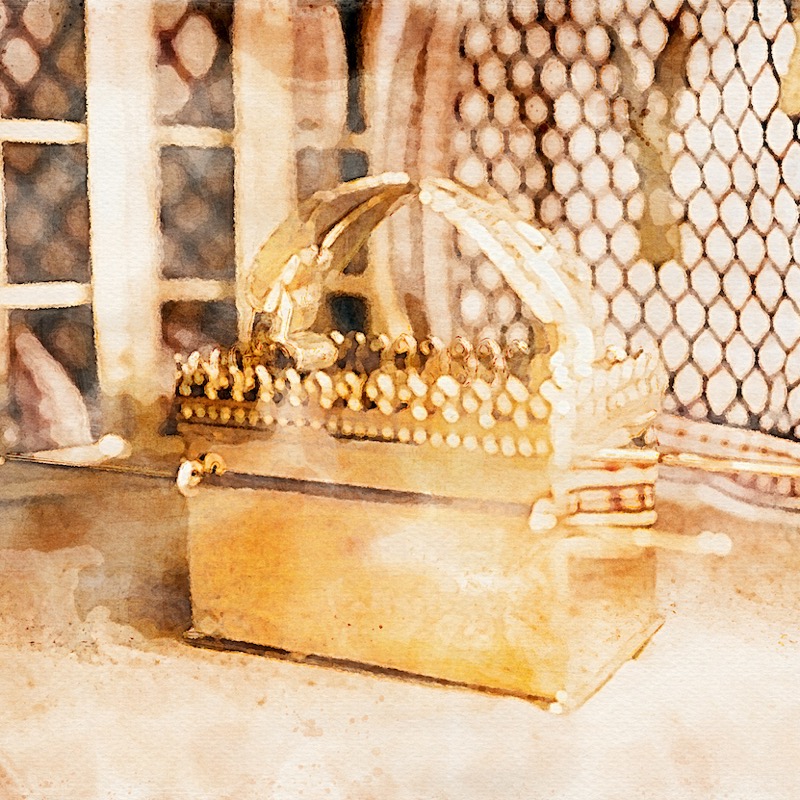
Thank you, Mr. Chairman, for those very kindly and generous remarks, and once more, welcome to you all to this, the seventh of our studies of the ancient Jewish tabernacle. In our last study, we came to the goal of the journey that we undertook at the beginning of these studies. We were following the road that God himself mapped out, by which people might come and approach him in his presence. The road was marked out by the stationing of certain sacred vessels as signposts. Each one of them not only a signpost, but a time to stop and to enjoy the experience that this spiritual exercise was meant to convey. So we followed, first of all, the big altar with its shedding of blood and the pronouncement of forgiveness. We came next to the laver with its water, offering cleansing from defilement. We came in and came at last to the third marker, the little golden altar of incense standing immediately before the veil. Then, in our last lecture, we confronted the veil, the veil, not just the curtain that hung at the door at the front of the tabernacle, but the veil that divided the building itself into two compartments. The first one, the holy place, called elsewhere the first tabernacle, and separated that first tabernacle from the second tabernacle, otherwise called the most holy place. And we considered that veil eventually, with the authority of the New Testament, as a foreshadowing of the humanity of our blessed Lord. That done, we moved in to the holy as holy of all, the most holy place, where was the presence of God and the symbolic throne of God. So I have now in my hand the model of that symbolic throne, and we noticed in our lecture that the throne of God was composed of two parts, not just one. There was, first of all, this ornate chest made of wood overlaid with gold, with a crown of gold around the top of it. In it were several objects, including the two tables of stone that were inscribed with the law of God given through Moses. Then on top of it was a slab, a lid, if you like, a slab of pure gold, no wood in this whatsoever, and it rested on top, contained there by the crown. From each end of that slab of gold, there was a cherub. And the cherubim, the two of them, were arching their wings over this slab of gold, and their eyes were pointed down to the center, because there the blood of atonement, the atonement made on the Day of Atonement once a year in the name of all Israel. The blood itself was brought in by the high priest on that one solitary occasion and sprinkled before and on the mercy seat, as this has come to be called in English. We owe the term mercy seat to dear old Luther, who called it the ganara stula, you'll see. Actually, in Hebrew, it means both a lid and the lid where propitiation was made, and so it is translated in the ancient Greek translation. But it may be more convenient to you, if you were brought up like me on the old, uh, English translations, to call it the mercy seat. And I, from time to time, because of my advanced years, will, uh, drop into calling it the mercy seat instead of calling it, as I should, the propitiatory. So in our last lecture, we studied it in some detail and found that, um, even in those far off days, though the symbolic throne of God contained the law given to Moses. Not even in those centuries long before the coming of Christ, was acceptance with God and forgiveness, uh, uh, uh, was not limited to the people that could keep the law of God. It was not a condition of Aaron's being accepted in this most holy place on the part of the people because either he or they had kept the law of God perfectly. The reason why he was accepted in the immediate presence of God was not on the grounds of that law, but in virtue of the blood of the sacrifice, of the propitiatory sacrifice that was sprinkled there on the mercy seat. Then we noticed how the New Testament comments on this same question. We read from Paul's letter to the Romans in chapter three, words like this: We know that whatever the law says, that is the law of Moses, it says to those that are under the law that every mouth may be stopped and the whole world become guilty before God. For by the deeds of the law shall no flesh be justified in his sight, and that for the simple reason that by the law comes the knowledge of sin. So that just in that moment when we might think we had done enough and had qualified and kept God's law enough for him to accept us, the law would spring up and apply to us one of its com- many commandments and demonstrate that we were sinners and deserved not acceptance, but exclusion. By the law comes the knowledge of sin. But then we heard the glory of the Christian gospel, that we are accepted by God, forgiven and justified, not on the grounds of keeping the law that God gave through Moses, but because of the atoning sacrifice of Jesus Christ, our Lord, whom, so says Romans chapter three— whom God has set forth to be a propitiation through his blood. And the word that Paul uses is the word that the Greek, ancient Greek translation uses to name this slab of gold, whom God has set forth to be a propitiatory, or in the older English versions, whom God has set forth to be a mercy seed, through faith on our part, but in value of the blood of Christ. For the blood signifies that he on the cross paid the penalty of human sin on our behalf. And they who come in true repentance and put their faith in Christ are there and then accepted before God. So much so that we do not have to wait until the final judgment delivers its verdict. We can know ourselves accepted with God the very moment we put our faith in Jesus Christ and his sacrifice upon the cross. Just like the dying thief, so called, dying terrorist, we might well put him in modern English. Who, in the moments of death, just a few hours maybe before he died, came to see the folly of his sin, came to see that Jesus Christ was more than human, had done nothing amiss, was indeed the Messiah, and one day would come again in his kingdom. And in repentance, as best he knew how, he turned to Christ and said, Lord, remember me when thou comest in thy kingdom. Erstwhile rebel. Wonderful act of God in his heart. Urstwhile rebel, asking if please he could be allowed entry into Christ's kingdom and thereafter obey him. And Christ's reply was, today I shall be with me in paradise. This is the magnificent story of the grace of God, of salvation by grace through faith. But it is the fact that when people hear of this salvation by grace, not by keeping the works of the law, they sometimes find it difficult to accept because it seems to them that what the preacher is saying, and perhaps the New Testament is saying, is that it doesn't really matter, so long as you believe in Christ, it doesn't really matter whether you keep God's law or not. In other words, sin doesn't really matter. You can go on sinning, not, of course, alarming sins, but the kind of sins that we commonly do, you know, we good people. And that doesn't matter at all, really, because salvation is by faith. But that is an absolutely false deduction. Salvation is not by works of the law, it is by grace through faith. That does not mean that a believer in Christ is free, therefore, to go and sin as he will. One verse for the moment could, uh, uh, guarantee that fact. That is to be found in that same epistle by Paul to the Romans and chapter eight. where it says, in verse, uh, 3, it says as follows, for what the law could not do, in that it was weak through the flesh, our inability to keep it, that is, God sending his own son in the likeness of sinful flesh and as an offering for sin, condemned sin in the flesh, that the righteous requirement of the law might be fulfilled in us. Let's underline that in our thinking. The whole object of salvation, pardon, acceptance with God through the sacrifice of Christ has this in mind, that what we were unable to do in our own strength before faith in Christ, now we shall be enabled to do, so that the righteous, uh, uh, uh, uh, requirement of the law shall be fulfilled in us, who walk not after the flesh, but after the Spirit. Now, to write that indelibly, if we can, on our minds and hearts, tonight again we are to look at this ark and its contents. For sometimes the ark is called the Ark of the Testimony, because it contained God's testimony to his people of what his requirements were. And sometimes it is called the Ark of the Covenant, because it contained the terms, eh, namely the Ten Commandments engraved on two tables of stone, and perhaps the Book of Testimony. It contained the terms upon which God made a covenant with Israel, and Israel made a covenant with God. That covenant is normally called the Old Covenant, and we are now to read, allow me to read to you, a short, short description of the making of that covenant. I'm going to read from Exodus chapter twenty four, verse uh three. And Moses came, he'd been up to hear God's word. Now he came and told the people all the words of the Lord and all the judgments. And all the people answered with one voice and said, all the words which the Lord has spoken, we will do. And Moses wrote all the words of the Lord and rose up early in the morning and builded an altar under the mountain and twelve pillars according to the twelve tribes of Israel. And he sent young men of the children of Israel which offered burnt offerings and sacrificed peace offerings of oxen unto the Lord. And Moses took half of the blood and put it in basins, and half of the blood he sprinkled on the altar. And he took the book of the covenant and read in the hearing of the people, and they said, all that the Lord has spoken, we will do and be obedient. And Moses took the blood and sprinkled it on the people and said, behold the blood of the covenant which the Lord has made with you concerning all these words. Then went up Moses and Aaron, Nadab and Abihu and seventy of the elders of Israel, and they saw the God of Israel. Famous description of the institution of what is called the Old Covenant. And I'd like you, if you will, to cooperate with me now and visualize the situation. As Moses took one of the bowls, and it was filled with the blood of the sacrifice, and he sprinkled it on the people. He sprinkled it on the book containing the words and conditions of the covenant. And he said, behold the covenant which the Lord God is making with you. Can you picture him? With that basin in his hand, saying this is the blood of the covenant. You've got it in your mind? Ah, then let me turn you to the New Testament, because now we have many times observed that the tabernacle was a foreshadowing of the good things to come. That old covenant was at best but a foreshadowing of a far better covenant. But now I read from Luke's gospel and chapter twenty two. And I break in on Luke's description of the Last Supper that Christ held with his disciples. And verse twenty says, and the cup in like manner after the supper, saying, this cup is the new covenant in my blood, even that which is poured out for you. Can you picture the similarity? There was Moses with the basin, and as he sprinkled the blood in that basin upon the people and on the book, he said, this is the covenant which the Lord has made with you. We come down the centuries to that upper room. Christ and his twelve disciples. And he took a cup of wine, and holding it up, he said, this cup is the new covenant in my blood. And according to Matthew, he added, which is shed for the forgiveness of sins. Shall we notice then that he didn't say this is a new covenant? He said it, this is the new covenant. And we have to ask, of course, what he meant by saying this is the new covenant. What he was referring to was the promise of God made through Jeremiah the prophet, that one day, Israel having failed, miserably failed, to keep the first covenant given through Moses, God in his mercy would make a new covenant with the house of Israel and with the house of Judah. And by your leave, I'm going to read this promise given by God in Jeremiah. It is chapter thirty one and verse thirty one following. Permit me to read it whole, because the terms are exceedingly significant. Behold, the days come, saith the Lord, that I will make a new covenant with the house of Israel and with the house of Judah, not according to the covenant that I made with their fathers in the day that I took them by the hand to bring them out of the land of Egypt. That is the covenant made through Moses, which my covenant they break, although I was an husband to them, saith the Lord. But this is the covenant that I will make with the house of Israel after those days, saith the Lord. I will put my law in their inward parts, and in their heart will I write it, and I will be their God, and they shall be my people. And they shall teach no more every man his neighbor and every man his brother, saying, know the Lord, for they shall all know me, from the greatest, uh, from the least of them unto the greatest of them, saith the Lord. For I will forgive their iniquity and their sin I will remember no more. You can't read it, can you, without your heart taking a little bit of a leap. That is to say, not if you're listening to the words and what they mean. That old covenant, where the people said, meaning it, honestly meaning it, all that the Lord hath commanded we will do and be obedient. Alas, for the reality, says God through Jeremiah, that covenant they broke. And we have no reason to criticize ancient Israel, or if we did to, they would point the finger at us. Have we not broken it? Times without number. What then is this new covenant that God proposes to make? And where is its advantage over the old covenant? Oh, this is the wonderful thing. The Old Covenant were laws written on tables of stone. Written, we are told, with the finger of God indeed. But then, if you were a careful s- and uh, and clever stonemason, it isn't too difficult, is it, to carve the Ten Commandments on bits of stone? Make them legible? No, that's not difficult. The difficult thing is getting people to keep them. Now God has a new promise. This time, the principles of the covenant will not be inscribed on tables of stone. God shall do, I nearly said the impossible, and write them on the hearts of his people. You say, how on earth does he do that? I mean, the heart is an old palpitating thing, isn't it? What have you? And in the Hebrew sense of heart, the mind. That's a very changing thing. But this apparently impossible thing is what God promises to do. He's going to write his laws on the hearts of his people, and on their minds will he inscribe them. Will no longer be a question of simply those things written up on stone. It will be a veritable new nature produced in the heart of the believer that will naturally think God's laws and will be given the grace of God to begin to do them. This was the promise, therefore, of the New Covenant. And when our Lord, with his twelve apostles, took the cup filled with wine, held it up to them and said, this is the new covenant in my blood. He was indicating that now had come the time for him to fulfill that gracious promise of God and institute the new covenant. Let's pause a moment at that point, to examine the term covenant a little bit more. So let me dive, uh, uh, verge, uh, diverge for a moment to tell you about a very important archaeological discovery. Somewhere about the nineteen thirties, archaeologists digging up what remains they could in places like Ugarit and Ebla discovered a Canaanite empire that they scarce had known existed before then. And they got to know about it because they uncovered thousands of clay tablets. And many of them, when they began to read them, were, uh, authorized by the Canaanite great emperor. And they were addressed to the vassal kings in various little states that owed their allegiance to the great Canaanite emperor. What interested the archaeologists and the historians was to notice the form that these covenants took. It varied over the centuries. But at the period when Moses was, uh, uh, uh, uh, in receipt of the Old Covenant, the Canaanite king emperor at the time would write like this to his vassal kings. He would mention his name, to take one example, Supilu Lyumu. Don't know how he was christened that name. Supilu Lyumu. I am Supilu Lyumu. And then he would add what he had done for people, generally conquered them and beaten them up, and this, that, and t other, you see. And then he would have the general prohibition, thou shalt have no other emperor but me. And then there would be a list of do's, what the vassal king and his people had not to do. And all the threats of what would happen to them if they broke these commands. Then, being an old pagan, he would call upon the gods to witness that this covenant had been made. He would then direct that the vassal king should take these cov- the- these laws, this principles of the covenant, and put them in safe, uh, uh, containers. From time to time, he should assemble the nation and then bring out of the storage the terms of the covenant and read them in the hearing of the people. And I suspect you have already perceived the corresponding form in the old covenant given through Moses. Remember how it begins? I am the Lord, your God. Then it adds what God has done for them. I brought you out of the house of bondage, delivered you from slavery in Egypt. Then the prohibition. Thou shalt have none other god but me, nor make any graven image of any god to bow down thereto. Then, of course, there are a list of thou shalts, aren't there? And a list of thou shalt not. And then Israel is warned of the consequences of disobeying those commandments. And Moses calls not on the gods, but on the true God, heaven itself, to witness the terms of this covenant. And then God prescribed that the stones and the book of the covenant should be put in a safe place, namely in his very symbolic throne. They formed the principles of his government. There they were to be kept. For now we see quite clearly that the covenant with the Canaanite emperor was an instrument of his government, the way he wanted to control his subjects. And then we perceive that the old covenant, the terms stored in the very throne of God, were likewise God's instrument of government of his people. With that in our minds, let's read again, shall we? One Corinthians, chapter eleven. um And this is Paul writing to the believers in Corinth. In one Corinthians eleven verse twenty three, he writes as follows: For I received of the Lord that which also I delivered unto you, how that the Lord Jesus, in the night in which he was betrayed, took bread. And when he had given thanks, he brake it and said, this is my body, which is for you. This do in remembrance of me. In like manner also the cup after supper, saying, this cup is the new covenant in my blood. This do as often as ye drink it in remembrance of me. For as often as you eat this bread and drink the cup, you proclaim the Lord's death till he come. Wherefore, whosoever shall eat the bread or drink the cup of the Lord unworthily shall be guilty of the body and the blood of the Lord. But let a person prove himself, and so let him eat of the bread and drink of the cup. For the one that eats and drinks, eats and drinks judgment unto himself, if he doesn't discern the body. For this cause, many among you are weak and sickly, and not a few sleep. But if we discerned ourselves, we should not be judged. But when we are judged, we're chastened of the Lord, that we may not be condemned with the world. It seems to me to be fairly obvious that what Paul is here saying is... that when we c- keep the Lord's Supper at the Lord's command, it is an instrument of his government. We have already quoted, let us quote it again, what our Lord Jesus said when he instituted the Lord's Supper to be held in remembrance of him. Holding the bowl of wine, the cup of wine before his apostles, he said, this is the new covenant in my blood. And writing to this largely Gentile church, pray notice it was a Gentile church largely. Paul is inspired to remind us what the Lord Jesus said as he handle- handed us the cup. This cup is the new covenant in my blood. This do as after as you drink it in remembrance of me. Solemn words of the Lord Jesus, designed to tug at our very hearts. For as we come to the Lord's Supper, and we take the cup, we don't just take it from our neighbor who sits in the same pew or on the same chair, on the row, same row of chairs, do we? We take that cup. We hear the Lord's voice to us. This cup is the new covenant in my blood. Sometimes a wicked notion comes in my head. You'll have to pardon me. May I ask you frankly? You who have many times taken the cup at the Lord's Supper. You hear him say, this cup is the new covenant in my blood. Can you recite by heart the terms of the covenant? I wa- will suppose you can. There were days when I couldn't have done. The terms of the covenant are as we have read, and are repeated in the New Testament, in the Epistle to the Hebrews, for instance, chapter eight, and then again in chapter ten, where he says, I will write my laws on their hearts, and on their minds will I write them. So is the Lord saying to us, as he hands us the cup and says, this is the new covenant in my blood. These are the terms of the new covenant, and it is the gracious Lord Jesus reminding us. I will write my laws on their hearts, and on their minds will I inscribe them. And my response ought to be, should it not? As the Lord hands me that cup with his promise, to say, Lord, please go on and write your laws ever more deeply on my heart. And please write them in my mind ever more clearly, so that I think in terms of your will and your laws, and my heart comes affectionately to long to do what you say. That is why, of course, Paul gives us his apostolic advice in this context. He says, you know, as we come to the Lord's Supper, it is proper that we should discern ourselves. What does that mean? Well, I can tell you what it means for me. I know as I stand here, and my friends know better than I do, that I'm not yet all I ought to be. Oh, I hope they find some Christian traces in me. I do hope that. And sometimes they speak so generously as to suggest they do as well. But then, of course, in private they say, you know him and his behavior is a bit odd on times and, and this kind of thing, and they mean it well, of course, and truly. But then I ought to discern myself, didn't I? Not to become unhealthily introspective, but yet to say to the Lord, Lord, I... there are things this week I, dear, oh dear, they're not as I would like, and not as you would require, if I were to discern myself. And so come to the Lord's Supper. It doesn't say I have to be perfect to come, but what is required is that I discern myself, and then I may come. Oh, to hear those blessed words again. This is my blood, the cup of the new covenant in my blood, shed for the forgiveness of sins. The terms of the covenant? I nearly forgot to tell you the best bit, and the Holy Spirit reserves it to the last, do you see? But it's in the covenant, part of the covenant. It says, first of all, you see, I will write my laws on their hearts, and on their minds will I inscribe them. And then it adds, they shall not teach each one his neighbor, saying, know the Lord. That doesn't mean that we don't need teachers. We do. God has given them. But here, knowledge is talking about that intimate knowledge. Like a little child knows its daddy and knows its mommy. Not because he's good at philosophy or something, he just knows. There's coming a time when all shall know me, all believers will know me, says God. And they shall not need to tell each other know the Lord, for all shall know me, from the least to the greatest. Personal relationship with the Lord. Marvelous, isn't it? I enjoy those bits in the Gospels where our Lord, uh, said to Peter, Peter, Peter, Simon, Simon, when Peter had said something outlandish that he ought never to have said, and our Lord gently rebuked him, Simon, Simon, oh dear. And when the Lord said to me- Martha, you see, Martha, Martha. Yes. He calls his own sheep by name, doesn't he? And the promise is, they shall all know me, from the least to the greatest. And then the Holy Spirit adds, as a term of the covenant, their sins and iniquities will I remember no more. Oh, praise God for this new covenant and its glorious promise. And I, for one, enjoy the order in which the terms are given. I'm glad it doesn't rest at the go- go the other way round. I'm glad it doesn't begin by saying, their sins and iniquities I will remember no more forever. And then add, and uh, you see, I write my laws in their hearts. I should then get the impression, well, we start off by forgiveness, but then if we don't in, uh, uh, uh, you know, discern ourselves and behave as we should, we shall lose some of the forgiveness. It's the other way around, you know. When I've had a rough week, and my conscience is burdened, and I confess it to the Lord. And discern myself. And I come to the Lord's supper. Oh, how wonderful to hear him say, this cup is the new covenant in my blood. And to hear him say, after all the terms, then says the Lord, I come to this, your sins and iniquities I will remember no more. Glorious, isn't it? What happens if a person comes lightly to the Lord's Supper and doesn't discern themselves? Well, if he's a, he or she is a true believer, the Lord was going to fulfill his covenant anyway. He'll do it in a way that's comfortable to us. But if we make it difficult, he'll do it anyway. But the way he does it then could be uncomfortable. For to come to the Lord's Supper carelessly is Is to to invite invite his discipline. For this cause, many are weak and sickly among you, says Paul, and some have even fallen asleep under the chastisement of the Lord. Who say, why does the Lord chastise some of his own people in that fashion? Well, because they are his, you see. And he chastises his people if need be. Now listen to this bit. So they shall not be condemned with the world. If they're true believers, the covenant hold. There is now no condemnation to them that are in Christ Jesus. While there is no condemnation and no wrath, yet if need be, there must be discipline. So does Paul write to the Corinthians. But tonight, let us grasp the wonderful encouragement of the last terms of the treaty, of the covenant. The writer to the Hebrews in chapter eight and then again in chapter ten quotes the covenant. Let me read to you from Hebrews ten. verse eleven onwards. And every priest, that is every Jewish priest, indeed, stands day by day, ministering and offering oftentimes the same sacrifices which can never take away sins. That was according to the old covenant. And the sacrifices they offered of animals and such could not in themselves ever put away sin. They were but foreshadowings of the great Lamb of God, whose sufferings can and do put away sins. But he, says verse twelve, when he had offered one sacrifice for sins forever, sat down on the right hand of God, from henceforth expecting till his enemies be made the footstool of his feet. For by one offering he has perfected forever them that are being sanctified. But how can the writer to the Hebrews, whoever he was, make such a claim? Perfected forever? Them that are being sanctified? Well, says the writer, I quote you the authority of scripture itself. Verse fifteen, and the Holy Spirit also beareth witness to us. For after he has said, now the writer is quoting Jeremiah thirty one. after he has said, this is the covenant that I will make with them after those days, saith the Lord, I will put my laws on their heart, and upon their mind also will I write them. Then says he, and their sins and their iniquities I will remember no more. All the blessedness of this great climax in the terms of the New Covenant. Their sins and iniquities will I remember no more. And I remind you, if I may, of what I may well have said in a previous lecture, but it's worth repeating. When God says, I will not remember their sins again, he doesn't mean that he will forget that we have been sinners, does he? Nor shall we forget that we once were sinners, shall we? When we hear the choirs of heaven saying, worthy is the Lamb that was slain, shall we nudge our fellow believers and tell me, why was he slain? I can't make sense of this. Shall we not know? Even when we get to glory, why the Lamb was slain. When we finally see ourselves as we were really, then glory will be ten thousand times more glory when we think that the Lord, knowing the very worst about us, loved us just the same and gave himself for us. When it is said that God will not remember our sins anymore, doesn't mean that God forgets we're sinners. But using the old metaphor drawn from the procedures of a royal court, there was in many a royal court a book of remembrance written in which the names and the deeds of sundry enemies were recorded. And if then the emperor chose to tell the scribe to bring out the book and read it in the presence of his majesty, and the scribe read that Tom, Dick and Harry had all three committed offenses against the king? Then the king would ask, had Tom, Dick, and Harry been punished for it? And if the reply was, no, not yet, your, my lord, then the emperor would command, well, get going then. Punish them. That's what it means when scripture uses the term to bring sins to remembrance. That is precisely what God has guaranteed in the terms of the New Covenant never to do for a believer. And when we stand before the Lord, oh, thank God for the assurance he'll not get out the book and read all our offenses and then demand we be punished. For the simple reason that his dear Son bore our sins in his body and was punished by God on our behalf. Oh, thank God. It's worth a profound hallelujah in our hearts, is it not? Now, let me just point out the conclusion that the writer draws. Where you've got forgiveness like this, there is no more process of offering. That is not saying simply that there's no other sacrifice beside the sacrifice of Christ. Doesn't mean that. It means that there is no longer any process of offering a sacrifice for sin. As you see from the context, every Jewish priest stands daily offering, this is the process, offering sacrifices and sin offerings. Every day he does it, which could never take away sin and is never finished and not allowed to sit down. He stands doing it. For those sacrifices could not perfect anyone according to the conscience. But because our blessed Lord, by one sacrifice for sin forever, has discharged our debt of guilt before God, and God has promised not to rake up against us in the judgment. Those are in that these are iniquities. Then, there's no longer any need to go on offering anything. When we assemble at the Lord's Supper, we take the bread and the wine in remembrance of the Lord. We're not offering them to God. I go to many countries. It saddened my hearts, my heart. To see in some countries people in an ecclesiastical building, stretched from side to side, two-thirds of the way down the church, is a large screen. And in the screen there are three doors. The central one is the door of the king. It has a door and a curtain, just like Solomon's temple is. During the services, the door is opened. Only the priests are allowed inside that most holy place, if that's what it is. The people are not allowed in. They have to stand outside. No boldness to enter the holiest of all. And then the people are encouraged to think that what they have given in terms of bread and wine are now taken, made into the body and blood of Christ and offered to God. It is an evidence that they have no conscience perfected by the sacrifice of Christ. Since Christ's sacrifice was perfect, he doesn't keep repeating it in heaven. He has sat down. There is no longer any process of offering any sacrifice for sins. But all through his sacrifice, the complete confidence, boldness indeed, to enter in, into the very presence of God in spirit now, and one day bodily to be with Christ, and to sit down with him on his throne, as he also overcame and sat down on the Father's throne. Surely it is fitting now to bow our heads a moment and give our gratitude and praise to the Lord. Our Father, the wonders of these thy promises and the terms of the covenant are so large in thy divine generosity and magnanimity, so full of thy forgiveness. And so reminding us of the tremendous sufferings of Christ that have made our enjoyment of these lovely things possible. We pray, Lord, now to accept the gratitude and the worship of our hearts. We pray as life goes by, Lord, deepen our understanding of what Christ has done for us, we pray. And please, Lord, go on writing thy laws on our minds and inscribe them on our hearts, that we might be daily more conformed to the image of thy dear Son, as we thank thee now for thy promise that when we see him, we shall be like him and forever conformed to his image. So take our evening thanks, we pray, through Jesus Christ our Lord. Amen.