Gooding, David: 7 - The Tabernacle Curtains
ID mfh_1087316752Date unavailableBefore 3.21Restored 4.38
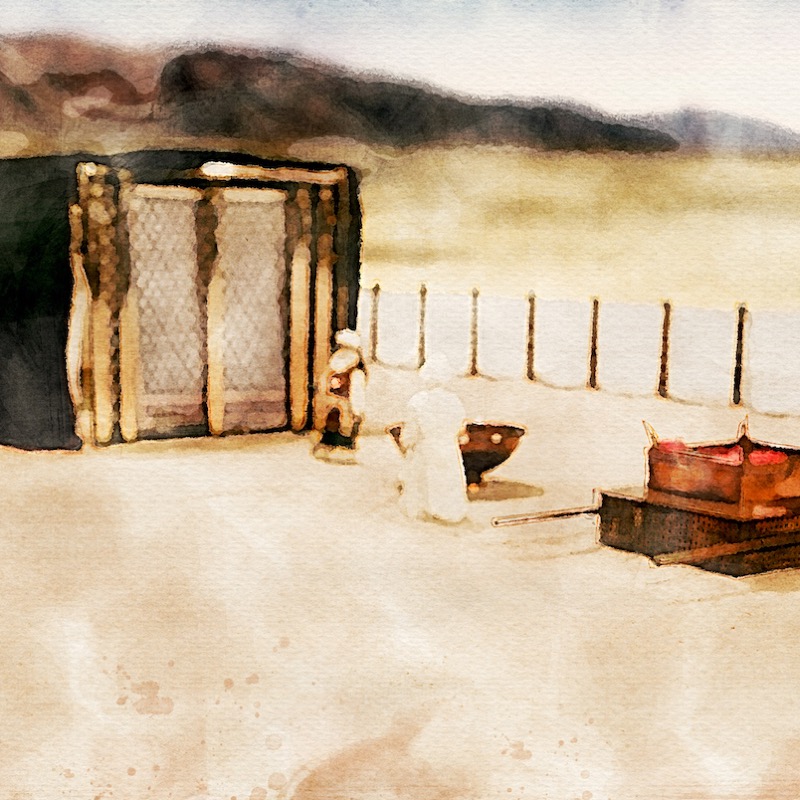
This, as you have heard, ladies and gentlemen, is the seventh of our study of the ancient Mosaic Tabernacle. And our task this evening is to familiarize ourselves with the various sets of coverings and curtains that serve to protect the tabernacle itself. So let's begin from the outside, and taken from the model here is the first set of skins that were used as the outer protection of the tabernacle. We're not exactly sure, uh, what material they were made of. The older versions talk about badger skins, but it is unlikely that the Hebrew word means badger skins. It is more likely to be either seal skin or dugong. These are seal skin, and we're not told the shape of them or how many skins went up to make the whole. Merely one half of a verse is devoted to describing these things. They were served the practical purpose, uh, to, uh, protect the tabernacle from the elements outside, from the dust storms and the occasional rainstorms that, uh, happen in the Sinai Desert. Some commentators, particularly older commentators, have suggested that the outside skins were very dull. Well, perhaps they might have been, I don't know. But we do know that this particular material, whether it was seal skin or dugong, and dugong is another word for the sea cow, and if you haven't seen a sea cow, they're things that live in the sea and and in the Red Sea in particular, do you see? Uh, innocent kind of things. Eh, uh, uh, uh, the seal skin or the dugong skin was the material that the fashionable ladies in Ezekiel's day used to make their shoes with, do you see? And I leave you to guess what finery the fashionable ladies of the day would have achieved by the use of this very expensive material. The second set of coverings that went under the seal skin are called, in our English translations, ram skins dyed red. Again, how many skins were stitched together to make this one set, we are not told. Indeed, we're not told whether they did make one set or they were lashed over, uh, separately. The word for dyed red, some people suggest means tanned. Tanned, uh, ram skins. They were the second defense underneath the seal skin to protect the tabernacle. When you come beneath them in the third place, we have the curtains, which is te- which are technically called the tent, and you will immediately see how much more elaborate they were than the skins. They are made of goat's hair woven, not seal skins with the hair still on them, like some translations incorrectly give it. We are explicitly told that the women folks, and what clever folks they were in Moses' day, took the, uh, the, uh, hair of the goats and they spun it. So they couldn't have been hair on the skins. Uh, here were the beautiful curtains made of goat's hair. This time we are told that there were eleven curtains. The curtains are running this way up along. You see, there's one of them there, there's another one here, and another here, and another here, and another here. So five curtains were stitched together, uh, to form one block of curtains. Then there were, on the other side, six of those curtains, likewise stitched together along their length, uh, you'll see, but on the other side, six of them, whereas there were five on this side. And so there were eleven curtains in all, and the two halves were then joined together by loops on the selvedge of the one set and loops on the selvedge of the other set, fifty loops on each side, and they were held together by fifty clasps of bronze. They are called the tent, and they formed a tent over the tabernacle. So presently, when we read the actual text, you will notice the term tent, and it's exceedingly important to get these technical terms correct. Three sets of, uh, coverings then for the tabernacle. Now we come to the tabernacle itself. And here we may need to pause a moment to get our thinking adjusted, because in general terms, in scripture, the whole edifice here is called the tabernacle. That is the general term. But when the term is being used, uh, more particularly, then the term tabernacle refers to these ten linen curtains. Thou shalt make the tabernacle, we'll read it in a moment, thou shalt make the tabernacle ten curtains. Once more, the curtains are running from where you sit lengthways, do you see? And there are five of them, two, three, four, in the first half stitched together, and then an equal number, five, stitched together, and these are then joined by the same principle, the loops of blue this time on the selvedge of the one set, and loops of blue on the selvedge of the other set, Fifty loops on each side, and they are joined by fifty clasps of gold. These curtains that form the tabernacle, they are made of linen, white linen, and were perhaps woven in, uh, do you see, uh, are are the colors blue, purple, and scarlet. And then on top of them, and we're not told exactly how, there were the cherubim, I suspect embroidered, uh, upon the curtains. They were all over, though we have only have a few here, uh, uh, just to note the fact that there were cherubim on these curtains, just as there were cherubim on the second veil. These curtains are, are beautifully done. The model, the curtains in the model, I mean, are beautifully done. They were made by Mrs. Cargill, Mrs. Muriel Cargill of Belfast, who took an enormous amount of trouble to, uh, find out what sort of, uh, design would be suitable for a building that was made some three thou- uh, thousand years ago. Major point we should get hold of in all this, that the is that these curtains here were the tabernacle, in Hebrew, the Mishkan. These formed God's dwelling place, the ten curtains. When we come to read of these frames, for instance, uh, here that form the sides and the back of the building, we shall find them described as frames for the tabernacle, meaning that these frames were for those ten curtains, so that the ten curtains that formed the dwelling place of God might be spread over the frames, and the frames uphold them so that they could function as the dwelling place of God. In that sense, these curtains were one of the most important parts of the whole scheme. With that in mind, let's just read what the Old Testament says, uh, and notice the technical detail. It is found in Exodus chapter twenty six. Exodus 26, beginning at verse 1. Moreover, thou shalt make the tabernacle ten curtains of fine twined linen and blue and purple and scarlet, with cherubim, the work of the cunning workman, shalt thou make them. The length of each curtain shall be eight and twenty cubits, and the breadth of each curtain four cubits. All the curtains shall have one measure. Five curtains shall be coupled together, one to another, sewn, that is, together, and other five curtains shall be coupled one to another. And thou shalt make loops of blue upon the edge of the one curtain from the selvedge in the coupling, and likewise shalt thou make in the edge of the curtain that is outmost in the second coupling. Fifty loops shalt thou make in one curtain, and fifty loops shalt thou make in the edge of the curtain that is in the second coupling. The loops shall be opposite one to another. And thou shalt make fifty clasps of gold and couple the curtains one to another with the clasps, and the tabernacle shall be one. Let's pause at that statement because it is in itself exceedingly important. The dwelling place of God had to be one. But the terms make sense in the end of the verse 6, if you will remember that the term in this verse, tabernacle, means these ten curtains that form God's dwelling place. Couple the ten together, couple the two halves together, and the tabernacle, that is the series of ten shall be one. And now we come to consider the goat's hair curtains. Let's read on. And thou shalt make curtains of goat's hair for a tent over the tabernacle. And you'll at once see now the meaning of that. These eleven curtains of goat's hair formed a tent over the ten curtains that were the tabernacle. So these linen curtains are the tabernacle, these goat's hair curtains are the tent over the tabernacle. The length of each curtain shall be thirty cubits, and the breadth of each curtain four cubits. The eleven curtains shall have one measure, and thou shalt couple five curtains by themselves and six curtains by themselves, and shalt double over the sixth curtain in the forefront of the tent. And thou shalt make fifty loops on the edge of the one curtain that is outmost in the coupling, and fifty loops upon the edge of the curtain which is outmost in the second coupling. And thou shalt make fifty clasps of bronze, and put the clasps into the loops, and couple the tent together, that it may be one. And now we notice the repeated emphasis. Different curtains though they were, with a different function. Yet it must be that with both sets, the set of tabernacle curtains and the set of goat's hair curtains, the tent, the tabernacle must be one, and the overhanging part that remaineth of the curtains of the tent, the half curtain that remaineth, shall hang over the back of the tabernacle. Because there were eleven curtains in the tent, then take the extra one and double it in ha- in half. You have a half, therefore, uh, uh, extra at the front, and you have a half extra at the back, so that the tabernacle might be adequately covered both in the front and the back. And the cubit on the one side, verse thirteen, and the cubit on the other side of that which remaineth in the length of the curtains of the tent shall hang over the sides of the tabernacle on this side and that to cover it. Because the tabernacle curtains were each twenty eight cubits long, and they were going lengthways over the building. The tabernacle was going up and across and over, that is the length of each curtain. So they were twenty eight cubits in length, were the curtains of the tabernacle. The tent curtains were thirty cubits, so that gave you an extra two. and this verse is telling us what was to be done with the extra two. Verse thirteen, and the cubit on the one side and the cubit on the other side of that which remaineth in the length of the curtains of the tent shall hang over the sides of the tabernacle, that is that sides of this dwelling place of God. On this side and that to cover it. And thou shalt make a covering for the tent of ram skins dyed red, and a covering of seal skins above. From which you notice the proportionate importance. The tabernacle and the tent take thirteen verses to describe. The two sets of skins, the ram skins dyed red, and the seal skins are dismissed in one verse. So much then for the actual technical, uh, details of these, uh, these, uh, curtains. We come now to the, uh, meat of the matter. The ten tabernacle curtains, beautiful curtains, made of fine, pure linen. And in the, uh, uh, uh, linen, uh, woven into it, these rich colors of blue and purple and scarlet. And then on them, these brilliant, um, cherubim all over them. They were the dwelling place of God. Now, why God directed the, uh, curtains to be made this way, two lots of five, one lot here, another lot there, and joined together with the clasps, why he had them done that way from a practical point of view, we are not told. But tonight we pass beyond the practicalities to the symbolism of it all. For when we notice the first easy thing to notice, that the dwelling place of God in those ancient days was made of two halves joined together, two sets of curtains joined together. Believers in our Lord Jesus will immediately find their minds going to a passage in the New Testament. Let's turn to it now, if you have a text with you. It is the second chapter of the Epistle to the Ephesians, Ephesians chapter two. and it is the second paragraph in that chapter, running from verse eleven to verse twenty two. And you will see that, um, in verses twenty and twenty one and twenty two, Paul comes to the conclusion of his thought in this particular paragraph by mentioning the great project that God has in hand. Being built, says he, upon the foundation of the apostles and prophets, Christ Jesus himself being the chief cornerstone, in whom each several building fitly framed together groweth into a holy temple in the Lord, in whom ye also are builded together for an habitation of God in the Spirit. This then is Paul's theme in this second paragraph of chapter two. This tremendous theme. That the Lord God, creator of heaven and earth, who once existed when there was no heaven and earth, eternal in his being, has decided, ladies and gentlemen, on this tremendous project that God, this sovereign God, is going to have constructed a dwelling place for himself within creation. Sometimes we get it into our heads and our hearts that one of these days we're going to heaven. And so we we are if we're believers. And we tend to look upon heaven as another place not belonging to this universe. Very good. But when you get home to heaven, my dear brother, my sister, you will not have ceased to be a creature of God, will you? Ah. And if it is true that you are to form with all the rest of the redeemed a dwelling place of God in the spirit, and that eternally. Then you will perceive that God will forever have a dwelling place that is inside his creation. That is a stupendous wonder. When King Solomon, blessed with extraordinary wisdom, was commissioned to build God a permanent temple in Jerusalem, and went to vast trouble and expense to get this building built. He said to himself, the house must be exceedingly magnificent, said he. Why? Why, for all, for it is to be the dwelling place of Almighty God, it must be exceeding magnificent. So he built it with all the wealth that David, his father, had accumulated over many years from all his battles and triumphs. At vast expense, he built it. Came the day when the place was now to be dedicated, and the nation was summoned to attend the ceremonies. And Solomon made a great platform in the court of the house and stood upon it to address the crowd, and then turned round to address Almighty God. And in that moment, the wonder of the whole thing almost overcame him. And will God dwell in this house that I have made, said Solomon? Why, the heaven of heavens couldn't possibly contain him. How could God dwell in this house? But God is infinite, isn't he? The problem is not less if you count out the myriads and the myriads of the redeemed. They shall hardly be infinite, shall they? How will God dwell? The eternal, infinite Lord within his creation. That is the startling wonder, my dear brethren, if it is true. Let's pray God that he will give us a spirit of wisdom and revelation in the knowledge of him, that we might grasp what is the hope of his calling. And some of you are not content to go home to see that glorious, uh, tabernacle. Oh, the day shall come when the holy city, the New Jerusalem, descends out of heaven, and a voice shall be heard saying, the tabernacle of God is with men, and he shall dwell with them. I say some of you are not content to wait till then, and you'll be for telling me and trying to convince me, won't you, that the Lord dwells in you Already. already. This is a stupendous thing. This dwelling place of God, then, that God is in process of constructing, as you'll see. Each bit of building operation, says verse twenty one, is being fitly framed together, and it is helping the building itself to grow. It's not completed yet. It groweth into a holy temple in the Lord, and you are being builded together for an habitation of God in the Spirit. It's made of people, you say. But then the interesting thing is, is it not, in chapter two verse eleven following, that Paul proceeds to tell us that this dwelling place of God is built of two parts. Let's read it, you see. Wherefore remember that aforetime, ye Gentiles in the flesh, who are called uncircumcision by that which is called circumcision in the flesh made by hands, that you were at that time separate from Christ, that separate from the Messiah. As Gentiles, you had no hope of a Messiah. You were alienated from the Commonwealth of Israel and strangers from the covenants of the promise, having no hope and without God in the world. But now in Christ Jesus, in the Messiah Jesus, you that were once afar off are made nigh by the blood of Christ. For he is our peace, who has made both one and break down the middle wall of petition, having abolished in his flesh the enmity in even the law of commandments contained in ordinances, that he might create in himself of the twain one new man, so making peace, and might reconcile them both in one body unto God through the cross, having slain the enmity thereby. Marvelous passage. Calls on us Gentiles to remember that once time we were Gentiles, uh, in the flesh, called uncircumcision by that which is called circumcision in the flesh. And the secret wi- wickedness inside me says, hmm, but was that fair? I mean, why did God call out that separate nation anyway? Why couldn't he, uh, call us all out? Uh. But Paul is thinking here, of course, of the dwelling place of God. It has always been true that all whosoever shall call on the name of the Lord shall be saved. But it wasn't just salvation that was at stake. This now for the redeemed people was to be a habitation of God on the earth. Figurative, partial, made of material, but in a genuine sense, a dwelling place of God on the earth. And therefore God had to begin to teach people what the sanctity of God's presence must mean. He chose out, therefore, Israel to be the example to the world, calling Abraham out of idolatry, calling the nation or out of all the vicious living and unclean habits that they had not only in their moral lives, but in their religious lives, that they might demonstrate to the world the worship of God, the service of God. How pure was that service? That when Gentiles came to this tabernacle and learned of its purity, no child offerings here, no child sacrifices here, no religious prostitutes in the court here. No No gods gods. formed after the figment of men's imaginations, gods that behave worse morally than the their supposed subjects. This was set down as God's first example to a world, that they might come and see Israel's priests and the service they did to God and what kind of a God he was. As a testimony to the world. It had to be that the nation was separated off, if that was their calling, from the unclean Gentile world around. We were once Gentiles. Alienated. Without the Messiah and no hope. And in fact, without God, sunk in idolatry. Oh, ponder the wonder of it. All the wonder of it. That unclean Gentiles now might be brought in and made part of the dwelling place of God. Not only a dwelling place here on earth, made of curtains and linen and goat's hair, but of that eternal tabernacle. The tabernacle which the Lord pitched and not man. How was it done? Well, not by adding Gentiles on to Jews. Did you notice that? It says something quite distinct, that he might make of the two one. Our doctrine and theology will go a little bit astray if we think that the church is merely an appendage to Israel. It's not that, is it? God has taken the two, and of the two he has made one new man. And the secret of the unity to be found in our blessed Lord Jesus. Listen to Peter. He was very uncertain as to whether he should go and drink coffee with a Gentile like Cornelius, because the food might be defiled, and the food laws said he wasn't to, and Peter was a godly man. But it was an odd situation that the strict rules and regulations of food laws of Israel would have made it impossible for Peter to go and preach the gospel to a Gentile, you know. It's marvelously difficult to explain the gospel to a man with whom you're not prepared to drink coffee or lemonade, whatever it is you drink. God had to intervene to teach Peter now the superior holiness, not found in little rules and regulations and food laws and things, but the true holiness of God. Watch Peter now go into the Gentile's house, full of nerves as usual, I suspect, as Peter was, but he has to learn that he that doeth righteousness in any nation whatsoever is acceptable to God. Not that man is saved by doing righteousness, but a God-fearing Gentile who did his alms. God had respect to him, read his heart, and seeing his heart, sent Peter to bring him the word through which he might be saved. And listen to dear old Peter tell the story about Jesus of Nazareth, a man marked out by signs and wonders. He went about doing good. And then Peter had to say it, whom they killed and hanged on a tree. I imagine Cornelius sitting there and saying, Peter, who killed him? Well... my nation did. What, you Jews? Guardians of the temple of God. Yes. So you weren't much better than us anyway, were you? And then Peter proclaims the gospel, whom God has raised him from the dead. To him give all the prophets witness, that whosoever believeth on him shall receive forgiveness of sins. See them both, the Jewish apostle and the Gentile centurion, bowing at the feet of Christ's cross, both without distinction sinners, and both without distinction saved through the grace of God and the sacrifice of the Lord Jesus. When Peter was called upon to pronounce as an apostle the doctrines of justification by faith, Acts fifteen, he eventually says, my dear brethren, I should know the terms upon which Gentiles are saved, because God was the one, God wa- sent me, I was the one whom God sent to preach the gospel, open the door of faith to the Gentiles. And I stood there, and I was preaching the gospel, my dear good folks, when, when the Holy Spirit descended on them, and God gave them his Holy Spirit, having cleansed their hearts by. And so Peter comes to his pronouncement. When it comes to salvation, it is our conviction, it is our belief, says he, speaking as a pos- an apostle, that it is by the grace of the Lord Jesus that we shall be s- we Jews shall be saved, even as, exactly as the Gentiles. On one common ground, both of them sinners brought together through Christ. Delightful, isn't it? Ah, what a sorry business the church made of it, the so-called church in medieval times. Turning Christianity into a religion and then into a state religion, and with unregenerate hearts, slaughtering Muslims and anybody else, and putting Genti- Jews to the stake in medieval, uh, Spain and the pogroms in Russia, all in the name of Christianity. It would break your heart, wouldn't it? Here, the basis of the union of this great, uh, dwelling place of God, already being formed on earth, and shall last for all eternity. All these were once sinners, defiled in his sight, now arrayed in pure garments, in praise they unite unto him who has loved us and washed us from sin, unto him be the glory forever. Amen. But there is something more about these, uh, tabernacle curtains that we ought to consider. Uh, hold up those once more so that all can see. It's not every day of the week that they see tabernacle curtains, my boy. There they are, you see. There two, three, four, here, and then there's five in the other set, and they're joined together, as we read, by fifty loops of blue down this selvedge here, and fifty loops of blue on the other selvedge, and then through the loops, fifty clasps of gold. Very elaborate method, that was, for joining those two halves together. uh Fifty, fifty, fifty. Thank you very much. Let's think about that. Fifty is not a very common number, I suppose, in the Old Testament. There is one festival, one religious feast in Israel, however, that is known by the name, uh, the number fifty. That is the feast that we call Pentecost. In Hebrew, Shavuot, meaning weeks, the feast of weeks. Called that because its timing was denoted by this, uh, uh, fifty uh, days, that is seven weeks plus one, seven sevens of forty nine m plus one. uh After the feast of the waving of the first fruits sheaf. Called, as I say in Hebrew, uh, Shavuot. But when the Jewish translators came to translate Shavuot into Greek, then they saw there were fifty days involved. They simply called it by the Greek word for fifty, pentikonta. And the fiftieth day is Imera Pentecosti, you'll see the fiftieth day. So they are the facts, the Jewish facts. Now I must ask you to forget that. Do your best to forget it. Forget I've ever told you that, or you ever heard it, because if you don't forget it, what I'm about to say could strike you fanciful. And, uh, I don't like being thought to be fanciful, do you see? So do forget that, if you can, forget it. Because I want to tell you about a, a, a, um, one particular Pentecostal day. And what happened on that Pentecostal day, you see? And I begin to read here from the New Testament, it is the Gospel of Mark and chapter one. Gospel of John, chapter one m and verse seven. Gospel of, sorry, Gospel of Mark, chapter one verse seven. And he, that is John Baptist, preached, saying, There cometh after me he that is mightier than I, the latchet of whose shoes I am not worthy to stoop down and unloose. I baptized you in water, but he shall baptize you in the Holy Spirit. Now, notice the contrast John is making. When people came repenting of their sins, as a token of their repentance, he baptized them in the Jordan River. So when it says he baptized them with or in water, it simply means that they came down and stepped in Jordan, where John stood, he got hold of them, and he baptized them in the water of Jordan. So there was John the Baptizer, there were the people coming to be baptized, and John baptized them in water. And now he makes a distinction between himself and our Lord. He, says John, shall baptize you in the Holy Spirit. We notice the parallel. This time it will be our blessed Lord Jesus who will do the baptizing. He gets those who trust him. He baptizes them in the Holy Spirit. So when we think about the baptism of the Holy Spirit, it's not the Holy Spirit that does the baptizing. It is our blessed Lord that does the baptizing. But immediately you see the immense difference between John the Baptist, the greatest of all the prophets though he was, and our blessed Lord. For somebody to be able to put somebody else in the Holy Spirit, just ponder that a moment. Who must that somebody be? The Holy Spirit, the blessed third person of the Trinity. His power, therefore, divine. To put someone in the Holy Spirit. Who must he be that can do it? When it actually happened on the day of Pentecost, Peter drew the conclusion for, for the crowd. Says he, this Jesus, having been received up into heaven, has received the promise of the Father, and he has poured out this Holy Spirit, as you have seen the effects before you. Let all the house of Israel therefore know of a certainty that God hath made him both Lord and Christ. How shall they know it? Because of what he's just done. Receiving the Spirit from the Father, he has poured it out. Who must he be? None less, of course, than the Son of God. God hath made him, this Jesus, both Lord and Christ. So it was in the days before Pentecost, our Lord Jesus told the apostles to stay in Jerusalem. They were to expect what John the Baptist had promised, that they would be baptized in the Holy Spirit. So did it happen at Pentecost, when the Blessed Lord did a thing that was unique in history. You won't read of it in the Old Testament. He baptized his people in the Holy Spirit. Now I want you to notice one of the effects of that baptism, and for this purpose I read from First Corinthians and chapter twelve. one of the effects of baptism in the Spirit. This is one Corinthians chapter twelve, and we begin there at verse twelve. For as the body is one and has many members, and all the members of the body, being many, are one body, so also is the Christ. For in one spirit were we all baptized into one body, whether Jews or Greeks, whether bond or free, and were all made to drink of one spirit. For the body is not one member, but many. Paul is now going to talk about the body of Christ. He's not here talking of us as a temple. He's done that in chapter three. But now what he wants to impress upon us is this, that the Christ, the body formed of Christ Jesus the head and all his members is a body, not a literal physical body, but then it bears certain likenesses, certain analogies with a physical body. You'll see. So the body, take the human body. Human body is one, is it not? Yet has it many members, fingers and toes and noses and eyes and all the rest of the menagerie. For all their many members, it is just one. In that same way, we are to think of the Christ, that is the Lord Jesus and all who trust him. We are one body. You'll say, what does that mean? We should seek to act and live as if we were one body. Well, that's perfectly true. But we can do that because, in fact, we are one body. Say, how does that come about? By a double operation. We were all baptized in one spirit into one body, says Paul, and we were all made to drink of one spirit. Two operations, baptism in the spirit, being made to drink of the spirit. Why do you need two operations to form the body of Christ? Well, let's take the analogy. Let's take water, for instance. If you baptize me in water, you have to get hold of me and put me in the water, do you not? Yes. If you make me drink water, then the opposite thing happens. I don't go into the water, the water goes into me, isn't that so? Baptized into water, I go into the water. Made to drink of the water, the water goes into me. And there, if that is true at the physical level, it's true at the spiritual level. Christ has baptized his people in the Spirit, so his people go in the Spirit. And he makes us drink of the Spirit, the Spirit goes into us. You say, why do we need both? Well, come. Look at this body that stands before you, if you can endure it, and you'll get rewarded afterwards by two cups of coffee for the strain. But you'll say it is many members, but it's only one body. What keeps these members all together as one body? Well, there's one simple answer to that, it's the oxygen. It is because I am in the air, and the air is in me. I must have both simultaneously, actually. It's no good the air being in me if I'm not in the air. If you take me by the throat and strangle me, I shall still be in the air, but the air will no longer be in me, yeah? If you throw me out into space, well, I might have a little air left in my lungs, but now I shall not be in the air because there's no air out there. Either way, I perish. To survive as a human being, all the pieces together are able to work. I must be in the air, and the air must be in me, and both simultaneously. A fish has got to be in the water, and the water in the fish, if it's going to survive. Here is the divine secret of the body of Christ. Every single member has been placed by the risen Lord in the Holy Spirit, and the Holy Spirit in that member. And if you, my brother, my sister, you are a believer, and Christ has put you in the Spirit and made you drink of the Spirit, well, he's done that for me. But it's the same Spirit. And whether you like the look of me or not, or whether you approve of all my ways or not, it remains the fact that we are together, united, because both of us are in the Holy Spirit, and the Holy Spirit is in us. Thus are we united to the head in heaven. My physical head is about five foot nine above my feet. It gets less every year, but never mind. Eh, about five foot nine above my feet. What keeps the head on my body and my body answering to the head? Because the same oxygen circulates all the way through. It's easy to understand the analogy. What we're called upon to do is to believe the reality. This wonderful thing, how shall I put it without, uh, going off into heresy? We shall never become God. Yet the Lord Jesus, using slightly different phraseology, prayed to his father that they might be one. Uh, they, uh, I in them, and I in God, in thee. So Father in the Son, and the Son in us, and we in the Son, and the Son in the Father. Wonderful, mysterious, beyond our comprehension. I repeat, we shall never be God. But ponder this vast, vast, vast mystery of what God has created in making the body of Christ. It was never heard of in the Old Testament. What wonderful new things happened when Christ came to earth. When he rose and went back to heaven. And it became clear that he was not returned just for himself, but he was in the b- process of beg- of bringing many sons to glory, and there was to be in glory eventually a thing that had never been there before, which was the body of Christ. With what awe and with what care should we treat our fellow members in the body? And now for my last ten minutes, I want you to come with me and, uh, consider just for these ten minutes the goat's hair curtains that formed the tent. So where is my assistant here? He's a excellent assistant. Mm-hmm. There they are. Beautiful goat's hair. Come up and see them afterwards. It was a spun goat's hair. And there were five curtains in the one half and six curtains in the other. So there were eleven curtains, and then each of those curtains in the length of it was twenty— uh, was thirty cubits instead of twenty eight. Those curtains were twenty eight long, these thirty. And the reason for the extra curtain and the extra length was that in all four directions, the tent should cover the tabernacle completely, so guarding it from all wrong. Of course, there were skins outside. So we have to ask ourselves, yes, that was a tent, a tent over the tabernacle, but if the skins outside, uh, the seal skin and then the ram skins dyed red, kept the water and the sand out, were these just for covering? Or were they part of the divine dwelling place, so to speak? Because they are elaborate, aren't they? Just, uh, like the tabernacle curtains. They were two halves joined together with fifty loops down the one side and fifty loops down the other, and fifty clasps of gold here. Well, these had fifty loops down the one side and fifty loops down the other side, and joined together with, um, clasps of bronze. Oh dear me, now I've gone and reminded you of that. Uh, Fifty fifty fifty. Mm. Well, anyway, they were joined together by these fifty loops each side and by the fifty clasps of bronze. What shall they teach us? Thank you very much. What shall they teach us? We may start from the fact that they were, in that sense, a protective covering. That you see by the fact that they had to cover the tabernacle curtains both in front and back and at the two sides. They were a covering of protection. They were made of goat's hair. And if there's any clue in it, we should remember that the goat was the central sacrifice on the Day of Atonement. It was the goat's blood that Aaron took into the holiest of all on behalf of the people. The goat, central on the Day of Atonement. But now I come to our Christian side. You are, were you not telling me, part of the present dwelling place of God? And the Lord dwells in you? Marvelous. And you're part of the church, you're part of the body of the Christ, and the... together with all the saints, you already form a dwelling place of God. That's astounding, marvelous. Hm. What protection have you from sin? Protection have you from doing damage to the church of God. That's a very serious thing if we did it, wouldn't it be? If anyone corrupt the temple of God, him shall God corrupt, destroy, says Says Paul. Paul. You say, yes, I know. But you see, I'm not in heaven yet. I see. And when you're going to get to heaven, you're never going to sin again. No, sir, I shan't sin again ever. Thank the Lord, when I get home to heaven, I shan't sin again. Uh-huh. What's going to stop you? You say, what do you mean, what's going to stop me? I should be perfect then. I see. May I ask you a question out of the blue? Where was Satan when he first sinned? I'll leave you to answer that one. And you're not going to sin when you get home to heaven? Thank the Lord you won't. Certainly not. How will he stop you? By taking away your free will? Will you still have your free will in heaven? Or will God have to de- degrade you into a machine to stop you sinning in heaven? What's the answer to this kind of question? Well, for my part, I- I- I'm tempted to use an illustration. Where are they? Here, with these curtains, you see. Joined one to another. Fifty loops, fifty clasps. Fifty loops on both sides, fifty clasps. That verb joined, used in the New Testament, you- you- you- you- you'll never read of Abraham being joined to God. But you will read in the New Testament of believers being joined to the Lord. He that is joined to the Lord is one spirit with him. Here we encounter a real and marvelous mystery, don't we? Says the New Testament, shall we continue in sin that grace may abound? Certainly not. How shall we that have died to sin live any longer therein? Or know you not that those as many of you as were baptized into Christ were baptized into his death, were therefore buried with him in baptism in death, that like as Christ was raised from the dead by the glory of the of the Father, Father, so also you should walk in newness of life. And we learn this wonderful thing. Not only did Christ die for us, but in God's sight, we died with him. Not only did Christ personally rise from the dead, but God has quickened us along with him, joined to the Savior. It's marvelous, isn't it? This is our hope of holiness, even now. You see, it starts with the legal aspect of the death of Christ. Says Paul to the Romans, sin shall not have dominion over you, my brothers, my sisters. Why not? Because you are not under law, but under grace. Notice that. At that point in his chapter six, he doesn't say, sin shall not have dominion over you because you are filled with the Holy Spirit. He waits to chapter eight before he says that. First he says, sin shall not have dominion over you, for you are not under law, but under grace. How is that a reason why sin doesn't, uh, overmaster us? For this simple reason, that if as believers, learning to live daily a little bit more like Christ, but often failing and falling. If as believers who fail from time to time and fall, we were under law, see what that would mean. The first time, my brother, you failed as a believer, that would be the end of you. No good telling the law, I will do better next time. The law would say you're not going to have another time. Sin demands death. And if that were so, if we were under law, then we might as well give up trying before we start. The wonderful thing is that sin shall not keep us down. Why not? Because Christ has laid the legal basis for our forgiveness, so that we can confess the sin to the Lord, and the blood of Jesus Christ, his son, cleanses us from all sin, and we're free to get up, forgive the language, and have another go. Marvelous, isn't it? Do shout hallelujah, or perhaps you're nearly perfect. You're not like me. I have to constantly shout hallelujah. For Christ has paid it, paid it in advance, all the cost of my spiritual education. At the school I went to, you know, some of the masters labored long, it was a difficult task, to try to teach us chemistry. But at the school I went to, any boy that was going to learn chemistry, his parents had to pay a deposit to the school, money deposit, in case the boy blew the whole chemistry lab up by mixing wrong things, you see. Ha. So parents had to pay in advance the potential expense that the lad might incur by trying to learn chemistry. Yes. I say it reverently, it is no encouragement to sin. My brother, my sister, God has paid in advance the cost of our spiritual education. For we died to the law. You say, how did we die to the law? Because when Christ died, you died, and the penalty was paid. And the old style man and woman came under God's verdict and the verdict of his law and was executed at Calvary. The old man from start to finish, paid for, executed, done with, as far as God's law is concerned. So there's no penalty to them that are in Christ. You died with Christ, now you're risen with him. There are, of course, consequences, my brother, my sister. There's no penalty for those that are in Christ. It doesn't mean that we're free to live as we like and it won't matter. There's no penalty, there are consequences. If, as a believer, I will get drunk, and in a drunken frenzy fall out of a fifth story window to the ground, and so smash up my leg that it has to be amputated, then if I'm a genuine believer and confess, and the Lord forgives, there's no penalty to them that are in Christ Jesus. But the consequences? Do you suppose that forthwith and at once the Lord will give me a new leg or something? No, you say, but uh, uh, I shall get a new leg when I get home to heaven. So you will. But there are some consequences that are eternal, aren't there? If any man build wood, hand, stubble. And the fire of Christ's criticism at the judgment seat consumes it. He shall suffer loss. That will be eternal. Though he himself shall be saved, yet so as by fire. What then is the secret of our becoming holy? If in that sense we're not under law, for there is no penalty. Well, Paul describes it in Romans seven. He says that we should serve no longer in the letter, but in the spirit. Meaning? It isn't just a question of having a law of God written on tables of stone, the letter, for the law told you what to do and what not to do, and could give you no power to obey it. What Christ has done is to write his laws on our hearts. And being free from the law because we've died to it when Christ died, we are now to be joined to another, that we might bring fruit to God. Whenever I read those words, I can't help thinking of that story in the Old Testament about Nabal. He was married to a woman called Abigail, but he had no time for David and mocked David and spurned and refused to help David. And Abigail could see what was going to happen. Must be a disturbing thing for a lady to wake up one day and find she's married to a fool. Well, you wouldn't know anything about that, but I imagine it would be.