Gooding, David: 1 - Peeling Back the Curtain on Reality
ID mfh_1087262083Date unavailableBefore 2.82Restored 4.54
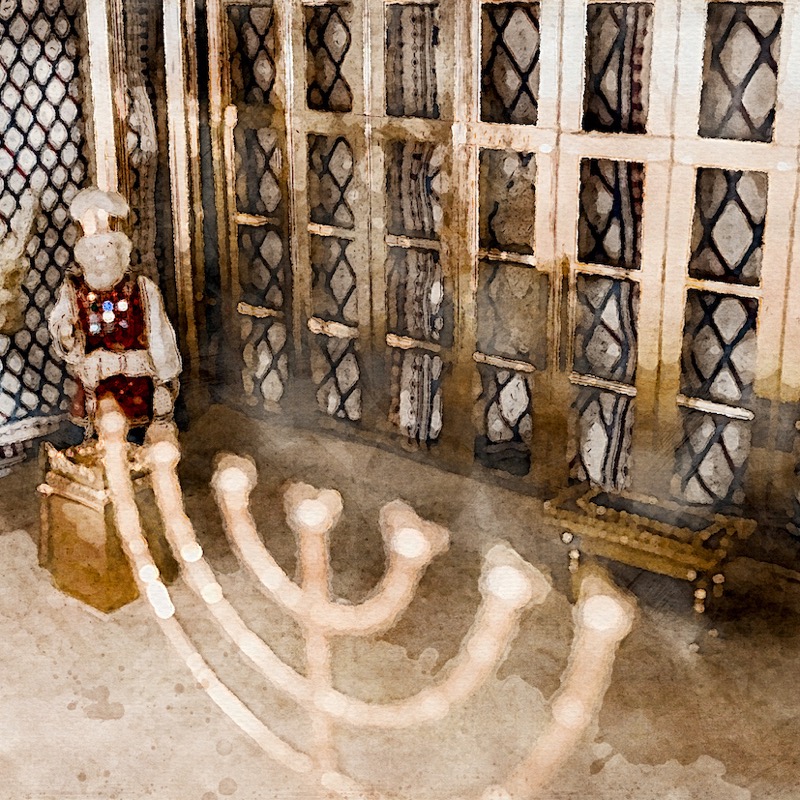
Listen to the Hebrews chapter nine beginning in verse one. Now even the first covenant had ordinances of divine service, and its sanctuary, a sanctuary of this world. For there was a tabernacle prepared, the first, wherein were the candlestick and the table and the showbread, which is called the holy place. And after the second veil, the tabernacle, which is called the holy of holies, having a golden altar and the ark of the covenant overlaid round about with pure gold, wherein was a golden pot holding the manna and Aaron's rod that budded and the tables of the covenant. And above it, cherubim of glory, overshadowing the mercy seat, of which things we cannot now speak severally. Now these things having been thus prepared, the priests go in continually into the first tabernacle, accomplishing the services. But into the second, the high priest alone, once in the year, not without blood, which he offereth for himself and for the errors of the people. The Holy Ghost this signifying that the way into the holy place hath not yet been made manifest, while as the first tabernacle is yet standing, which is a parable for the time now present, according to which are offered both gifts and sacrifices that cannot, as touching the conscience, make the worshipper perfect, being only with meats and drinks and divers washings, carnal ordinances imposed until the time of Reformation. But Christ, having come a high priest of the good things to come, through the greater and more perfect tabernacle, not made with hands, that is to say, not of this creation, nor yet through the blood of goats and calves, but through his own blood, entered in once for all into the holy place, having obtained eternal redemption. For if the blood of goats and bulls and the ashes of a heifer, sprinkling them that have been defiled, sanctify unto the cleanness of the flesh. How much more shall the blood of Christ, who through the eternal Spirit offered himself without blemish unto God, cleanse your conscience from dead works to serve the living God? And may God give us good understanding of his holy word and graciously presents himself with us in our studies this weekend. Now, first of all, let me say what a delight and an encouragement it is for me to see you all here gathered this weekend. As you know, this weekend was originally planned as a somewhat informal get-together of people interested in the tabernacle, for the purpose of encouraging one another and helping one another in our understanding of this great part of God's self-revelation to men. And at the same time, in encouraging us one another not only to understand, but as appropriate, to use this marvelous visual object that God has given us with which to understand and to teach his word. In days gone by, it used to be taught very regularly, perhaps a little too oftenly. Nowadays, at least in my country, it has become, as some people call it, old fashioned. And it seems to me that there are many more of God's good workers who could profitably use this vid- visual object lesson in the course of their preaching the gospel, their teaching of Sunday school, their conducting of Bible classes, their exposition generally, but have perhaps either been discouraged by prevalent views that tend to be against typology, or else imagine that the tabernacle is some complicated thing that only the Mike- Michael the Archangel and a few others are capable of expounding. So if we can help one another this weekend to see that the tabernacle is not only a wonderful means of, uh, uh, understanding God's word, but also a very useful object lesson to use at all levels, we shall have accomplished much. We're here to help one another. To my own knowledge already, though I know, uh, uh, not all of you by any means, but I do happen to know that there is one expert, nationwide expert on the tabernacle sitting in the audience in the person of Mr. George Heidman. And I advise you to do, particularly in the intervals, what I intend to do, that is to pick his brains as often as I possibly can. And you will profitably consult him in filling in those things that time forbids me to say, or ignorance leads me to say as they shouldn't be said. A word more of explanation. We only have eleven sessions. Some of you will be thinking that that's about nine too many. We only have eleven sessions here concentrated this weekend, and that means I shall have to give an exceedingly abbreviated account of the tabernacle and leave out many important things. Therefore, I shall be concentrating in the formal talks on one particular approach to the tabernacle. Let it be understood that I realize that there are many other approaches to it. It is possible, you see, to approach the tabernacle from the New Testament. That is, to come with massive knowledge of the New Testament, way back to the Old Testament, and concentrate on the details of the tabernacle there, and a very profitable study that will be. I propose to do the very opposite. I shall be starting with the tabernacle and letting the tabernacle in its broad teaching and significance lead me and you to the New Testament. And that is why these talks have been advertised as the tabernacle in the epistle. I shall be using the tabernacle merely as a means, an uh, uh model to think with, to help us explore the New Testament. And in so doing, of course, I shall leave a lot of the tabernacle detail untouched, and that is what you will need to consult one another about in the intervals. Other matters that we ought briefly to notice as we introduce ourselves to the topic this afternoon. If we were dealing in some context, as as as for instance, if you got a chance to take it into a local school, or the Mother's Union, or whatever local art club was around. Suppose you got an opportunity to take your model into such a place. And you might want to talk, at the beginning at least, on the tabernacle in the context of the history of art, the history of architecture, and of technology. Then, uh, let me remind you that there has been a recent article in the journal of the Royal Institute of British Architects, written by an architect who is also a believer. And it is written from an architect's point of view and discusses the proportions of the building and the court of the tabernacle, very interestingly, I must say. And he makes the point that whereas most architects, at least in Britain, have been brought up in their architectural schools to look upon the temples of Greece as the great models of classical proportion. The claim to be the leader of classical proportion in the history of art and architecture more rightly lies with the tabernacle that predates, of course, Greek temples and such like things, and shows in its proportions those classical proportions that have been so greatly, uh, praised in Hellenistic architecture. As to technology, we are blessed in Northern Ireland with having an institute for the research on linen, and just before I came here, having regard to the fact that I should be a Daniel among the den of critics and experts, I hide me to this institute of linen, you'll see, to discover from them certain technical things about linen. They have there some of the linen that was taken from the tomb of Tutankhamun. They showed me linen that is so fine twined linen as to be diaphanous. You could almost see through it. And it shows us that when the Old Testament talks about fine twined linen, and the subsequent Greek, that is the Jewish Greek translators, translate it by the Greek word meaning very fine linen. It follows that the beautiful linen tabernacle curtains, for instance, that form the tabernacle to be found in here, would have been made of the most gorgeous and beautifully spun and woven linen that you could have found in the whole land of Egypt. They would not have been crude, coarse things like you see in some reconstructions of tabernacle models. I was asking the aforesaid experts at the Linen Institute how they thought the colors would have been put upon the curtains and upon the gate and upon the door. Would they have been added by embroidery, or would they have been woven in the weaving of the linen? That is to say, would they have been tapestry or damask? So they hunted for me in the books and came up with evidence that even in the time of Moses, the technologists, quite apart from divine in- help and inspiration, would have been able to weave those colors in the linen, in the weaving of it, it were, they were not necessarily added, uh, uh, by embroidery. And that also is a very interesting thing, because when we come inside and consider the cherubim that are on the tabernacle curtains and on the veil, the question arises for the technologists, just how were those tabernacles put there? Were they done by embroidery or by tapestry? The answer to that seems to be it would have been possible for them to do it by tapestry, though, of course, we cannot be definite. They may have been added, uh, with, um, by embroidery. But of those technical details of history of art and architecture and technology, I do not now speak, though I just repeat the fact that I have found it a very useful way in, in using the tabernacle model amongst unconverted people. Why shouldn't you? I've had it in my own university to a general meeting of, uh, people of all sorts, kinds, shapes, sizes, and background beliefs, you'll see. And to get their beginnings of their interest, I have talked about the history of art and architecture and such like things, and moved on to the symbolism in art, and thus away into the gospel without their scarce knowing what I was doing till I got to the end, you'll see. It is a useful thing to do, eh, in that kind of context. Another thing that you may want to talk about if you are going to lecture on tabernacle, uh, is the question of its historicity. Now, I don't know what is taught to your young people in schools. You have a different system here. In our schools in Britain, where we have religious instruction and therefore teaching of the Bible, it has been very often an utter disaster. Not always, of course. In Northern Ireland, which is next door to paradise on the map, uh, in Northern Ireland we have many schools that are bound with Christian teachers, though they're not Christian schools, they're ordinary state schools, but we have so many believers in Northern Ireland that it is not an uncommon thing to have a half a dozen really true believers teaching in school, and if teachers like that teach religious instruction, that is very good indeed. Alas, in other schools and in the majority of schools in England, the teachers are not believers. Some of them are positively unbelievers, and they use their time for teaching religious instruction in order to spin the old, uh, modernistic and atheistic sometimes theories. And when in the higher classes they come to talk about tabernacle, they follow the rather out of date modernists and tell the children that the, uh, tabernacle as de- described in the book of Exodus is not historical. There never was such a building, they say. And one of the arguments they bring to bear upon the topic is, they say, you will notice that the tabernacle was a framework with curtains and skins stretched over it, not please, of course, with a, a ridged roof, a peaked roof, but flat, the curtains stretched over in the manner of a pall over a coffin. And they say, you'll say, the curtains being thus stretched over, the dust would have collected on the top here, on the roof, and every year and a half or so, when in that part of the world they get rain, and they get it with sudden torrential downpours, the water would have settled here, and it would have collapsed the sides inwards. You'll see, because they notice that there is no actual instruction in the Old Testament for any struts going across the top of the building. But now, in that regard, two things can be said. When we follow the instructions in the book of Exodus, not everything is told us. There are certain details that you would need to know in building a tabernacle, a literal one, that are not given us in Exodus. So there may well have been struts going across the top that would have stopped the building from collapsing anyway. As for the feasibility of people in the time of Moses making an elaborate model of this or- tabernacle of this order, it is the fact that a thousand years before Moses, in Egypt, the pharaohs had portable pavilions made. They were open framework, and they had curtains over them and furniture inside them. And I repeat, such things were built a thousand years before Moses. To say that Moses and his skilled workmen could not have built such a thing, or that they were impractical, is laughable historical nonsense. And it is perhaps worth pointing out to senior students in senior classes, eh, if you're teaching them. You won't need to teach your elders that in the church. They might even get impatient with you if you talked about such things. But to the young folks who have to meet the blast of modernism from all directions in their schools and universities, then it's a worthwhile thing pointing out to the historicity of this record that there was a tabernacle, and such a building was certainly feasible even by ordinary secular technology in the time of Moses, and resembled some of the actual portable pavilions that had been in use for a thousand years before Moses was born. But no time now to go further with the, um, uh, technicalities. I leave them now and come to our study in earnest. One of the things that has always been mentioned to me by other preachers, Bible class leaders, and students of tabernacle is, how do you make it relevant to people so that you can dispose them to listening to it? Of course, all your believers in America are veritable paragons of theological interest, you'll see, but we have some in our country who tend to think that the tabernacle is a very difficult and not to say boring subject, you see. And they say, brother, oh, choose something more practical than tabernacle. Because people don't see that it is relevant. So if you wanted to make it relevant, what would you do? How would you make it relevant? Well, there are all sorts of things you can say, aren't there, to make it relevant. Let me take one, just one possible way. There are many others. But let me, at the same time, indicate that it is sometimes necessary to make our use of the tabernacle relevant to people. One way of making it relevant is to put it in its historical context, of course. Most believers, if they're believers at all, have heard of Moses, the Passover, and the Exodus. And of course, the majority of believers rejoice in that because they see in it an easy picture of our redemption in our Lord Jesus Christ. Israel were slaves in Egypt under the domination of Pharaoh. God came down to deliver them. They were saved from the wrath of God through the blood of the Passover lamb. They were saved from Pharaoh's tyranny by the power of God at the Red Sea. And being redeemed from Egypt, they were promised that there was an inheritance awaiting them, if not incorruptible and undefiled and unfading, it was an inheritance with grass and honey and cows and bees and other such delightful commodities. Only to get from Egypt, where they had been redeemed, to their inheritance, they had to journey across the wilderness. It was as they were crossing that wilderness that God himself came down to Sinai in order to make clear to those people what the goal of their redemption was. And here's a point, perhaps, in our preaching to dwell upon a little bit. You can innocently say to a half a dozen believers, uh, uh, can't you? What do you suppose the goal of Israel's redemption is, was? They say, well, the goal of their redemption was, uh, the Promised Land. You say, really? And what is the goal of your redemption? And they say, well, heaven, of course. What do you think? Heaven is the goal of our redemption. And then you can afford to tell them that neither of their ideas is correct. Long before Israel got to the land flowing with milk and honey, God himself came down from heaven and stood on Mount Sinai to make it abundantly clear what the goal of redemption was for Israel. He said, you have seen how I have borne you on eagle's wings and brought you to myself. God himself was the goal of redemption. And because God himself was the goal of their redemption, God made to Israel a proposition, and it went like this: If you will obey my voice and keep my covenant, then you shall be a peculiar people unto me from all the nations of the world. You shall be a kingdom of priests to me. And if you will, you may build me a tabernacle, and I will come down and dwell among you as you journey through the desert home to your promised land. Marvelous, wasn't it? The goal of redemption was God himself. The presence of God known in their midst. Long before they got to Canaan, they were able to enjoy God as the goal of their redemption, who came and dwelled among them and walked every mile of the wilderness with them, home to their destiny of the Promised Land. That is the goal of redemption. And the goal of our redemption? Not heaven, ladies and gentlemen. That's our destiny, to be sure. The goal of redemption is God himself. And in his grace, he offers to come and dwell among us, in the believer, in the New Testament will say. Not only has the Lord gone to prepare us a dwelling place in the Father's house, but if we are friends of him and love him, we will keep his commandment, and he will come, and his father will come, and make their abiding place with us. That's where it fits into our modern spiritual experience. And oh, how easy to preach a gospel that is merely forgiveness of sins and a heaven beyond, and forget to preach that part of our gospel, which is Christ in you, the hope of glory. And let me remind you, therefore, what happened historically. Israel, of course, being given that odd proposition by God that he come and dwell among them, said, yes, yes, yes, yes, of course, of course, of course, of course. Come and dwell among us. So Moses went up the mountain to, uh, get the details of the tabernacle that Israel then would make so that God could come and dwell among them. And he was gone up the mountain rather a long time. One breakfast time, or was it after lunch? I don't know. There were a number of chaps sitting around outside their tent, you'll see, and one of them said, uh, ha- has it struck you, it struck me just the other day, what a funny position we're in. Oh, said the other fellow, what do you mean? Well, he said, here we are sitting at the bottom of this mountain. Oh, yes. Uh, and you know, that man Moses that was meant to be guiding us, I don't know what has become of him. Gone up that mountain. Where is he now? Oh, said the other fellow, he's coming back, you know. He said he would. Uh, they said that last week, said the first fellow, and he isn't back yet, is he? And you know, the idea spread. Oh. And they began to scratch their heads, and they said, this is a bit of a ridiculous, isn't it? There's all us, thousands of folks, sitting around the bottom of this mountain, trusting in a man we can't see who's gone off who knows where. You know, this isn't very practical. I mean, you can't just sit around in the wilderness twizzling your thumbs. We want to be aiming at something, going somewhere. So off they went to Aaron. They said, look here, Aaron, we don't know what's become of this Moses, and we doubt the whole business, all this business of you coming back again and the promised land out there. No, for reasonable modern people, we'll have to have a more realistic goal to aim at. Make us gods to go before us, Moses, they said. So Moses did, and he broke off their earrings and made a god out of their earrings as a god to go before them. That's a funny thing to go before, isn't it? Earrings made into gods, I mean to say. But then you see, in the ancient world, people carried their excess wealth in the form of jewelry. So they made big earrings of their spare gold and put them in their ears, you see, it represented their capital. And they set that as their god to aim at and to go before. And forgot completely about the true God and his coming to dwell among them. And they nearly forfeited the whole thing. It's possible, brethren, isn't it, and sisters, to forget this great part of the gospel, the question of God among us, Christ in us, and to make to ourselves other goals to aim at in life, be they gold and capital or other things. Well, when that happened, God called, summoned Moses up the mountain and announced to Moses that he was going to destroy the lot of them, and he would have done had it not been for Moses' intercession. Little by little, God relented, as it seems. So that at one stage he said to Moses, all right, Moses, ah, yes, all right, I'll spare the people. And what was more, Moses, he said, I'll give them the promised land, they can have it. I promised them a few cows and some green grass there in Palestine. All right, Moses. They can have the cows and they can have the grass. Take them away, Moses. Uh, just one thing, Moses, I can't be coming with you. They don't want me? Well, they don't have to have me. They can have Canaan without me. What would you have said to that offer? Oh, well, mm-hmm, but the grass is good grass and cows are now very profitable, would you? Said Moses, no, God, if you don't come with us, we don't want Canaan. Would you want to go to heaven if God went there? I wouldn't, would you? You see, if God is the goal of redemption, if you got to heaven and God weren't there, that's not worth going. No, says Moses, Lord, the only thing is if you will consent again to come and dwell among us now and walk with us all the way to glory. That then is one relevance of the tabernacle to our spiritual experience. The whole this ki- this centered joy of glory will be the presence of God. And if I believe that, I shall give heed to the lessons taught by this tabernacle about God dwelling among us now in the wilderness. You will, of course, think, uh, of other things as well, as to how to make this study relevant to Christians in this present age. Now let us turn to think about our authority for saying that the tabernacle does have any lesson for us. In my country, this is often challenged. Let us notice then that according to the two New Testament, the tabernacle had two functions. The first of them is given us in Hebrews chapter eight and verse five. Talking of the ancient tabernacle, the writer says it is or was a copy and shadow of heavenly things. Copy and shadow of heavenly things. That is to say, it was that for Israel, it served Israel as that. It was a means by which God took heavenly, spiritual, and eternal truths, and illustrated them by material objects and rituals, so gearing them down to Israel's understanding and perception as they went through the wilderness. And you can readily see, can't you, what a tremendous lot of lessons this tabernacle actually taught Israel. And as Christians, we mustn't forget that. We're sometimes a little bit impatient to get to the lessons that it teaches us, but it is a wise thing to start with the lessons that it taught historically to Israel. It taught Israel, didn't it, about the beauty of God. All those lovely colors, those cherubim, those blue, purple, and scarlet, uh, curtains, that richly embroidered veil, those lovely colors on the gate. They taught Israel something about the sheer glory and the beauty of God. Isn't that worth learning? It taught some Israel something about the holiness of God, the great mystery of his being, who dwelt in the most holy place and was utterly unapproachable even by the high priest except one day in the year. Beauty and holiness. It taught Israel something about the, uh, friendliness of God in that tabernacle. There was a table. On that table was bread. It was put there at the beginning of the week for God's benefit and enjoyment, and left there a whole week for God. At the end of that week, the priests came, and they were allowed to eat the bread that had been put there for God, and then replace other bread for God. In symbol form, man and God ate at the same table. How could God have said it more clearly to Israel that he wanted to be friends with man and bring man into fellowship with God. That big altar at the front, as we are about to see in a moment, taught Israel, did it not, the exceeding sinfulness of sin. Way here in the most holy place was the ark, and inside were the tables of the testimony of God's law, that likewise, when they were read in the hearing of Israel, taught Israel the seriousness of sin. Their ancient sacrifice taught them that sin cannot be forgiven without the forfeiture of a life, and that sin leads to death. Multitudes of lessons then were taught Israel actually, historically, literally. And we do well to remember that when Israelites brought their sacrifice to that altar and confessed their sins, Leviticus said those sins were actually forgiven them. Though it was a copy and shadow of heavenly things, gearing heavenly and eternal truths down to Israel's perceptions by means of these symbols and rituals. And when from time to time we listen to those lessons ourselves, we shall be able to draw straight lines across from the lessons taught to Israel to ourselves simply by analogy. Then there was a second function, was there not? Look now, if you will, to Hebrews chapter ten verse one: For the law having a shadow of the good things to come, not the very image of the things, they can never, with the same sacrifices which they offer year by year continually, make perfect them that draw nigh. Notice, if you will, the phrase having a shadow of the good things to come. What good things to come? Why, the good things that had been promised and prophesied and actually came with the Lord Jesus. Look at chapter nine verse eleven, But Christ, having come a high priest of the good things to come. So while this tabernacle stood on the sands of the desert or at, uh, Shiloh or elsewhere, it not only taught Israel at the time lessons, it also formed a kind of a prophecy of coming good things. Now it is not to be thought that many Israelites would have understood that second function. As they came and brought their lamb to that altar, shed its blood, and were forgiven, very few Israelites, I suspect, ever dreamed that that lamb that they had just slaughtered was a prophecy of a coming lamb. It was, however, in fact, even if they didn't see it. So the tabernacle was designed as a shadow of the coming good things. Why do that, you say? Well, for all kinds of reasons. One reason is the question of evidence. How do you know that Jesus is the Christ? What makes you sure he is the Son of God? One way is to take the shadow, the prophecy written centuries before his coming, and then compare it with him and see whether the two match. Yeah? Hm. You, for instance, uh, sir and you, madam, hmm, you decide one of these cold winters when the snow is piled upside out- piled up outside your door, you decide that you're going to take a summer holiday in Bermuda, hmm. So you get out the brochures to look at the hotels, and you look at this one and that one, and then this third one catches your eye. Oh, it's beautiful. It's snowy white, uh, and there's the swimming pool in impossible blue, and there's the one palm tree, and there's the sea. You say, now that's our hotel. Yes, that'll be that one. And that thing up there, that yellow dot, that's the sun in the sky, shining brightly without a hint of snow. Ah. You say, that's the hotel, my. And my dear replies, what do you mean that isn't a hotel? That's a bit of paper. Well, you say, yes, of course it's a bit of paper, I know that. But it's a picture of the hotel. Do you know it's, uh, uh, taken by photography? Do you know what photography is? Compass. And the compass, the misgeres, is by definition a thing that goes around the outside. You can't have a compass going inside. If an army compasses a city, it goes round the outside. Here is the compass, the misgereth, going round the outside of the altar. There it is, as you'll see, going round here on the color slide. The grate, says the text, has to be under the misgereth, underneath the compass, reaching halfway up. So there it is. It is vertical, of course, and comes up under the compass. Thirdly, the text says that the staves by which they carried the altar were to be put through rings, and the rings were not on the altar itself, they were on the great work grating, the grating work. That grating work must have been outside, therefore, mustn't it? It can't have been inside if the rings for carrying the whole thing were on the grating. You'll say, if that were true, where did they put the sacrifice then to burn it? I don't know that we're told. All sorts of, there are all sorts of possibilities. They could have used this merely as a framework, and when they settled down for the night to offer the evening sacrifice, they could have filled it with the loose sand and dirt that was around the wilderness and burnt the offering on the top of it, just like, uh, the, uh, Solomon's temple, they burned the sacrifice on the top of the altar. And then, uh, they could have put the, uh, uh, a grating inside that we're not told about. Or they could have put the altar base here just a little bit higher than the grating and allowed for draught to go on and taught- treated the whole thing as an incinerator. I leave you to decide which you think is the better. But this, as far as we're concerned, is what the technical details prescribe, though we shall not, uh, fall out with anybody, and we shan't completely rule you, uh, read you out of fellowship if you don't agree with us on the topic. That for the technicalities then, and in our second session we come to the significance. Thus, let's bow briefly in a word of prayer. Our Father, we thank thee for this ancient tabernacle, so expressive of thy desire to dwell among thy redeemed people. Help us, help it to move our hearts to love thee the more, and make thee the more readily and fully a dwelling place in our hearts. We thank thee, Lord, for thy divine wisdom and genius in constructing such a vivid and wonderful illustration of the good things to come. Grant that as we once more consider the illustration, our hearts may be aflamed with the richness and the wealth of thy great salvation, and all to thy glory and the greater love of our Savior, in whose name we pray.