Gooding, David: 10 - Peeling Back the Curtain on Reality
ID mfh_1087262071Date unavailableBefore 2.83Restored 4.42
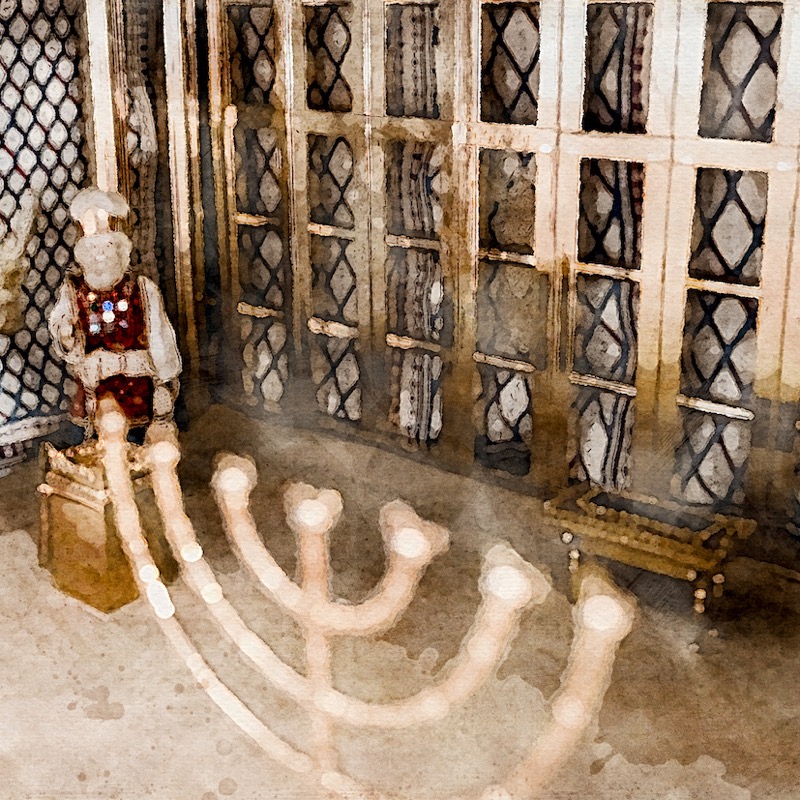
Last night we began a study of the coverings and curtains over the dwelling place of God. We found that the outer covering was a covering of skin, made either from seals or perhaps from dugong. Just one half of a verse is devoted to telling us about those skins, their obvious purpose being to protect the dwelling place of God from the ravages of sand and wind and sun and occasionally rain. Underneath the dugong or seal skins were another set of skins made of ram skin dyed red. A dark, earthy color red. Some scholars have even said it means ram skins tanned. Be that as it may, that too is described in just one half of a verse. Underneath those skin coverings were two sets of curtains, obviously far more important. And at this juncture, you may care just to notice them and to notice their technical names. There was this series of eleven curtains made of goat's hair. These are the curtains that we are about to study this morning. The technical name for them is the tent. And you will read in our reading about the tent going over the tabernacle. And you should understand when you read that technical phrase that what it is talking about when it says going over the tabernacle at the back of the tabernacle, is that it's talking about this other set of curtains made of fine twined linen and blue and scarlet with cherubim on them. There were ten curtains joined together, and the technical term for them is the tabernacle. As we said last night, these things here, these frames, are merely frames for the tabernacle. The tabernacle, hamishkan in Hebrew, being this set of ten linen curtains. They form the dwelling place of God and were supported in their place to function as his dwelling place by the frames, frames for the tabernacle. Over the tabernacle, this set of goat's hair curtains, and it is of them now that we are to read. Book of Exodus, if you will, please, chapter twenty six, Verses seven to thirteen. And thou shalt make curtains of goat's hair for a tent over the tabernacle. Eleven curtains shalt thou make them. The length of each curtain shall be thirty cubits, and the breadth of each curtain four cubits. The eleven curtains shall have one measure. Thou shalt couple five curtains by themselves, and six curtains by themselves, and shalt double over the sixth curtain in the forefront of the tent. And thou shalt make fifty loops on the edge of the one curtain that is outmost in the coupling, and fifty loops upon the edge of the curtain which is outmost in the second coupling. And thou shalt make fifty clasps of copper, and put the clasps into the loops, and couple the tent together, that it may be one. And the overhanging part that remaineth of the curtains of the tent, the half curtain that remaineth, shall hang over the back of the tabernacle. And the cubit on the one side and the cubit on the other side of that which remaineth in the length of the curtains of the tent shall hang over the sides of the tabernacle on this side and on that side, to cover it. Now, as I say, last night we were studying together in our last session the beautiful set of linen curtains that formed God, his dwelling place. There you see them in the models stretched over the frames, and if we have a slide, we can see once more the beauty of them, as the colors and the cherubim would have appeared to anyone who entered into the holy place. This morning we move on to consider the curtains of the tent, easily distinguished, of course, and made of goat's hair spun, not goat's skin, goat's hair spun. And their function, obviously, at the first level, to protect the beautiful curtains of the tabernacle. But when we have said that, it is obvious that these eleven curtains that formed the tent over the tabernacle, while they were there to protect, were far more important than this double series of skins. Of course, from a practical point of view, these skins were important. They gave protection from water and so forth. But the two of the sets of skins are dismissed, as I say, in one verse in Holy Scripture, where a whole series of verses talks of these goat's hair curtains that formed the tent of covering over the tabernacle. We notice at once that there are eleven of them and that they are as elaborate as the tabernacle curtains were. In the, um, tabernacle, there were ten curtains, and they were, next one please, they were joined together by an elaborate system of loops and golden clasps. Fifty loops in one selvedge, fifty loops in another selvedge, and joining them fifty clasps of gold. In an equally elaborate manner, the tent was composed of a series of curtains. There were this time not ten but eleven. They were joined in two groups. There were six in one group and five in the other. The curtains, of course, you will see them that way better, are going this way on. They were thirty cubits in length, and their breadth of each curtain was four cubits. They were joined together in two sets, one, two, three, four, five, six in the one group, and one, two, three, four, five in the other group. And then they were equipped with fifty loops down the one selvedge, fifty loops down the other selvedge, and then joining the loops, fifty clasps, though this time not of gold, but of copper. Elaborate curtains then. And before we are finished, we shall see that they, like the beautiful tabernacle curtains, did not merely function for Israel as a practical device to protect the tabernacle, but were intended by God to convey spiritual meaning as they were shadows of the good things to come. But let's start then with the practical question. They were, as they were put over the tabernacle, obviously there to protect it. With all that consummate and exquisite beauty of the dwelling place of God, God was naturally anxious, of course, that nothing should spoil it. No sand, no wind, no sun, no tempestuous rain, nothing should be allowed to spoil the exquisite beauty of that tabernacle, or indeed the exquisite beauty of the furniture that was therein. As we think of that, of course, we think of a more serious problem. Last night, as we studied the tabernacle curtains, we found it to be a picture of the present dwelling place of God, among other things. A dwelling place that is made up of human personalities, Christ and his people. To change the metaphor, a picture of the body of Christ, where there are many members, and yet only one body. But as we think of ourselves as joined with Christ, as forming the dwelling place and tabernacle of God, very soon there must occur to our mind too, mustn't there, what provision has God made for the protection of this his dwelling place. To provide that nothing shall spoil or damage this beautiful thing. Perhaps we feel a little trembling in our hearts. For as we think of ourselves now as the people of God, baptized in one spirit and made to drink of one spirit, and forming God a dwelling place through the spirit, how we must hang our heads in shame at the damage that has so frequently been done. To the people of God, as the dwelling place of God. We ask therefore rightly, is there no provision for stopping us from sinning and thus damaging the dwelling place of God? We ask the question about our present experience. We should be wise also to ask it about the future when we get home to glory. Oh, you say, don't worry about that, Mr. Preacher. Huh? When we get home to glory, we shall have stopped all this sinning business. There won't be any sinning in heaven. There can't be, can there? Oh, wait a minute. Where was Satan when he sinned? Hmm. I say, the thought of it chills the spirit, doesn't it? Was he indeed the anointed cherub that had the supreme privilege of covering God and his throne? And he sinned there, using his creaturely free will to give vent to pride and the folly of imagining that he could be equal with God. It is the fact, of course, according to the descriptions given us in the plain statements of scripture, that when we get home to glory, there will be no more sinning. But the relevant question is, how will God achieve it? What's going to happen to you, my brother and sister, because you freely admit in your saner moments that now you do still sin? What's going to happen to you when you get home to glory to stop this sinning business? Ah. We better turn to our scriptures to find out, haven't we? But let us begin by noticing once more the sheer practical facts. The curtains of the tabernacle were ten of them, and therefore, the curtains of the tent being eleven. from back to front, the curtains of the tent were longer. There were eleven of them, and eleven fours are forty four, whereas ten fours are forty. So they were longer from back to front, and they were able to be folded over, two cubits of the extra curtain folded over in the front, and two cubits, the other two cubits of the extra curtain hanging over the back of the tabernacle behind. Then we notice also that the curtains of the tabernacle were this way on in length, twenty eight cubits, but the curtains of the tent were that way on thirty cubits. So there was an additional cubit on each side of the tabernacle, so that the tent curtains should completely cover the whole of the tabernacle and more than cover it. As we think of that, our minds go, do they not, to the famous statement in scripture that deals with the problem that we have been mentioning. What provision has Christ made to cover the dwelling place of God. And I ask you to turn with me now to the Epistle to the Romans and to begin reading with me in chapter five. Chapter five. And we shall start reading in verse six. for while we were yet weak into season, Christ died for the ungodly. For scarcely for a righteous man will one die, yet peradventure for the good man some would even dare to die. But God commendeth his own love toward us, in that while we were yet sinners, Christ died for us. Much more then, being now justified by his blood, we shall be saved from the wrath of God through him. For if while we were enemies, we were reconciled to God through the death of his son, much more being reconciled, shall we be saved by his life. And here we begin to meet that phrase that so delights our hearts, much more. You see, actually, there was much more material in the tent curtains, wasn't there, than there was in the tabernacle curtains, so that on all four sides, there being much more of it, it completely covered and completely protected the tabernacle curtain. And I'm glad to stand here to be able to repeat God's assurance in your ears that there is much more in the provision he has made in Christ for the protection of his people. What do we need to be protected from? The first thing that we need to be protected from is the wrath of God. Look at verse nine again, much more than being now justified by his blood, we shall be saved from the wrath of God through him. The biggest danger, the most fearful storm that could ever arise in the whole of the universe is that great tempest of the righteous wrath of God. Notice how Romans five verse nine reminds us that that wrath is future. There is a coming wrath. How peaceably and gladly we sit before God this morning, knowing there is enough in the sacrifice of Christ on our behalf to cover us and protect us from the coming storm of God's wrath. Pray see the argument in its context, if you will. For the chapter five and the early verses are telling us that being justified by faith, we already have peace with God through our Lord Jesus Christ. We have access to God into his holy presence, says Romans chapter five, Not only peace, but access. And we rejoice in the certain prospect of attaining one day to the glory of God. Not only so, says Paul, but we can actually exult in our tribulations. The old English translates that we joy in our tribulations. Don't mistake the meaning. I don't find tribulations all that joyful. I, when I'm under tribulation, I'm not singing, I'm H-A-P-P-Y, I'm singing all the day long. We leave those excesses to the choruses of hymns. Uh, actually, when the tribulation comes, I'm pretty grim in the face and grinding my teeth and whatnot, you know, but, uh, uh, says scripture, we can nonetheless exult in our tribulations. We can look them in the face. In the name of God, we can defy our tribulations. Grim though we may be, and in pain and sorrow, we can triumphantly defy them, knowing that tribulation, the very worst it can do, is to work endurance. With endurance comes the evidence that we are genuine, and the evidence that we are genuine gives us an additional ground for hope. Then there are two grounds for hope, aren't there? There is, of course, the he- ground of hope that is the evidence of a believer's life, that he is proved genuine under the trials of life. There is that more profound ground for hope. Founded here for the love of God is shed abroad in our hearts by the Holy Spirit that he has given to us. What a lovely metaphor it is. When we trust Christ, when a man or woman trusts Christ, one of the early ministries of the Holy Spirit towards them is to take God's love for them and pour it out into their hearts, into the deep well of their subconscious mind. So that when people that once were enemies of God and thought of God as either hostile or a terrific bore. Begin now to realize the glorious love of God that flows under all those lesser difficulties, anxieties, trials, and tribulations that we suffer. He pours it out in our heart like I'm pouring water on this floor, and it's gone all over the floor here. That's how God intends his love to be in your heart, my brother, my sister. Spreading through little by little and breaking through here and breaking through there and getting under the old neurosis somewhere else, you'll see, and quietly beginning to pour in us a different basis in the love of God that we might be rooted and grounded in love. Isn't that delightful? I've often wondered why I would like to have got a helicopter and, and, and flown above Paul when he was in the Mediterranean holding onto a bit of old wood. Because I don't en- I don't enjoy being a missionary in the, in the water myself. I would have had a helicopter above it, you see. And I come along and I see Paul, uh, down there in the water, hanging on to this bit of, uh, wood, you see. And I say, Paul, you're, you're, you're in difficulty, aren't you, old fellow? Yes, he is, yes, he says, yes. Hmm. I say, you know, I've got the feeling that, uh, God doesn't love you as much as he could, does he? I mean to say you've been working hard for him and wearing yourself out, man, and your fingers are all horny with hard corns in making tent, and you've been preaching day and night and praying and writing bits of the Bible. And is this all that God can do for you? Letting you down in the soup? Oh no, God doesn't love you as he could, does he? And if Paul could get his mouth above the water, i- i- he'd rebuke me at once, wouldn't he? What? What are you talking about, man? I am persuaded, would he say above the wind and the wave that neither things present nor things to come, the Mediterranean all at once, or life or death or any other creature, can separate us from the love of God, which is in Christ Jesus our Lord. What a lovely job the Holy Spirit had done with him, hadn't he? Pouring the love of God in his heart, not making his circumstances easy, but giving him the ability to respond to them, secure in the love of God. The way the Holy Spirit pours out the love of God in our hearts is, at first sight, a little curious. We might expect it to come in the form of marvelous feelings. The Holy Spirit induces it by the help of logic. You'll see God's love isn't like our love. Uh, suddenly we find ourselves moved by all sorts of emotion, and for five minutes we love, and then the mo- emotion dies away, then we don't love anymore, see. Not God. His love is utterly consistent. You can argue logically from the nature of God's love. And the argument the Holy Spirit uses is this. He says, now, pray consider, hmm, what is the biggest thing God will ever do for you? Oh, you say, I, I'm not absolutely sure, but I, I hope when I get home to glory, uh, I'm going to get a marvelously glittering crown. Never know what it might be. I mean, perhaps God might give me a whole galaxy to look after. Something really big I'm hoping for God to give me. I think that will be the biggest thing God will ever give to me. You're wrong, of course, aren't you? And I hope it doesn't disappoint you to know the biggest thing God will ever give you, he has already given. Ah. Given his son to die for you. Well, you might help me then with a bit of information. Pray tell me, this stupendous and almost incredible gift of the Son of God to die for you. When did God give you that gift, if you could tell me exactly? I think perhaps was it after you had repented and you believed and you were making some improvement in your life, you sorely needed to anyway, but after you were making some improvement in your life, then God said, well, perhaps now I would consider giving my son for them, but perhaps a little bit more improvement were necessary before I actually do it. Was it so? You say no, of course it wasn't. It was while we were sinners. Christ died for us. And God commends his love. I like the, I like the verb, you know. Hm. I mustn't liken the Almighty to unworthy people, but in our country we have salesmen that come round the door, and they have a technique, I think they learned it at Harvard, that when the housewife opens the door, it's a selling technique, uh, before they speak the word, they put the foot in the door to give them the chance to advertise their wares. What has it come to when Almighty God comes to us, knocks on the door, and when we open it, he puts his foot in? In order to commend his love. But while we were enemies, we were reconciled to God by the death of his son. Says the writer, if that is true, if he loved you and gave Christ for you while you were still a sinner, ungodly, weak, sinful, and positively hostile. If he loved you then and gave his son for you then, do you suppose that now you've been justified and turned from an enemy to a friend and a saint of God? God would now sometime cast you out. I was at a conference once, and uh, the time schedule was pretty short, and I had to get from the end of the conference to the railway station pronto, you'll see. So I left the hall as soon as I could, and I was walking up the street, half running, half walking, when a dear brother arrived in a car, or what he called a car, and offered me a lift, you'll see. I got in the car. Well, it banged and it splattered, and then it wouldn't go, and then it had to be kicked, and then you had to pull the starter, and then you banged it again, and it went a few yards and stopped, you see, and I was getting very nervous and upset because this train was going and I had to be where I had to be. It was important, and, you know, being very unkind, I nearly said, why don't you sell this thing and get a car? Truth to tell, he couldn't because he'd spent everything he'd got on it. I sometimes wondered why God doesn't abandon me too, haven't you? For my brother, he's spent everything he's got on me. Do you suppose God, having given his son for me while I was still a sinner, now that I've become a saint, will one day abandon me. No, of course not. Why not? Because that would betray an inconsistency in the love of God. God's love is utterly consistent, so consistent you can learn to argue logically, and you better. Emotions are no guide to whether God is loving us or not. Emotions can be the worst of liars under the sun. Sometimes misrepresent the situation. We must learn to walk by faith, calling logic given us of the Holy Spirit to remind us of the unchanging character of the love of God. If Christ died for us when we were sinners, much more shall we be justified, shall we be saved from the coming wrath of God through him. All that marvelous protection. If while we were enemies, we were reconciled to God by the death of, ah, by the death of his son. When I think of the term, I can't help remembering the parable how the wicked husbandman saw the father's son, the owner's son coming, and they said, this is the son. The father had sent him, according to the parable, hadn't he, saying, well, they've maltreated my servants, but I've one son, I'll send him. Perhaps they'll reverence him. But they took the son, and they murdered him and threw him out of the vineyard. Do you know where your salvation was most in doubt? It was when God saw his son spiked to Calvary and your hostility raging against his son and pressing the thorns into his head and the spear wound in his side. If ever your salvation was doubtful, it was then, I tell you it was. How didn't God's love get exhausted then and proclaim he couldn't stand it anymore? You mean to say that in that moment, Christ did what has reconciled you to God by those very sufferings, and God has been pleased to accept the suffering of Christ as an atonement for your sin? Well, if that be true, then you are saved forevermore indeed. You shall be saved by his life. For if through his death that caused God such infinite grief, you have found re- re- reconciliation, what shall you find through his life that causes God such intense and never-ending joy? Much more, says Paul, you shall be saved from the wrath of God through him. Protection from the wrath of God. But in the second half of, uh, this, uh, chapter five, we read a protection from another direction. Protection from the wreckage that has ensued from Adam's sin. Because, as verse twelve remarks, as through one man sin entered into the world, and death through sin, and so death passed unto all man, for that all have sinned. Not only were we exposed to the wrath of God in our unconverted day, day, but in addition, there came upon us, did there not, the wreckage caused by Adam's sin. With those fearful tyrannies that have ensued, the tyranny of sin, sin reigning, the tyranny of death, death reigning, and the tyranny of law reigning. We need to be delivered from all three. Is there enough in Christ to do it? Watch Paul at his argument. He first of all draws the parallel between Adam and Christ. And he says, you know why the human race, every single man, woman, and child without exception is born a sinner. Why is it that we never see one in a million, not one in ten million, not one in one thousand million people born into this world? Why do we never see one that's born without sin? Except our blessed Lord. And the answer is that by the sin of Adam, the whole race has been constituted. Paul draws the parallel, doesn't he? Just as all in Adam are ruined, Adam becomes a type of Christ. All in Christ shall be constituted righteous. But having drawn the parallel, Paul goes aside for a moment just to make sure you don't understand him, and with a smile on his face he said, but you know, don't get it wrong. It isn't just a clear-cut parallel, is it, with Christ equaling Adam. Oh, on the side of Christ, there is infinitely more than was lost in Adam. The sheer genius and grace of God. And so before Paul points to the similarities, he points to the contrast. Look at verse seventeen: For if by the trespass of the one death reigned through the one, much more shall they that receive the abundance of grace and of the gift of righteousness reign in life through the one, Jesus Christ our Lord. Picture the metaphor as death has reigned. I picture in my mind those old juggernauts in India, rolling remorselessly along the road, and bodies put in the front of them and going over them and crossing them. Death has reigned, hasn't it? And we lift our hands with all their medical skill to try and push him back an inch, and it's said to be a tremendous, uh, uh, advance in medicine. And now the life expectancy on an average in somewhat decent countries, more or less like America, from being about, you know, age forty three, you may now expect to live to age sixty three. That's a marvelous thing, isn't it? We pushed him back a centimeter, and he still comes rolling on. Death reigns irresistibly. Ah, but I tell you, says Paul, through what Christ has done, you shall not, uh, only live, yes, you'll live eternally, thank God, I'll do more than that. You will reign in life. No longer frustrated, a prisoner in your own castle, wanting to do things that you can't do and frustrated by weakness and sickness and defect of personality. One day you will reign in life through our Lord Jesus Christ. You see, there's much more in him than was lost in Adam. And again, Paul reiterates it, of course, doesn't he? If you look, uh, you'll see at verse, um, uh, fifteen: For if by the trespass of the one the many died, much more did the grace of God and the gift by the grace of the one man Jesus Christ abound unto. We all say, Adam did one sin, it was enough to affect, to infect the whole planet until the planet is destroyed. One sin. I wonder what he thinks of it now. How many sins have you done? If one sin was enough to curse a whole race, how many sins have you done? Oh, how much more there is in the great sacrifice of Christ that covers all your sins and will pay for the damage that your sins have done to others. Oh, what a mystery it is, isn't it? Imagine getting home to heaven. There's some dear widow woman, and she's being received by the Lord, and she's delighted to be in heaven. And coming round one of the heavenly pillars, she sees this other person. She says that's, that if I mistake not, is Joe Bloggs. She turns to the Lord and says, Lord, what's he doing here? You mean Joe Bloggs? Yes. What's he doing here? Why shouldn't he be here? Well, he was one of the gang that peddled dregs in the, uh, drugs in the university, and he put my go- daughter on drugs and and blasted her mind to nothing. And he's here. Well, yes, says the Lord, I've I've forgiven him. You've done what? You've forgiven him. My daughter, as far as I know, went to a Christless eternity, killed before she had time to repent, and you've gone and forgiven the man. What will God say to that? All the damage our sins have done. Have you never done any damage to sinning? Damage would give anything to undo if you could, but you can't. What shall you say to those whom you have damaged when you see them in glory? Oh, thank God for that great trespass offering that is Jesus Christ our Lord. He's paid for the damage, will compensate everybody I damaged until they have no objection left even to my being in him. Much more. Oh, that where sin abounded, grace did much more abound. Well then, says the Paul, with a logic born of experience, I dare say, in the synagogue and the marketplace. For when he preached this kind of message, the grace of God, there would have been many who would have laughed at him and said, Paul, if what you say is true, then we could go on sinning. It isn't true, of course, is it, that we can go on sinning? But the story of God's grace is true. How is it then that if we're saved utterly by grace, a true believer doesn't want to go on sinning and mustn't go on sinning either? What provision has God made for us along that line? Let's see our tabernacle curtains again. Let's see them on the screen. And we remind ourselves of their complicated beauty. There were ten curtains in the tabernacle, not just one. And they were joined together with these fifty loops of blue and the fifty clasps of gold. And last night, when we were thinking of that, we reminded ourselves of what happened on the fiftieth day of Pentecost. That the Holy Spirit was sent down from heaven, and our risen Lord baptized his people in the Holy Spirit. One spirit, they were baptized into one body, and they were all made to drink of one spirit, and by those twin operations, the people of God were united to the Lord Jesus and to one another, and became one. Just as those tabernacle curtains were made one, so were these eleven goat's hair curtains made one. And that is interesting because if the symbolism is going to be consistent, this too will have to tell us, not just about the Lord Jesus who died for our sins, though they tell us that, don't they? And very suitably with their symbolism, these curtains were made of goat's hair, and the goat on the great day of atonement was the central animal for the offering for sin. Goat's hair curtains telling us that Christ died for us, but they're going to tell us more than that, aren't they? Look at their elaborate symbolism. They are many curtains, yet one ten. They tell the great mystery that through the coming of the Holy Spirit, consequent upon our faith, our repentance and faith, we have been joined with Christ. So God tells us, not only did Christ die for us, but when Christ died, we died with him. And we were buried with him. And we've been raised together with him. That we should walk in newness of life. One of these days, thank God, we shall be glorified with him. Here is God's great answer for protecting us, not now from his wrath, and delivering us from sinning. You say, I don't get that, really. Mm. I mean, our blessed Lord died two thousand years ago. How can I possibly say I died with him? Well, I don't know, perhaps my analogies are too shallow. Would you like to become a Queen of England, madam? Because I wasn't born to that level. Well, marry the Prince of Wales. Because he was born to that dignity, one day will be king. Want to be king? Marry him. And then the throne and the crown will belong to you as it belongs to him, the one with him. Because I can't, Diana has married him. Oh, how un- how unfortunate. But anyway, my analogy breaks down, doesn't it, to see? But the woman that is legally married to the prince, the woman that is legally married to the king becomes queen and shares his life with him. And all the privilege that was his right from birth now transfers to her. You joined with Christ. Then in the sight of God's law, what happened to him at Calvary happened to you. As far as God law, God's law knows, you died with Christ. You were buried with him. You were raised with him. You will be glorified with him. As briefly as we may, just let us follow the mountain tops of Paul's argument then through these coming verses. First of all, through Christ and our union with him, we get deliverance from the tyranny of sin. Let us look at chapter six of Romans for a moment and verse fourteen. For sin shall not have dominion over you, shall not reign as a king over you, for you are not under law, but under grace. Now we need to look at that very carefully. Well, sometimes when we read that great statement, sin shall not have dominion over you, we mentally supply a reason that Paul doesn't here give. We read the verse as though it said, sin shall not have dominion over you because you are now filled with the Holy Spirit, and the Holy Spirit will give you power to live a sin, a a a a holy life. That isn't what Paul says, is it? Not here. He will say that in chapter eight, but here he says, sin shall not have dominion over you because, what is it that breaks the tyranny of sin in our lives? Because you are not under law. Notice there is no definite article. You are not under law, not under the law, but under law as a principle. Therein lies the secret of the breaking of the tyranny of sin. Because I don't, for the life of me, see the connection. It would make sense to me if it said you, sin shall not have dominion because the Holy Spirit helps you to be strong and overcome temptation. But what on earth is the connection when it says sin shall not have dominion over you because you're not under law? Well, first of all, we should remember what law is. Law is not just some sound advice, you know. Mm, uh, try if you thought about it, uh, try loving the Lord your God with all your heart, mind, soul, and strength, and see how you get on. That's a good way of doing things. No, it isn't just kindly advice. It is command, and it's not only command, but it's command plus penalty. That's law. Law stands by you in the name of God's majesty, says you shall love the Lord your God with all your heart, mind, soul, and strength. If you come one hairbreadth short, I shall curse you. That's law. How do you stand as you go about your Christian life? Just imagine me if I were under law as a believer, under command plus penalty, and I should open my eyes on a Monday morning in bed, and there would be the law standing by my side. The law would say, Gooding, get up. Now start from now, and today you will love the Lord your God with all your heart, mind, soul, and strength, and if you come one hairbread short, Gooding, I shall curse you. Well, I've been a believer as close on, uh, and more than fifty years. If I were under law, do you know what I should say to the law of a, of a Monday morning? Get up, Gooding. You profess to be a Christian, don't you? Love the Lord your God with all your heart, mind, soul, and strength, and if you come one hairbread short, I shall curse you and consign you to the pit. I should say, thank you, I shall stay in bed. What's the good of getting up? Because before the day was through, I should have broken the law, shouldn't I? What about you? Would you do any better? I say, sorry, that's impossible, law. I'm staying in bed, and then the law would curse me for staying in bed as well. Wouldn't it? And if I got out of bed and tried to live on those terms the very first time I sinned, I should be done for. How would God ever train me to live a holy life? On those terms. Secret of breaking the dominion of sin is first and foremost a legal secret. And what is that? That you're not under law, command plus penalty. It means that when I may fall as a believer, I shall not make light of it, but all thank God I'm not under law, command plus penalty. I know that there is no condemnation to them that are in Christ Jesus. I can confess it to the Lord and get up and have another go. Where would you be today on the path of holiness if you hadn't been allowed to get up 10,000 times and have another go? You'll say, tell me, how did we get out of being under the law? That's what I want to know. How did we get out? Well, it wasn't, was it, that God said, well, I see I set too high a standard for these people. They're never going to, they're never going to, um, manage it, so I'll scrap the standard. Oh, no, no, no. How did you get out from under the law? Why, you died with Christ, that's how you got out. And you were crucified with Christ, buried with Christ. Our old man was crucified with Christ. The body of sin should be done away. He'll say, tell me, Mr. Preacher, this old man, who's he? We gotta be very careful there, haven't we? What many people there are that adhere to the view that before we trusted Christ, we were made up of two parts. The nice part and the nasty part. The nice part was me. Oh no, how not? And the nasty part was my old man. A lot of folks think like that, isn't it? They regard themselves as nice red rosy apples that unfortunately have one little speck of, of, of rottenness, and they're hoping that, uh, by the Lord's help, they're going to get at this little speck of rottenness out, and then they'll be left ninety five percent a nice red rosy apple. That is quite false. The more you try to get rid of that speck of corruption in the apple, you'll find it goes right to the core and spreads through the whole thing. It is not true to say there was a nice part of us and a nasty part of us, and Christ has come to deliver us and take away the nasty bit and leave the nice bit. The fact is that under God's law, the whole man was condemned, hook, line, and sinker. You try spinning the yard to your judges. Well, perhaps they'll accept you here. Ours wouldn't. You're coming out of town behind some drivers that never ought to be allowed to drive a wheelbarrow, let alone a car, you'll say, and you're waiting to get home because if you don't, you're getting in a terrible row with your wife for being late for dinner, and you are fuming and fuming and fuming and fuming, and at last there comes a space, you put your foot down, a whomp, you go up the road, Sixty five, seventy, eighty. This is Ireland, of course, not America, and uh, uh, police come and gong you down. You get a summons to appear before the judge. The judge says, according to my information, you were doing eighty five point five in a thirty mile an air restrict- uh, uh, 30 mile an hour restricted zone. You'll say, but judge, your honor, wasn't me that did it. It was my temper did it, you'll say. I do admit I have a nasty temper, but you'll say it wasn't my fault. There was that, uh, that, that, that, that driver in front, and ooh, she exasperated me, and it was my temper got the better of me, you'll see. And the judge will say, oh, I see. Well, I now fine your temper, but I won't fine you. Absurd. So you oughtn't to, you oughtn't to have let your temper make you do it. And I must fine you. And if I were up for capital murder, the judge would say, I can't help it that it was your temper made you murder. I shall have to sentence you to be executed. That's the old man. Responsible to God under God's law. Brought before God's law, and the law said, the old man, the whole lot must be destroyed and got rid of. And when I was prepared radically to repent and own the justice of the sentence, I found the Savior standing by, and it was told me that if I received him and became one with him, God's law could count it, that when he died, he bore the sentence, and I died with him. The old man was crucified, and I'm dead in Christ. Suppose you could go up to heaven one of these days and be allowed into the vaults where they keep the records, huh? Of all that people have done. You'll have a look at your own and then hurry over, and you'll say, let's turn up that page of that chap that was here preaching on the tabernacle, you know, Gooding chap. It'd be interesting. He stands up there and makes out he's such a wonderful chap and a wonderful Christian. Let's have a look at his list. And you turn the old ledger and find it, oh, look at that, look at the red ink, oh la, look at the red ink, pages of it, pages of it, pages of it, pages of it. You said we had a little bit of a notion ourselves, you know, that he wasn't all that, uh, dorsey. Ha. You turn the page and suddenly you find it comes to abrupt end. Account closed, prisoner executed. You say, that's funny, because I saw him walking about in, i- i- in Pennsylvania the other day. Hm. Yes, so you did. But as far as God's law knows, the prisoner has been executed, and the whole sanctions of God's law for his sins past present, and future, has been paid. Christ died for it, and the prisoner died with Christ. And it sets me free from the law. Not being under law, that is command plus penalty. Now, when I fall and fail, I'm free to get up, confess it to the Lord, and have another go. You say, that's fine, but then that seems to say, suggest that really, after all, now actually it doesn't matter that you sin. Oh, come, says Paul, as he comes to chapter five, uh, chapter six and verse, um, uh, uh fifteen. What shall we, what then shall we sin because we are not under law but under grace? Oh, God forbid. Why not? If there's no penalty, why shouldn't I go on sinning? Because though there's no penalty, there are consequences, brethren. We do well to make the distinction between penalty and consequences, don't we? You say, what is that then? Well, here's a father, and he's got an eight-year-old boy, and in the garden there's a beautiful peach tree. And father has to go away on business for a week or two, and he thinks it wise to get the little boy and bring him before the peach tree and say, now, son, you'll see these peaches. They're not ripe yet. Now, when they're ripe, I'll give you some, but you mustn't pluck them now and try to eat them because they're not ripe. And if you pluck them now and try to eat them, they'll give you a terrible stomach ache. And what is more, when I come home, if I found you've eaten them before they're ripe, I should give you six of the best on that part of your anatomy made for the purpose. Father comes home and says, where's Johnny? And mum says, oh, he's in bed, he's not feeling well. Oh, says father. Has he got the stomach ache? Yes, he's complaining of a stomach ache. And father goes up bed to, up to the bed to see Johnny, and Johnny's a sniveling and a crying, and he says, what's wrong, Johnny? You got the stomach ache? Yes, dad. Ah, you haven't been eating unripe peaches, have you, Johnny? Yes, Dad. And now you found out what I told you, that if you eat this unripe fruit, you'll get the stomach ache. Yes, Dad. Do you remember what else I told you? Yes, Dad. Huh. You got the stomach ache as a consequence of your sin. But I said there would be something else, didn't I, Johnny? There'd be a penalty of your sin. Oh, Dad. And Dad then, in his mercy, allows himself to yield, and the son says sorry, and Dad forgives him, and there's no penalty, and he doesn't get six of the best, and the stomach ache disappears forthwith. Oh no, stomachache keeps on. There are two things, aren't there? There's penalty and there's consequence, and when we trust Christ, the penalty is gone, but not necessarily the consequence. And says Paul, I speak after the manner of men, but if you are believers, don't go constantly offering your members to sin, to be the m- to be the weapons of sin. Why shouldn't I do it, you say, Paul? There is no penalty. No, so says Paul, but there are consequences, aren't there? And if you constantly, as a believer, yield your members to sin, it will become an enslaving habit, and you will find yourself slaves. Oh yes, believers develop habits they can't find very difficult to break, don't they? As a consequence of sinning. Yield your members rather to God. Become, if you like, Paul apologizes for the metaphor, slaves to God. Slavery to him is freedom, of course. But get into the habit of working for him, of living for him. Get in the habit of yielding your members to him, and you will find that the constant doing so builds a habit. Even in ordinary, well, not ordinary, but mechanical things. Here comes Tuesday night, it's prayer meeting night. You have got a busy job on, and you don't want to go to the prayer meeting, but ah, you say, ah, the Lord would have me to go to the prayer meeting. So you drop everything, much against your will perhaps, and you go to the prayer meeting. Comes next Tuesday night, you're doing something else. Ah, but it's prayer meeting night, and you, you, you, you go to the prayer meeting. Come, uh, the next week, and you were thinking of not going to the prayer meeting, then habit asserts itself and says, but it's prayer meeting night, and you should go. Do it fifty two weeks in the year, and it becomes a very big habit, doesn't it? Ah, but you allow yourself as a believer, come Tuesday night, ah, well, the primroses need watering in the garden, so I shan't go to the prayer meeting tonight. So you don't go that night. And next week, of course, the daffodils need watering, so you don't go that week either. After that, i- i- it's the roses that need pruning, and you don't go that week either. The fourth week, you don't even remember it was the prayer meeting. Yes. And so it is with things small, but things great as well. There are consequences of disobedience, and there are consequences of obedience. Then what is the secret? It is, says Paul, like it is in marriage. Now we're dead to the law by the body of Christ, not to do as we please, but so that we can yield our members to another, even to him that is risen from the dead, so that he through us may bring forth fruit to God. What a lovely principle of living. Holiness is an affair of the heart with Christ, isn't it? It's being joined to the risen Savior, that through us he might bring forth fruit to God. And much else and much else does Paul say on this matter that God has provided that we live holy lives. When we come to chapter eight of this letter, Paul tells us of this other and supreme secret. You'll see, if it were left to me to yield my members to the blessed Lord Jesus, I should want to do it and then fail to do it. But there is another power, isn't there? Another force. That is the gracious power of the Holy Spirit within me. But what of glory, you say? What's going to happen so that in glory we never sin again? For in spite of this provision, we still sin now. What's going to be in glory that we never sin? And the answer is this. You'll say when you came to Christ, more things happened than you knew. You repented in a radical fashion. You consented to be executed. You were circumcised, says Colossians, with the circumcision of Christ. Before you trusted Christ, you, the real you, were in the flesh as the ground of your being. You had no other ground. That flesh and you came under the judgments of God. You consented to his judgment, and God got out his big knife, and he cut the roots of your existence and transferred them over, so that you are not in the flesh. You are in the spirit. All the flesh is still very much with you, alas. We can, I have to confess, see it now and again. You have the flesh in you, but you, the real you, made alive and joined to Christ, you are rooted now, not in the flesh, but in the spirit. When the Lord comes, the old flesh and all that pertains to it will fall away like a chrysalis falls from the rising butterfly. And you, as united with the Lord Jesus, shall rise to the glory of God's heaven. Here is those people. Not that God will take away your free will, but you have consented, haven't you? No longer to be a single individual. Isn't that true? You have consented eternally to be joined to the Lord Jesus, to be rooted in God's spirit, and to be controlled by his spirit. That is how God proposes to keep you from sinning through all eternity. I think I hear you say, roll on the day fast, Lord, when the old flesh shall be put away and I rise like the butterfly into the presence of the Lord, where no shade nor stain can enter, nor the gold be dim, there in holiness unsullied I shall walk with him. Meet companion then for Jesus, of him, for him made. Glory of God's grace, the fullness there in Christ displayed. Shall we pray? Lord, bless this study of thy word, we do beseech thee. Stimulate our gratitude to thee in ever-growing quantities, and to make us more holy now, while we wait for our final sanctification in the day to come. Thank you, Lord, for the certain expectation that we shall one day attain the very glory of God and shall know a world that sin shall enter nevermore. And for that we praise thee and go out with renewed courage by thy grace to learn our lessons and to follow our training in the school of Christ's holy