Gooding, David: 11 - Peeling Back the Curtain on Reality
ID mfh_1087262059Date unavailableBefore 3.02Restored 4.59
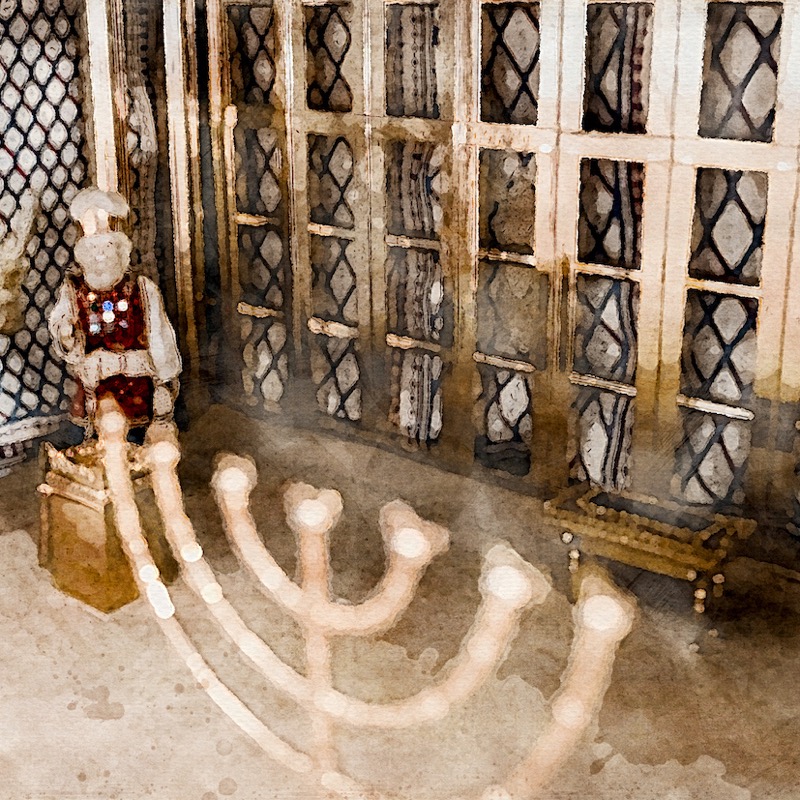
Just allow me to say how deeply grateful I am to you for joining us here this weekend and making it such a pleasure to study the tabernacle with you. Thank you, so many of you have come from such long distances to be present with us, and all of you have sat unconscionably long hours in order to join in these studies. I know it has been crazy to try and pack so much into so little a time. If you never do anything crazy for Christ, you're liable to do nothing at all. Let your excess of endurance and zeal in learning about the Lord be a testimony to all who hear of it that there are great riches in God's word. If, in fact, Clint had arranged for a whole barrel full of gold to be here, I tell you the people would have been here at one minute past twelve in the morning until twelve o'clock at night. And they wouldn't have thought it crazy to have been here so long. But thank you for your powers of endurance. The anguish that your lower members have endured sitting on the seats has at least not come through to your faces, and you've made it look as if you found it easy to sit so long. Thank you very much, and let us begin to read for our final study the book of Exodus, chapter uh twenty six. Exodus twenty six verse fifteen: and thou shalt make the boards for the tabernacle. But as you will see from our model and from the overhead films, the objects here described were not really solid boards at all, but frames. The word that is in many translations translated tenon, verse seventeen, two tenons, yadot in Hebrew, can of course mean a tenon if it wants to. It can also mean a long strut. And what the Hebrew is saying, as far as I can make out, is that there shall be, you'll see, the frames for the tabernacle of acacia wood standing up. They shall be made of two struts, the bottom of which are placed in two sockets of silver. They are then joined together like a ladder. More than that, I do not say now, for time's sake. Those of you who are interested in it, and in particular those who hold a contrary view and would like to discuss it, the one to discuss it with is my brother sitting here below. He is the great expert on these matters. Trouble him with your inquiries and criticisms. So let us read, but I'm so used to reading from the King James that I shall lapse into calling these things boards, even when I should call them frames. You will of your mercy pardon me. Thou shalt make the frames for the tabernacle of acacia wood standing up. Ten cubits shall be the length of a frame, and a cubit into half the breadth of each frame. Two struts there shall be in each frame, joined one to another. Thus shalt thou make for all the frames of the tabernacle. And thou shalt make the frames for the tabernacle, twenty frames for the south side southward. And thou shalt make forty sockets of silver under the twenty frames, two sockets under one frame for its two struts, and two sockets under another frame for its two struts. And for the second side of the tabernacle, on the north side, twenty frames, and there forty sockets of silver, two sockets under one frame and two sockets under another frame. And for the hind part of the tabernacle westward, thou shalt make six frames, and two frames shalt thou make for the corners of the tabernacle in the hind apart. And they shall be doubled beneath, and in like manner they shall be entire unto the top thereof, unto one ring. Thus shall it be for them both. They shall be for the two corners. And there shall be eight frames and their sockets of silver, sixteen sockets, two sockets under one frame and two sockets under another frame. And thou shalt make bars of acacia wood, five for the frames of the one side of the tabernacle, and five bars for the frames of the other side of the tabernacle, and five bars for the frames of the side of the tabernacle for the hind part westward. And the middle bar in the midst of the frames shall pass through from end to end. And thou shalt overlay the frames with gold, and make their rings of gold for places for the bars, and thou shalt overlay the bars with gold. And thou shalt rear up the tabernacle according to the fashion thereof which has been showed thee in the mount. The Lord give us good understanding of his holy word. Last night, and to some extent this morning, we were considering together the dwelling place of God, that is the tabernacle of the Lord, formed of the ten linen curtains, beautifully colored and embroidered symbolically with the cherubim. These These tur- curtains we saw, technically speaking, were the tabernacle. They were the dwelling place of God. Now we come in our last study to think of the frames which God provided to hold up the tabernacle so that the ten tabernacle, uh, frames could achieve their objective in forming a practical dwelling place of God on the earth. And that, of course, they did, uh, splendidly because they were open ladder-like frames. And they not only held the curtain in place to form a, a, a dwelling place, but as you will see here, and as you will see if we look again at, uh, one of the films, they gave expression to the delightful colors and artistry of the dwelling place of God. Because being open ladder-like frames, they permitted the beautiful colors and the symbolic cherubim to appear through. It must have been a delightful aesthetic pleasure for the priests who were allowed to minister inside, to see those lovely colors illumined in the soft light of the olive oil lampstands. And not only, of course, an aesthetic delight, but also a means of conveying spiritual truth to them, even in those far off days. It would have taken them no difficulty at all to see, would it, as the priests entered into the holy place with all these cherubim around them, the living ones, as Ezekiel called them, that the God they served was no mere dead idol. This was the house of the living God. Every wit of it spoke of life in all its forms. It was a characteristic of Elijah and Elisha, was it not? Though perhaps they never went near the temple at Jerusalem, but lived in the enjoyment of what that temple symbolized, that constantly they will refer to themselves thus, I tell you this in the name of the living God before whom I stand. And of course, when we come to the New Testament, and Paul takes to writing to Timothy about behavior in the house of God, he says this, these things I write hoping to come to thee shortly, but if I tarry that thou mayest know how men ought to behave themselves in the house of God, which is the church of the living God. God is no dead idol today either, and he has his ideas on life. And of course, when we form part of his house, he lays down direction for our lifestyle, and particularly for the lifestyle of the bishops and the deacons who minister in the house of God responsibly. Their lifestyle has to match the lifestyle and the life of God, thus in the tabernacle symbolized in those cherubim. So now this afternoon we are to read of the frames that were provided in order to give expression and function to the ten curtains that form the tabernacle. And it conveys a straightforward lesson to us, does it not? When we were considering the ten curtains of the tabernacle, we pointed out to one another, did we not, how beautifully they symbolize the present dwelling place of God, that delightful unity made up of a plurality, that they, being many curtains, ten curtains no less, were so joined together that they made one tabernacle. And that unity to which these curtains point is a blessed fact, is it not? It is. It is not something that we have to contrive or to try to make up. There is one body. You don't have to make it. It exists. There is one body, and it is the fact, the glorious fact, that every true believer in the Lord Jesus Christ is a member of that one body, and thank God nothing can in- uh, undo it. All the same, that glorious spiritual fact of the unity of the body of Christ has to be given practical expression, doesn't it? By itself, it is a spiritual truth, but it is God's goodwill and intention that we should, as believers, give practical expression to the glorious spiritual unity that God has created. And that, my brethren and sisters, is not quite such an easy thing, is it? At least the record of Christendom is all down the centuries that it has proved remarkably difficult. Oh, for the shame of our scandal, the shattering of the unity of the body of Christ into ten thousand times ten thousand little pieces. Where can we find direction, practical direction, that will help us give practical expression to the unity of the body of Christ? I speak, I trust, this afternoon in consciousness of the seriousness of the problem. We must not grow cynical, may we, nor must we give way to despair. We must speak humbly in the face of reality. What then was God's provision for giving expression to this spiritual reality of unity. And the answer is that he ordered that they should make frames for the tabernacle. That is, frames to uphold the ten linen curtains, frames for the tabernacle. I shall make these frames for the tabernacle of acacia wood, standing up. That was, of course, a good thing to do for a frame, wasn't it? How on earth would they give an expression to the curtains if they'd have laid down? Which is a small point, but reminds us there is no place in the assembly of the Lord for people who want to lay down and go to sleep. Thou shalt make frames with the tabernacle standing up. Praise God, standing up, yes. And though we have to phys- fit to sit physically because of my our advanced age, yet my brothers and sisters, spiritually and in spirit, we stand up, don't we? In order to give expression to these glorious spiritual realities. But thereby hangs a problem, of course. How do you get friends fifteen feet high to stand up straight without wavering. Not only stand up, for that was only a small part of the problem, to stand up in the presence of God in the holy place. What was even more severe a test, to stand up in the very holiest of all. How did you get them to stand? That is a practical problem for us too, isn't it? To stand up in the presence of God, firm, solid, without wavering. To do it here on earth is wonderful. I remind you that one day you'll have to stand in the immediate presence of the eternal God and form him a tabernacle. So says the revelation. There will be no innermost shrine in that tabernacle, for the Lord God and the Lamb are the innermost shrine, and they who stand to form his tabernacle will stand in the immediate presence of the eternal Shekinah glory. Oh, how shall I, whose native sphere is dark, whose mind is dim, before the ineffable appear, and on my naked spirit bear that uncreated beam. How shall I stand? The answer, as we know, was that God ordered that these frames should be provided with two silver sockets. And you see them in this technical drawing. There they are, there are frames here, here go the silver sockets all the way round. The two struts of each frame are standing, one each, in the sockets. One socket under one strut, one socket under another strut. So each frame stood in two solid sockets of silver. Of course, that reduced, uh, lowered their point of gravity, didn't it? Their center of gravity, and got them sort of, uh, solid here at the bottom, you'll see. Other things were needed, but this was a beginning. So from the practical point of view, it was the weight of those sockets that was valuable. But of course, symbolically, they had another significance. We are told in a later chapter where the silver came from to make those sockets. It tells us in Exodus thirty that when the males of Israel came to have their names enrolled in the census lists, they had to pay each one a ransom for their soul. Life being forfeit, it must be redeemed if it were to continue by the paying of the half shekel of ransom silver. All those half shekels of silver were collected, melted down, of course, and made into sockets, among other things, for helping the frames to stand. It tells its own spiritual lesson, doesn't it? As a shadow of the good things to come, it points to the basis we have for standing in the presence of God now and standing in the presence of God in the age to come. We stand on redemption ground. We stand not in nature, we stand not in natural soil, we stand solely and altogether on the precious blood of our redeeming Lord. We have redemption, if you would feel the weight of the sockets under your feet this afternoon, my brother and sister, if you're feeling just a little bit unsteady after lunch and you want to feel the weight under your spiritual. Oh, remember this, that you have redemption in his blood. Whose blood? In his blood, who is the transcendent Lord of all the universes, for they were made in him and through him and for him, and he is before all things. You have redemption in his blood. A little practical matter calls for our attention. You'll notice that in each frame there were two socket, there were two struts. Now, the strut on the left, it had to be in silver. Ah. What, pray, was the other strut in? You say, I don't get that. I mean, you're being stupid again, aren't you? Um, well, perhaps. You say, silver, of course. Oh yes, but not quite the off course, my brother. At least there are a lot of people that haven't grasped it, have they? That not only one foot, but both feet had to be in the silver. I remember being asked to meet a certain gentleman once d- uh, one day, and he was a good believer, so I found out, though he was muddled up with a very curious Christ- uh, so-called cult. And I was asking him, uh, did he have assurance of salvation? And he said, well, up to the present. I said, well, what about the future? Oh, well, no, he said, you can't be sure of salvation in the future. You can be sure up to the present, but not in, uh, for the future. Oh, I said, that's very. I said, um, uh, tell me, uh, what are you relying upon for salvation? Oh, he said, the the work of Christ, my good brother, the precious blood of Christ. I said, that's excellent. But why can't you be sure of salvation? Ah, he says, there's always my r- my wretched evil flesh. Oh, I said, I see. You've got one foot on the blood of Christ, and you're absolutely sure that won't let you down, and the other foot is on your nasty flesh, and you have a strong feeling that that will let you down. Agree with you? If we would learn to stand in the presence of God, it's one foot on the silver and the other foot on the silver, of course. On Christ, the solid rock, I stand, all other ground is sinking sand. Yes, but let us mark the point that every frame that stood shoulder to shoulder to form God his dwelling place, every frame had to stand on a s- two sockets of silver. You couldn't have the situation where five or six frames were standing on the silver, and then one or two frames were standing on the ground. Wouldn't do, would it? Nor will it do in your church either, if you can help it. All the weakness that has come to Christian churches that have not been careful in this thing, and have admitted to membership of the church people who are not standing on the silver. Charming people, lovely people, trying to be believers, but not yet redeemed. Not yet born again. Not yet having personally learned what it is to believe the Savior. They stand in nature's ground still. They do not stand upon the silver. The result is that inevitably they prove a weakness in the church, and they drag the testimony of the church down, don't they? We must be kindly firm, and as far as it is given to us to do it, to be sure that the members of the church are people that have been genuinely born again. But not only were the individual frames provided with sockets, then came the questions, large, big, difficult questions, of how you would persuade about forty-eight boards to stand, frames to stand shoulder by shoulder. Joel say, no, no, the first one, Joe. Ha. Boards will be boards, won't they? I mean, boys will be boys, and boards will be boards, and frames will be frames. Ha ha ha. And if it was a question of just standing alone by yourself, you'd be excellent, wouldn't you? But you try the problem of getting alongside of your fellow believer and standing, you know, not higgledy piggledy, but in order. One chap will say you have to stand over here. No, no, no, says the other chap. It's got to be over here. Ah. One says this line ought to go over there, one says it ought to go over here. One leans in and the other leans out, don't they? One makes it too broad and the other makes it too narrow. Eh, what eggly pigly you get, don't you? And has God made no provision for that either? As far as I can see in this, in this, uh, tabernacle, he had two answers to the problem. The one was that in the back part, in the two corners, there were... a technical drawing, please. There were two corner frames, two corner boards. Now, you probably cannot see it from where you sit, and as far as the technicalities of reproducing the tabernacle are concerned, the experts all merrily disagree among themselves, so never mind them. As I say, if you have problems about it, do come up and speak to my brother, and he will argue the case with you at great length, why we have chosen this particular, uh, interpretation of the thing. But anyway, in our reconstruction, there are two, uh, corner frames, one here and one there. They are aimed at giving the structure rigidity, of course, and firmness, so it didn't wobble. And they, of course, controlled at that end the precise angle of the building. When we come to the New Testament, we do not read of corner frames, do we? For the obvious reason. But we read of a counterpart to that. For the New Testament talks of us as a temple of the Lord, using the analogy of the stone-built temples of the ancient world. And it says that in one Peter two, in fact, it says it, that our blessed Lord performs the function for us not of a chief corner frame, but of a chief corner stone. And if you would like to know what a cornerstone is, then get you to Jerusalem, go down to the southeast corner of the Temple Mount and have a look at the dig that Brian Marzar did over several years. And if you hire yourself a guide, get them to show you the cornerstones in the Temple Mount. Massive, enormous stones. You'll see. Uh, they set the angle, they took the weight of the building. And Peter uses that as an analogy, doesn't he, when he says in one Peter chapter two verse four, unto whom coming a living stone rejected indeed of men, but with God elect precious, ye also as living stones are built up, a spiritual house to be a holy sacrifice, acceptable to God through Jesus Christ, because it is contained in scripture, behold, I lay in Zion a chief cornerstone, elect pressures, and he that believeth on him shall not be put to shame. Mark then the function of the chief cornerstone. This wasn't the capstone, this was the foundation stone that held the weight and gave the angle to the corner of the building. And Peter is discussing how God proposes to achieve his objective, that we are to be built as together as a spiritual house to offer up spiritual sacrifices acceptable to God through Jesus Christ. We pick up immediately the objective, not merely to offer sacrifices. It is number one necessity that our sacrifices must be acceptable to God, mustn't they? Why, all the gentlemen present know that. Ha ha. Comes wife's birthday tomorrow, you'll see. And the gentleman says, now, my dear, it's your birthday tomorrow. I've managed miraculously to remember it. What would you like for your birthday? Would you like daffodils, or would you like a bar of chocolate? The wife says, well, I would like daffodils, do you see? Comes the next morning of the birthday, and down comes husband with his present for his wife. When he's kissed her, he brings it out behind his back, and it's a large bar of chocolate. Oh, she says, thank you, my dear, but um, weren't there any daffodils around? Oh yes, there were daffodils. But you brought me chocolate. Yes, I know, he says, but I like chocolate. You wouldn't dare do it, gentlemen, I tell you now. It's a question of giving a present to your wife. Number one consideration has got to be, and if you haven't learned it in sixty years, learn it now. You must consult what she likes, not what you like. And when it comes to our worship of the Lord, what will the criterion be? But I like it that way. Well, what, so what if you do? When was that the criterion? The criterion is what God likes. We are to offer him spiritual sacrifices acceptable to God. The higgledy-piggledy of our churches is very often because we have failed to observe the point, and we have organized things as we like them, as they appeal to us, and have not primarily consulted God's tastes in the matter. And how may I determine what God likes? Where says God, now I'm supposed to build a temple. Now here, ladies and gentlemen, is the chief cornerstone, says he. I put it down, I lay it in Zion. And all the other stones that are going to be built up into my house have got to be built on and around this chief corner stone. So God laid the stone down, you see, and the Pharisees came and had a look at it. And they stroked their pharisaical beards, and they said, you know, I don't like that stone very much. I mean, all this talk about being born again, this is very unpleasant stuff, unpalatable, you. Raving around people must be born again. We think that's rather narrow-minded, you'll say. We don't like that. And as for that John the Baptist fellow, well, he's impossible. And so they rejected the chief cornerstone. In fact, they crucified him. Went back to their own temple to worship God, and God said, thank you very much, but if you don't want my chief cornerstone, I don't want your temple. And in AD seventy, he allowed the Romans to destroy it. Because God's temple has got to be built around the chief cornerstone, and says Peter, to whom coming, you also are built up living stones. What do you mean, Peter, you also? Well, he said, I came, didn't I? I came to Christ, the chief cornerstone. He changed me somewhat. And now you come. I came to Christ, and all I was was Simon, you know. And he said to me when I came to him, you shall be Cephas, that is interpretat- interpreted a stone. He made me a living stone in his temple. You come. You also are built up living stone. That is the beginning. We must be made into living stones, mustn't we? Of course we must. Temples made of ordinary stone, uh, can be interesting, Gothic cathedrals in Europe and things like that, you know. Uh, if you go in them on your holidays to Britain, I don't know if you do or you don't, well, never mind, but if you should go in, oh, you say to yourself, what stories these stones could tell, if only they could speak. But dear old stones, they can't speak. They're the same today as they were, oh, five, ten centuries ago. No good going up to one of them and tapping it and saying, stone, tell me what you know about the Lord. No. The beauty of a living stone is you can go up to that and knock it in the ribs and say, tell me, old stone, uh, tell me what you know about the Lord. And the stone can speak, can't it? Yeah? Lovely. Gonna be marvelous getting home. I'm looking, uh, to the occasion after I have re- paid my worshipful respects to the Lord, of course, or why I'm going around some of these living stones. And I'm going to say, now tell me, you've got five minutes, because we got all eternity, so five minutes isn't long. Lend me find minutes and tell me about your experience of the Lord. Oh, I'm looking forward to it. Sarah, for instance, she'll have some story to tell, I'm sure. And as for that dear old Dorcas, yeah, what will it be to dwell above? And here the story of redeeming grace told ten by ten million times ten millions and thousands of thousands of the living experience of a living Lord. But notice the participle is in the present, won't you? It's not to whom having come, but to whom coming. We need constantly to come, as Peter found out. He came the first time and was changed, wasn't he? From being simply Simon, he became Peter. But there were various other times when he found himself coming to the living stone. And when he came, he thought the stone was a bit odd, not quite right in all its parts, in all its parts, and he proceeded to correct the stone, you know, didn't he? You remember, for instance, when the Lord said that he must go up to Jerusalem and be rejected of the chief priests and be killed and crucified. Oh no, no, says Peter, you've got that bit wrong. Do allow me to tell you, Lord, you that that that bit now you've got wrong, you see. You're not going to be rejected. That's that's unfortunate to think that way round. No, no, no, you're not going to be rejected. You're going to be very successful. So Peter wasn't fitting onto the stone very well, was he? And who had to change? What do you say? Peter had to change. That's what it was. I don't know whether a tear fell on the old page when he wrote it down, the very same word, to whom coming as a living stone, rejected. He'd learned his message now, hadn't he? Tell me, why is it that our Lord had to be rejected? Well, it wasn't because God was being contrary, was it? It was because the scripture puts it in the name of God. My thoughts are not your thoughts, neither are my ways your ways, saith the Lord, as high as the heaven is above the earth, so are my thoughts higher than your thoughts, and my thoughts than my ways than your ways. It stands almost by definition that God thinks differently from what we do, and we shall find that we constantly have to be adjusted. To whom constantly coming, we shall constantly find he's different from what we thought, and we shall have to change and be adjusted to him. Wasn't merely a question then. That was one important answer to the problem of getting the boards to stand at the proper angle and so forth, and with the proper firmness. There was a second practical problem, or a third, and that was, how did you get the frames to stand then from the corner to here to the front, and again from the corner to the front and along the back? How did you get the frames to stand up in orderly fashion, side by side, without some leaning in and some leaning out? You know, it's a trouble with frames. The chap that leans in, he thinks he's straight. And then when he looks at the chap who's leaning out, he thinks he's straight as well, but there's about virtually ninety degrees between them, you see. They both think they're straight, you see. That's the trouble. Ha. How do you get them standing kind of shoulder to shoulder and up straight? And what standard would you use to measure it with, to determine what is straight? The answer, of course, that God provided, as you well know, with the tabernacle frames was as follows. There are a few Levites, I can't tell you their particular names, but there they are, and they're in process of erecting the frames. And you see what, uh, has been done. Each frame has been provided with a number of rings. And then there are a number of bars, and the frames are being shunted down through the bars, you see, like that. Each frame for itself has got to consent to the bar going through its rings, you see. Each frame has got to get hold of the bar here, and the bar here, and the bar there. It's very much an individual matter, as you perceive, for each frame to do, but lo and behold, as each frame consents to the bar being put through its ring, hey presto, it looks around and find a lot of other bars, other frames that have got hold of the bars. And since they've all got hold of the same bars, they stand equally side by side. Simple device, wasn't it? Nice more difficult thing to apply it because, how shall we seem not to be dealing lightly with an exceedingly grievous problem? Is there really some answer to the problem of creating practical Christian unity? Or has God here left us to our own devices? It seems to me that far from leaving us to our own devices, the risen Lord has indeed made provision, and that provision is discussed in the Epistle to the Ephesians chapter four. In the early part of that chapter, Paul talks about the unity, the spiritual unity that already exists. It doesn't have to be made. Ephesians chapter four, He says, you'll see, verse three, given dili- giving diligence to keep the unity of the Spirit in the bond of peace, because there is one body, one spirit, one hope of your calling, one Lord, one faith, one baptism, one God and Father of all. This is the unity that already exists. It is, as you see, not quite unity, but oneness. There is only one God. Don't you go and make two. There is only one Lord. Pray don't go and make two, will you? And there is only one baptism, don't go and make two. Yes? Tell me, my brothers, uh, what were you baptize- in what name were you baptized? Oh, so baptized in the name of the Lord Jesus, the Father, the Son, and the Holy Ghost. You were really? Weren't you baptized in the name of the Christian brethren? No, no, you say, of course not. No? Well, perhaps you were baptized in the name of the Lord Jesus and the Christian brethren. No, no, you say, don't talk so foolishly, don't man. That's almost a blasphemy. Was Paul baptized for you? Peter baptized for you? Wesley baptized for you? Crucified for you? Dead and buried for you? Of course not, and you wouldn't dream of being baptized in the name of Wesley, would you? Or Darby? Or Paul? Or the Christian brethren? There is only one baptism, and thanks be to God, in spite of all the divisions of Christendom, I've never yet heard of any Christian that was baptized into any other name, have you, than Jesus Christ our Lord? But I've heard of millions of Christians who, on their notice board outside their church, put names galore. You come to Belfast, and of a quiet Saturday night when the traffic is gone, go round and look at the church notice boards. The last name on them you'll see is Christ. You'll find every other name under the sun on the notice boards, and some carry the name Christian Brethren. Yes? By what right do you dare call yourself by any other name than Christ? There is one Lord. Why must we advertise it to the world? Yes, we're Christians, but not like those down the road. Please notice we're different. There is one Lord, one faith, one baptism. Keep it that way. There is another sense, of course, in which the unity does not yet exist, or only in part. And so we read in the later verses that our blessed Lord has ascended up on high. He has given gifts for the perfecting of the saints unto the work of ministering, unto the building up of the body of Christ, till we all attain unto the unity of the faith. So here is a unity to which we have not yet attained. It is here called the unity of the faith. It is the fact, isn't it, that not all believers believe exactly the same thing. I suspect if we took a questionnaire around the room today, even here, there would be some points of doctrine, wouldn't there? Not fundamental ones, I trust, but some points of doctrine on which we don't yet agree. You certainly wouldn't agree with me in everything, I'm sure. But we mustn't become cynical. Our risen Lord has made provision for us that one day we shall all attain to believing exactly the same thing. You say, so that will be paradise. Well, that's precisely so. It will be paradise. The living risen Lord is working to that end, is he not? Till we come to that glorious day when all of us believe exactly the same thing. Until then, we must be patient and grow. No longer be children tossed around with every wind of doctrine, but grow. And for that purpose, the risen Lord has made provision by giving gifts to his church, and Paul lists them. There are pastors and evangelists, there are apostles and prophets, you'll see. There are teachers. And how it happens is this. Out goes the evangelist through the length and breadth of Pels- Pennsylvania, you'll see, and he preaches the gospel. And somebody here hears the gospel, how he needs to repent and believe, and he accepts the message. He's got hold of the bar of the evangelist, hasn't he, if you see what I mean. Some other dear lady down the road, around the corner in the next house painted green, she hears the evangelist, uh, she hears the word of God, she repents, she trusts the Savior, she receives the gospel message, and she gets hold of it and discovers that now she's standing by the side of her neighbor around the corner. They got hold of the same bar, haven't they? Synagogue, I say it again. The sine qua non is this basic demand. You must be born again. We don't surrender it. Christendom may have in the interest of getting large churches, but they who care for God's dwelling place will insist on the basic necessity that men and women be born again. And it can happen, can't it? Oh, what myriads of triumphs God has achieved to bring multi-millions into unity of the faith on this thing, that they have believed the gospel, and they have been born again. Oh, it started, my brothers and sisters. This is not imagination, this is sheer practice. Ah, but after that, there are other bars along that the, the frames had to get hold of. So our God has given us apostles and prophets of the New Testament day, authoritatively to lay down the word of God, to define the gospel, to define the doctrine of the church. It is ours, isn't it, to submit to what they say. It's not a question of my interfering in your assembly, surely not. I have no jurisdiction there, nor you in mine. We don't belong to a confederacy, do we? With you at the top or somebody else as our pope. We are independent local churches, yes? But in my local church, I must be concerned to bow to what the apostles say. And when it is necessary, they say it, don't they? You listen to Paul. Behold, I, Paul, say to you. Yes, he was an apostle. None of this saying, oh, that's only Paul said that. I, Paul, say unto you. For to receive an apostle is to receive the Lord, and to reject what an apostle says is to reject what the Lord says. If any man thinks himself to be spiritual, says Paul, let him recognize that the things I write are the commandments of the Lord. Let me submit to the apostles, accept the bar of their teaching and authority, and you submit. And bit by bit, we're coming closer together, aren't we? And there are the teachers that God has given to expound what the apostles and the prophets say. And there are the pastors to keep coming round, you know, in their gracious manner, aren't they gracious? I hope your elders are gracious. And I hope they do come round, actually. You know what? You won't split on me if I tell it to you, will you? I'm older than you think, and never yet have I had any elder come to visit me to ask how I was getting on in the Lord. You imagine that? What has happened, my brother, to the concept of eldership? I could really do with an elder now and again, you know, coming around and say, gooding, you're a bit out of line there, and kicking in the bottom of my frame, kidding me a bit, and giving me a tug at the top, you know, shunting me. I give it as my opinion in many countries that I've visited. God be praised for my elders. I'm not complaining. I have some lovely elders in Belfast. What delightful men they are, and what hospitality they've shown this wizened old bachelor all down the years. What immense kindness. I give it as my opinion that one of the biggest weaknesses in assemblies around the world is this, the lack of the actual practice of eldership. God help our elders. This is a difficult task as they come around us and frame by frame make sure that we're submitted, we have submitted to the gospel, we have submitted to the apostles, we have submitted to the elders and the pastors and the teachers. And of course, supremely, we submit, surely, to the risen Lord among us. Though, as Ephesians now admits, we shall not be perfect in the day, shall we? And with the very best of intentions, and trying to expound and understand scriptures as we should, the most godly people find that from this point and that point, they disagree among themselves. God's own word indicates it. This is a unity that we must have as a goal. We cannot demand on its complete fulfillment here, this side of glory. We're growing towards it. God give us the grace to persevere. My brother, do you believe exactly as I believe on prophecy? I don't know because I've never asked you. But if you should find I don't, I hope you wouldn't cast me out. I do stand on the silver. We are to receive one another, not on the ground of our prophetic teaching. We are to receive one another as God also has received us. And he's received even me, my brother. God give you the grace to receive me likewise. For I do want to grow up to Christ. Where I'm wrong in my doctrine, I don't want to be wrong. And I shall need your patience while you teach me better. And finally, to achieve unity, God said that they were to take these frames that started off as bits of wood, and they were to overlay them with gold. Everyone at the bars, all the frames, all overlaid with gold. So in that respect, they were all alike. That must have been a very wealthy looking thing, mustn't it? Dazzling in its gold. You think of the expense of it. The gold on these frames, the gold on the bars, the silver of the sockets. And then it all fades as we listen to the Lord Jesus say to his father, and the glory thou hast given me, I have given them that they may be one. I in them and thou in me, that they may be perfected into one. You must look beyond my crotchety old personality, my gnarled bits of knots in the oak of my character. You must begin to recognize the sheer wonder of this, that the living Lord who is in you, that living Lord is in me. Glory thou has given me, I have given them, that they all may be one, even as we are one. The Lord bless his word. Give us responsible understanding of it and sympathetic application of it to the greater glory of his name and the more effective testimony of our witness in the world. We feel, Lord, a little bit like the Queen of Sheba, that thy glories are so immense that there is no spirit left in us. As we go, we praise thee that as the m- the emotion of friendship and our fellowship together departs, we face the world outside, the continued practicalities of thy work, the difficulties of assembly life, that thou wilt show to us that these glorious things that we have thought about, these are actually unfading realities. Our grasp of them sometimes fades. We thank thee the realities remain. As we can bear it, constantly bring them before our soul's vision, we beseech thee. And as we ponder the immense expense that has been given for our redemption and for our glorification and beautification, God, give us humble, teachable hearts, we do beseech thee. Rigorous to understand thy word by the help of thy spirit of our elders and the apostles and our pastors and teachers. And grace to carry out thy word in humble obedience, love for all thy people, and bright burning hope for the day of consummation, when we shall be gathered together to the Lord, and the great and eternal tabernacle shall be erected in all its glory and its perfect beauty. For thy name's sake. Amen.