Gooding, David: 3 - Peeling Back the Curtain on Reality
ID mfh_1087262044Date unavailableBefore 3.09Restored 4.57
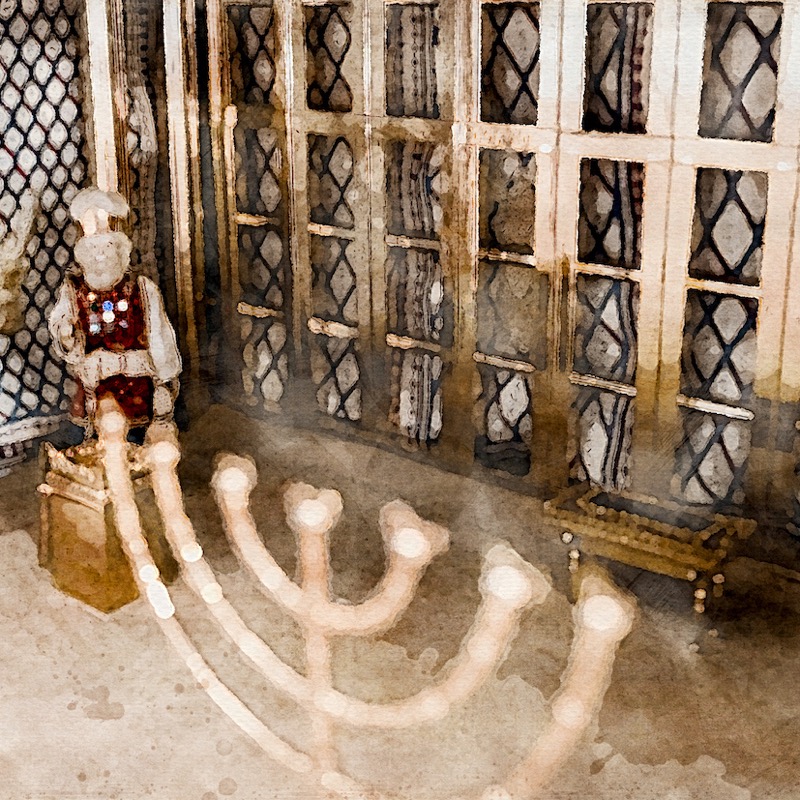
Tonight we move on to consider the second vessel in the court that lies on the way of approach in from the outside towards the most holy presence of God. So we moved in by the gate, and we came in our last talk to the altar. Now we move on to the laver that stands here in the film and in the model here. You may care to be looking at it as we read also appropriate passages of scripture, beginning in Exodus chapter thirty. Exodus chapter thirty, reading there verses seventeen to twenty one. And the Lord spake unto Moses, saying, Thou shalt also make a laver of copper, and the base thereof of copper, to wash withal. And thou shalt put it between the tent of meeting and the altar, and shalt put water therein. And Aaron and his sons shall wash their hands and their feet thereat. When they go into the tent of meeting, they shall wash with water that they die not. Or when they come near to the altar to minister, to burn an offering made by fire unto the Lord, so they shall wash their hands and their feet that they die not. And it shall be a statute forever to them, even to him and to his seed throughout their generations. Chapter thirty eight and verse eight. Thirty eight verse eight. and he made the laver of copper and the base thereof of copper of the mirrors of the serving women which served at the door of the tent of meeting. Chapter forty, verses six and seven. And thou shalt set the altar of burnt offering before the door of the tabernacle of the tent of meeting, and thou shalt set the laver between the tent of meeting and the altar, and shall put water therein. And finally, going backwards to chapter twenty nine, chapter twenty nine of Exodus, let us read verse one and then verse four. And this is the thing that thou shalt do unto them, to hallow them, to minister unto me in the priest's office. Take one young bullock and two rams without blemish. Verse 4. And Aaron and his sons shalt thou bring unto the door of the tent of meeting, and shalt wash them with water. Our first then, go back to the court. Our first there task then tonight is to, the court please, to observe that in the court of the tabernacle there stood not one vessel, but two. That is an exceedingly elementary observation to make, but I ask you nonetheless to make it. In the court of the tabernacle there stood not one vessel, but two. First the altar and then the laver. And in this model here, as you'll see, first the altar here, the big altar standing first, and then the copper laver. Two vessels, not one. Then shall we notice that both those vessels in Israel's time were concerned with the matter of cleaning. At the altar, there was provided cleansing by blood. At the laver, there was provided cleansing by water. That simple fact ought to be enough to jog our Christian thinking. If in Israel they had cleansing both by blood and by water, how is it with us in Christianity? Do we have both cleansing by blood and cleansing by water? And the answer to it is, of course, a definite yes, of course we do. We have cleansing by blood. The famous verse in one John chapter one reminds us. Here it is, one John seven: But if we walk in the light as he is in the light, we have fellowship one with another, and the blood of Jesus Christ, God's son, cleanses us from all sin or from all unrighteousness. So we in Christianity have cleansing by blood. But then, of course, we have cleansing by water too, don't we? And here a stock verse would be Ephesians chapter five and verse, um, twenty five. Husbands, love your wives, even as Christ also loved the church and gave himself up for her, that he might sanctify her, having cleansed her by the washing of water with the word, that he might present the church to himself a glorious church, not having spot or wrinkle or any such thing, but that she should be holy and without blemish. So he cleanses the church, we are told, by the washing of water. So the tabernacle then has already done us a little service, hasn't it? In jogging our Christian minds to think about our own Christian salvation, and to remind us thereby that in Christianity we are provided with a double cleansing. There is cleansing by blood, and there is cleansing by water. And it leads to the elementary question: why do we need two types of cleansing? Why is it not enough to have the cleansing by the blood of Christ and simply to rest in the glorious fact, for fact it is, that the blood of Jesus Christ, God's son, cleanses us from all sin. Why must we go on and have cleansing by water? That could lead us profitably, could it not, to ask, well, let's think for a moment. The blood of Jesus Christ cleanses us from all sin. But what do you mean it cleanses us from sin? And how does it cleanse us from sin? I speak with all reverence, I trust, but you ladies, if you get a spot of grease upon your evening gown, you get some kind of detergent or dry cleaning to rub upon the spot and remove it. Is that how the blood of Christ acts? As a kind of spiritual detergent to rub out the guilt of our sin and thus cleanse us? How does the blood of Christ cleanse? And what in particular does it cleanse? The answer is to be found, of course, in the straight words of Holy Scripture. Would you care to look at Hebrews chapter nine and vo- verse fourteen? Hebrews nine fourteen. For connection, let's read verse thirteen. For if the blood of goats and bulls and the ashes of a heifer sprinkling them that have been defiled sanctify unto the cleanness of the flesh, how much more shall the blood of Christ, who through the eternal spirit offered himself without blemish unto God, cleanse your conscience from dead works to serve the living God? And that verse tells us some very fundamental and important things. The blood of Christ cleanses the conscience, and it cleanses the conscience from dead works. How? Well, for the simple reason that when we sin against God, our conscience witnesses to us that we have done wrong. And it witnesses to the truth of God's holy law that every sin and disobedience ought to receive its righteous recompense of just reward. And if our conscience is regulated, therefore, by the holy law of God, our conscience will nag and witness and refuse to be silenced. For our conscience has been defiled by the guilt of sin. How can you cleanse a conscience from guilt? Why, says Holy Scripture, the blood of Jesus Christ cleanses our conscience from guilt? And pray, how does it cleanse them? Why, this simple way, though it is far from a simple thing. When I perceive that Christ bore my sin, and indeed that particular sin that has been worrying my conscience, and when I perceived he paid the penalty of God's law and paid all its sanctions, even for that particular sin, then my conscience is cleansed from guilt, and I am no longer afraid that I too shall have to suffer the sanctions of God's law for that sin? It's like it was in the days of the Passover, said God, when I see the blood, I will pass over you, and the blood shall be for you a token. That where the blood has been shed and put upon the lintel, the destroying angel of God shall never enter to destroy those who have fled for refuge. So the blood of Christ protects us, cleanses our guilty conscience by showing them that Christ has borne the penalty of God's law that was due to us. Blood cleanses conscience from guilt. Well, you say, if that is so, why do I need cleansing by water? And pray, what kind of thing is it that water cleanses? And, uh, how does it cleanse? The epistle to the Ephesians that we read just now is helpful in this regard, isn't it? It says this. Christ loved the church and gave himself for her that he might sanctify her, having cleansed her by the washing of water with the word, that he might present the church to himself, a glorious church, not having spot or wrinkle or any such thing, but that she should be holy and without blemish. And now you notice the difference in the terminology. It doesn't say that Christ cleanses the church by the washing of the water to wash away her guilt of sin. Nothing of the sort, does it? Or to cleanse her heart from dead works or something. No, it says something quite different. Christ applies the water to his church that he re- might remove what he here calls spots and blemishes and wrinkles and other such things. Permit the simple to use a simple illustration. There's a difference between guilt, isn't there, and wrinkles and spots and blemishes, as any husband knows. Suppose, sir, one day you come home from work and you find that your wife has prepared you an extraordinarily elaborate dinner, and it's beautiful. And when you devour the last course and are drinking your coffee and you're feeling in that lovely relaxed mood as the world is very pleasant. Your wife says suddenly, you know, I was out this afternoon. Were you, my dear? Yes, I was. And you know, I saw a friend down the road I hadn't seen for years. You say, that was lovely. Yes, she says, and while I was waving to her, you'll see, and I wasn't exactly looking where I was going, I ran your brand new Cadillac against the side of a lorry, and I dented the radiator and put an enormous great gas all the way from stem to stern. And you say, sir, were you hurt, my dear? Oh no, she says, I wasn't hurt. That's all that matters, you say. That Cadillac's only a junk bit of old iron anyway, so it doesn't matter. And then you add, but you shouldn't have done it, should you? Who's going to pay? I mean, I told you that before. Waving to people the other side of the road and not looking where you're going. And who's going to pay for it? Do you know how many thousand dollars that will take? And the dear wife, he says, oh, but I'm sorry, I didn't intend to. Then you say, well, ah, never mind, my dear, I forgive you, and I'll pay the debt myself. And assured by a great kiss upon the cheek that you have forgiven her guilt and paid the penalty and the cost. But suppose one morning she arrives down to breakfast, and over the bacon and eggs while you're reading the daily newspaper, or your muffins or whatever, you'll suddenly look over the top and see your wife, and she's developed a terrible great carbuncle upon her cheek. Oh, you say, my dear, whatever is that you've got upon your cheek? She said, oh, I've got a thing that's coming up. I should say you have, he says. You know, my dear, it quite spoils your beauty. What do you say next, sir? I have no experience of the people. Do you say, oh, but I forgive you, my dear, for having that carbuncle? Well, of course you don't say anything so silly. You don't forgive people for having carbuncles or wrinkles or any such thing, do you? It's not a matter of guilt. It is a matter of the old evil poison coming out, of course. And you see, to be serious, the blood of Christ cleanses us from the guilt of sin. That's not the only cleansing we need. Some of us show some rare specimens of carbuncles, don't we, in our behavior. They erupt, and they quite spoil our beauty, don't they? That ugly temper, that boiling over like Vesuvius, transforms us from reasonable people into unreasonable, grotesque fools. And that envy and that spite and that jealousy and that barbed tongue and that gossiping mind, that greed, that cowardice and uncleanness. Oh, what wrinkles and blots and blemishes there are in our characters and personality. Do we not clean- need clean- cleansing from them? You should be, suppose somebody does a mu- a murder here in America, and he has been sentenced to death and is lying in a cell on death row. And your president at length, in the nick of time, graciously extends to the criminal a pardon. And he comes out of prison. He is pardoned by the president and need not suffer the penalty of the law. Do you suppose he's fit to go and live in the White House with the president and the first lady forthwith and attend all their state banquets? Just being pardoned will not have removed his drug addiction, will it? His tendency to get drunk, his filthy habits, and his filthy mouth as well. Just being pardoned the guilt of sin doesn't fit him to sit at the table with the president, does it come now? And my brethren, we have to sit at a far more exalted table. Forgive my saying it as an Englishman. We have to sit down with the saints of all the ages, uh, of the ages, with our blessed Lord in his kingdom, where no sin or stain can enter, or the gold be dim. How shall we find cleansing from the spots and the blemishes? I am to notice, therefore, at this altar here in the tabernacle, there was in fact historically two types of cleansing. When the priests were first inducted, says Exodus chapter twenty nine, they were brought to the door of the tabernacle, and there they were bathed in water before their garments were then put on them. Now, I will confess to you at once that the text does not say that they were bathed at the laver, but they were bathed at the door, near the door here somewhere, in water, so I leave you to guess where they got the water from. Bathed all over, and then clad in their official garments. That happened simply when they were inducted. Thereafter, as ever they came to enter the holy place, they had to rinse hands and feet at this altar. So there was a double washing by water. That prompts our Christian mind to think also, doesn't it? Is it so that in Christianity there is a double cleansing by water, or only one? Now here I must tread tenderly, for otherwise I shall tread ungraciously on theological toes. Because many there are of serious students of the Word of God who have held that the once and for all cleansing offered us in Holy Scripture is by the blood of Christ. That cleansing by water is not a once and for all cleansing, but a repeated cleansing, and that there is no such thing as a once and for all cleansing by water in Christianity. With the greatest of respect for those who hold so, I want to argue the case that in Christianity there is both. There is a once and for all cleansing by water, and then there is a constantly repeated cleansing by water. And for my first authority in those matters, I refer you to the famous incident in John chapter thirteen, where at the supper, supper being now in process, our Lord got up, divested himself of his clothes, wrapped a towel around him, poured water into a basin, and began to rinse his disciples' feet. And you remember what happened? As he rinsed their feet, he came to Peter, who protested that the Lord should never wash his feet. Whereupon our Lord said, if I wash thee not, thou hast no part with me. Thereupon Peter, typically enough, went to the other extreme and said, well then, Lord, not my f- uh, feet only, but my hands and my head. And once more, our Lord had to correct his excess of enthusiasm. And he said as follows, he that has been bathed, that is all over, needs not save to rinse his feet, but is clean every bit. Well, now it is evident that the cleansing of the feet, the rinsing of the feet was done in water, wasn't it? Our Lord had just done it. But what about this once and for all bathing? He that has been bathed once and for all needs not after that except to rinse his feet, but is every bit clean. You say, Mr. Preacher, sir, it's about time you knew the once and for all bathing that our Lord talked about is bathing in blood, and the rinsing is by water. Well, that certainly would introduce into John thirteen a somewhat extraneous idea, wouldn't it? It was water cleansing that our Lord was talking about anyway. But we have a scripture that settles it, as far as I can see. We're looking now to ask ourselves, is there such a thing as a once and for all bathing in water in our Christian salvation? Read with me, will you please, Hebrews chapter ten. Hebrews chapter ten, And beginning at verse nineteen. we're on the lookout for any scripture reference to the possibility of there being a once and for all bathing in water. So we read, Hebrews ten nineteen: having therefore, brethren, boldness to enter into the holy place by the blood of Jesus, by the way which he dedicated for us, a new and a living way, through the veil, that is to say his flesh, and having a great priest over the house of God, let us draw near with a true heart in fullness of faith, having our hearts sprinkled from an evil conscience. Sprinkled with what? Well, we just learned that, haven't we? What is it that cleanse our, cleanses our conscience? You say the blood of Christ cleanses the conscience. And as in Old Testament, they sprinkled people with blood, not bathed them in blood ever in the Old Testament. So the New Testament, consistent in its terminology, says that our hearts have been sprinkled, that is, with the blood of Christ, from an evil conscience. And then, and our body bathed. And that's a very interesting word, for it's exactly the same word as our Lord uses in John thirteen. He who has been bathed. Bathed in what? The verse tells us, Hebrews ten verse twenty two, our body bathed, not rinsed, bathed all over with pure water. I submit to you, my brethren and sisters, that there is such a thing in Christianity as a once and for all bathing in water. And if I hadn't have been so inept as to raise it over the tabernacle, I should have found you believed it anyway, didn't you? Of course you did. For you preach with all your might and main, John chapter three, except a man be born of water, don't you, and of the spirit. What about that for a once and for all experience of water. Oh, but then listen with me, if you will, to Paul talking in his letter to Titus, where I would wish to submit one f- uh, further, we have a brilliant example of this once and for all bathing in water. He, uh, Titus, this is verse three, Chapter three, I mean, and verse one. Put them in mind, says Paul to Titus, to be in subjection to rulers, to authorities, to be obedient, to be ready unto every good work, to speak evil of no man, not to be contentious, to be gentle, showing all meekness towards all men. For we also were aforetime foolish, disobedient, deceived, serving divers lusts and pleasures, living in malice and envy, hateful, hating one another. What a ugly list of blots, blemishes, and wrinkles there were upon the characters of the Cre- of the Cretans. And how would they say? Let's read on. We also were like that, says, uh, Paul, but when the kindness of God our Savior and his love toward man appeared, not by works done in righteousness which we did ourselves, but according to his mercy he saved us. And how did he save us? You say through the blood of Christ. Well, that's true in its way, but that's not what he says here, is he? For he's talking about blots and blemishes and wrinkles, and not to talk about carbuncles. And he says, he saved us through the washing of regeneration and renewing performed by the Holy Spirit. Now notice the next metaphor, whom he poured out upon us. Through Jesus Christ, our Savior. And I submit to you, brethren, we here have here nothing strange. It is the other integral half of the gospel message, that in Christ's blood we have forgiveness and cleansing from the guilt of sin because he paid the penalty. But in the Holy Spirit, whom Christ gives to us, we have that once and for all basic cleansing that is regeneration. And what a gospel it is, isn't it? There is this radical renewal. It is important to remember when we are preaching the gospel to the unconverted, isn't it? It is not enough to get people having faith in Jesus for forgiveness and leave them with lives that are utterly unchanged, just to carry on in their worldliness and sin as they were before. You cannot enter the kingdom of God without this radical regeneration. Our Lord himself is witness thereto, isn't he? There is no such thing as coming to Jesus for forgiveness, being in the family and kingdom of God, and not yet regenerate. They go together. Here they are illustrated apart to help us see the double concept of salvation. In actual fact, we receive both together when we receive the Savior, don't we? But let's not preach it as though it were legalism. The gospel! Ah. Do you see, it's not merely that I am grateful for forgiveness and then do my best to be a Christian. But many people there are who conceive of Christianity like that, don't they? They look around and they would like to be Christian, so they say to themselves, now, now, now, now, what do Christians do? If I could do those things, I should become a Christian, perhaps. Well, Christians go to church, and Christians read the Bible, and Christians sing hymns, and, and righto, let me have a go. And they go to church and sing hymns and say a few prayers and attempt to read the Bible and be good and give some money to Oxfam. In the hope that if they do these things long enough, they will become Christians. I do remember a dear lady, after a lecture I gave once, coming up to me and getting me away from the crowd, and she opened her handbag, and I wondered what was coming, and she pulled out a card, and on the card was the prayer of Saint Francis of Assisi. It's a delightful prayer, isn't it? Where there's hatred, let me show love, and so forth. And she said, what do you think of that? I said, it's delightful, madam. Yes, she said. She said, I try to keep it. I said, yes. It's no good, though. Oh, I said, why is that? Well, she says, I managed to keep it for a couple of days, and I think I'm doing well, and then my husband comes home and does something a- a- annoying. I lose my temper and I ruin the whole lot, she said. She'll say, it's like taking one step forwards and two steps backwards. Trying to become a Christian by doing the things that Christians do. Oh, that's hideous bondage, isn't it? We have a gospel to preach. The God who knows that we not only have guilt of sin and has provided the blood for it, knows that we have wrinkles and blemishes and has his answer to it in a thing that is nothing less than the gospel. It could save and transform cretins. It can save and transform us. It is the regeneration performed by the Holy Spirit. You'll see, why has new life coupled with cleansing? Well, how would you cleanse a corpse? I mean, if you ever set about, have you ever tried cleansing a corpse? You open, uh, one of these mighty great sepulchres in the churchyard, and it's rather offensive, and you say, I better clean this place up. How would you do it? Wash the corpse or something? How would you cleanse his corpse? I wouldn't know how to do it. But you see, if you were to plant an acorn inside, wouldn't altogether improve the corpse, but presently there would spring up a new life, wouldn't there? Ah, that is our Savior's method, isn't it? Comes to us in our corruption, wrinkles, boils, carbuncles, and cancers. And the way he begins is to put a new life inside, and with that new life, the divine nature inside, as Saint Peter says in two Peter chapter one. And there begins a new life with new desires and new powers and new strengths. It doesn't mean that we're perfect at once, does it? But it means that the new life grows and begins to predominate. And we find then we have two powers within. We have that old flesh, but we have God's spirit, and the spirit desires against the flesh, and the flesh against the spirit. We have a new power within, and it is a glorious gospel to have to preach to men and women. We must preach it, though, mustn't we? For there is a danger if we forget it. Peter, in his second epistle, where he talks to us about this new divine nature that we have received, has his reasons for talking about it, because there were those in those Christian churches in that part of the earth were teaching the believers that it was all right to begin with faith in Christ, but then go on living like the world lives with divorce and immorality and what have you. Peter says that that is not true. These false teachers were absolute tools of the very devil, he says, and the darkness is reserved for them. The trouble was that they were unsettling the believers, and some of the believers were being carried away by their specious talking and falling from their steadfastness, and they needed to be brought back. And other people there were that were just beginning to escape the corruptions that were in the world through lust. When instead of going on and finding the Savior and finding regeneration, they heard these false teachers of permissiveness and went back to their unclean ways, thinking they had God's permission. And it has happened unto them, says Peter, as the old proverb has it, the sow that went to the baths. Now, to be sure, that's a funny proverb to find in Holy Scripture, isn't it? Did you ever hear the Greek proverb, the sow that went to the baths? It shows Peter had read something outside the Bible, any rate. For the Greeks had this proverb, and Peter borrows it from the Greeks. It's that delightful little parable, fable of the sow that went to the baths, because in the ancient Greek worlds, they didn't have baths or shower baths in their houses like you have, and ladies had to go down to the public baths to take their monthly bath. And this, uh, this, uh, sow had been watching the ladies go in, says the Greek fable, and watching them come out. You'll see they came out, oh, they did look beautiful. If they'd looked beautiful before, they look especially beautiful now, all pink and rosy, and diamonds are hanging from their ears and a beautiful new dress, as you'll see, and sandals, and walking up the street with that graceful manner that ladies do. And the old sow decided it would, it was, it would, it would, uh, behave like the ladies, you see. It worked it out in its little, uh, sow mind. And what you had to do, therefore, was to go to the bars, apparently. So down to the bars it went and got itself clean, and it came out all pink and beautiful, and the tail was curling. And then it had a diamond or two in its ears and one in the snout, do you see, and put on a beautiful dress. And it went up the street on its hind legs, walking as best it could, and to its satisfaction thought it had become a lady. Until, alas, it came across a huge puddle of mud. And forgetting all about being a lady, wallop it went into the mud and rolled in it and grunted its satisfaction. Why? Well, it had been washed outside. It had no change inside. It's like our Lord said, using the same final words, it was happened unto them, the last state was worse than the first. When an evil spirit goes out of a man, he says, it comes back and has a look, and should it find the house swept, decorated, but empty, goes and takes seven other spirits and comes back and dwells therein. The peril of outward moral reformation that stops short of divine regeneration. We must look to it in our churches, mustn't we? As far as it is given us for by God to do. That we preach the need and the glorious possibility of regeneration and a new life in God's Holy Spirit. The once and for all regeneration then, and it never needs to be repeated. And as compared with rinsing of hands and feet, of course, it is the far bigger operation, isn't it? We said our Lord to say, he that has once been bathed all over, well, the big thing has been achieved then, and he never needs to be bathed all over again. But of course, he does very sorely need constantly to allow the Lord Jesus to rinse his feet, or to use the Old Testament metaphor, his hands and his feet. For said our Lord, if I wash you not, if I don't rinse your hands and feet, Peter, you have no part with me. We'll see the sheer fact is that when we have been born again of the Holy Spirit, then have we received the life of God and the very nature of God. We still have that old ugly thing with us, don't we? And from time to time, provoked by the world, under the temptations of the devil or what have you, it will rise up and lead to actions that defile us. And we shall need to be cleansed. Indeed, more than that. It's not merely that we shall need, uh, to say, Lord, forgive me for losing my temper today. I did make a fool of myself and I hurt my Christian brethren. But we shall need to come to the Lord more seriously than that, can't we, and say, Lord, I still have these ugly things about me, a pimple here, a wrinkle there, and a carbuncle somewhere else. They do make me rather unpleasant company, Lord, and it must displease you too. And the marriage supper of the Lamb is coming on a pace, Lord, and I want to be at my best for the occasion. Lord, cleanse away these deep-seated false attitudes. For you see, says our Lord, if you continue in my word, then you're really my disciples, and you shall know the truth. You'll come to know the truth about those false attitudes, and what you think is protecting you, and so you let go with your temper. That's untrue, isn't it? Instead of protecting you, that makes you look a fool, actually. And that lust that, when it occurs, makes you think it's necessary to your pleasure, is in truth your jailer. Getting to know the no- know the truth about it is the first step towards becoming free. Oh, could we see the truth about ourselves in those ugly moments when we give way to undesirable patterns of behavior? It can be done. Our Lord asks us to yield hand and foot to him. That through his word, we first of all might be exposed. And then in repentance and faith, be cleansed and made daily more like the Lord Jesus. What happens if I don't let the Lord do that? And am content to know I'm forgiven from the guilt and therefore the penalty of sin, but found careless in the constant rinsing by water. Well, says our Lord, if I rinse you not, you don't have any part with me. Woe betide the translations that went and put thou hast, you have no part in me. Once in Christ, in him forever. On the question of being in Christ, it's a question of having a part with Christ. Yes. You will see, not that it ever happened in New York, uh, you share a common drive with your next door neighbor, and he came up the drive the other week and was rather careless. He might have been a little bit, uh, drunk, and he went all over your bed of tulips, your prized tulips. Oh, when you came home, you saw these flattened tulips. You said, I've told them about this before. I'll go next door and I'll boot him right. Next door you go, knock on the door, the man comes to the door, you say, what are you doing? You see, you fool, what you've done to my tulips? And you give him a piece of your mind, that's which you couldn't afford. And... when you have delivered this, uh, yourself of this harangue, you're retreating down the path, and you say, oh, excuse me, I forgot, we've got a series of gospel meetings at our hall, would you care to come? Well, he says, not if they're all like you. In our Lord's gracious work, if we want part in it, we shall have to take seriously, can't we, this matter of the daily cleansing, the examination of our heart and conscience and personality in the light of God's wholesome word, that we may discover our faults, and then have them rinsed away. That is what the Lord Jesus says about the Lord's Supper, isn't it? That we are to discern ourselves. I must know standing here, my dear fellow Christian, I must know standing here that some of my attitudes are wrong. I can't see it very well, you can see it very well. It's up to me, isn't it, not to wait until these things burst their banks, but patiently to come to the Lord and his word, and let him expose me to myself, that I might be given the grace of repentance, and therefore of cleansing. My fellowship with the Lord be deeper. As we do, they had mirrors made of copper, and very prized objects they were, weren't they? Of course, they're very expensive, and I might add, very necessary. How could you possibly be a lady altogether without a mirror to look into? I don't know. Uh... We understand more than you think, ladies, because the gentlemen are equally as vain on time. But anyway, uh, Dulcie, mirrors are so important, aren't they? And God, doesn't God want us to look our best? We should not, uh, blame the ladies, therefore, for having these mirrors and looking in them from time to time. It's a duty towards society, I should have thought, to make yourself look as pleasing as you can look, isn't it? But when it came apparent that God wanted a laver, that his priests might wash therein and be the more acceptable company for God in his ho- house, these lovely ladies sacrificed their mirrors to make the laver. You can't but admire their sense of priority, can you? You'll see they were giving up external adornment for moral and spiritual adornment, weren't they? Even in those far off days. I'm not typologizing, I'm just calling the fact of history. And it's a thing we could ask ourselves, what is the comparative amount of time and money we spend on adorning the outer man, compared with the time, money, and energy we spend on adorning the inner man. Yes. And the other thing that we could observe is this. In the ancient history, we're told that on their way to God, as we have said, the Israelite would have found first an altar that offered him cleansing by blood, and then a laver that offered him cleansing by water. We too know a cleansing by blood and a cleansing by water. And if I have read it right, that cleansing by blood at that altar was a shadow of the coming good thing that was the death of Christ at Calvary. Yes, but our blessed Lord who died at Calvary rose again, didn't he? And ascended into glory, and like John Baptist had promised, ascended to the Father's right hand, he poured out his Holy Spirit, didn't he? And baptized his people in the Holy Spirit, didn't Didn't he he now? know? And that raises a little question in my mind. Moses, you know, how did he know to get them in the right order? I mean to say, if Moses had put the altar here and he'd put the laver there, from any practical point of view, what difference would it have made? But if he'd gone and put the laver first and the altar second, it would have spoiled a lovely thing, wouldn't it? Because tell me, which came first, Calvary or Pentecost? Yeah. Calvary came first, and Pentecost came next. And John Baptist said it, didn't he? In John chapter one he is recorded as saying two things about the Savior. Behold, said he, the Lamb of God that beareth away the sin of the world. It points to his sacrifice at Golgotha. This is he, said John, that baptizes with the Holy Spirit, and he said those two things in that order. How did Moses get it right? Well, you know the answer to that question without my telling you. This laver was made of copper only. And if we have any right to regard that also as typical, then whereas at that altar we found our Lord represented by two materials, and saw why, in order to die for our sins, he had to be both man and God, when we come to the laver, we find it's made of one material only. There's no wood in that thing, it's solid copper. It reminds me, at any rate, of what Peter said on the day of Pentecost, explaining the phenomenon of Pentecost to his contemporaries, he said, and now, gentlemen, I want you to know that it is not only that the Lord, the Holy Spirit has come after the ascension of Christ, but it is this Jesus who has poured out the Holy Spirit. And if Jesus can pour out the Holy Spirit, who must Jesus be? The Holy Spirit is not so much power, you know, not so much stuff. He is the divine third person of the Trinity. What mere man could ever pour out or impart the Holy Spirit? When we think of that, we think of one who is God of very God, and able therefore to dispense the Holy Spirit of God. Cleansing by blood, cleansing by water, made possible in reality by Calvary and Pentecost, made real in our experience when we repent and trust the Savior. Lest you should think I have been preaching minor heresy to you tonight, let me quote you an old, old hymn, and it runs like this: Let the water and the blood on thy riven side which flowed be of sin the double cure. Cleanse me from its guilt. That's the blood, isn't it? And power. And that's the water. God make it real in the experience of us all and effective in our preaching. Shall we pray?