Gooding, David: 6 - Peeling Back the Curtain on Reality
ID mfh_1087262017Date unavailableBefore 2.00Restored 4.53
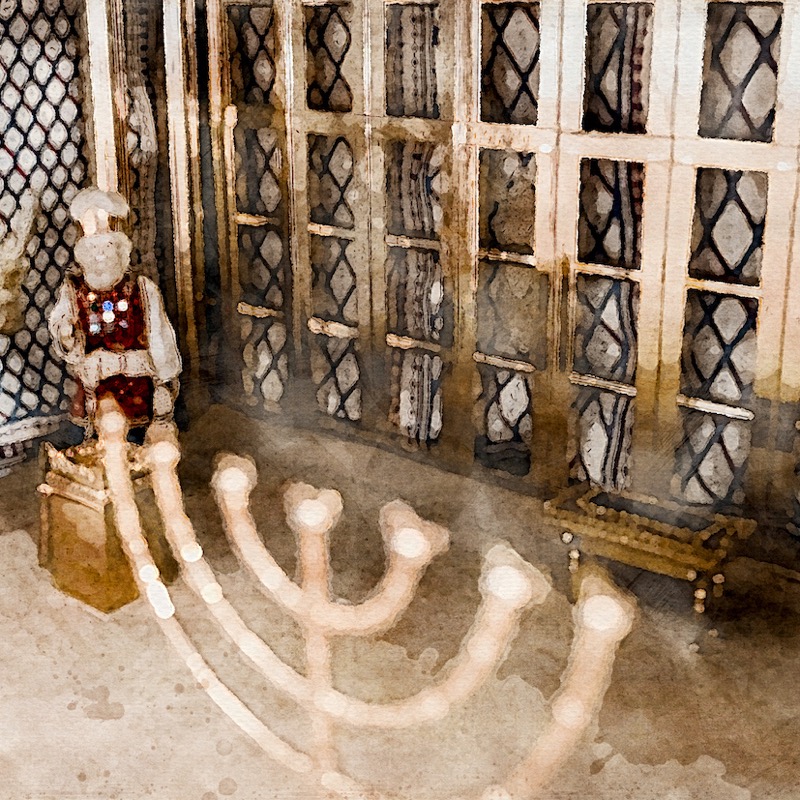
Let's begin by reading in Hebrews chapter nine verses one to five. Now, even the first covenant had ordinances of divine service, and its sanctuary, a sanctuary of this world. For there was a tabernacle prepared, the first, wherein were the candlestick and the table and the showbread, which is called the holy place. And after the second veil, the tabernacle which is called the Holy of Holies, having a golden altar and the Ark of the Covenant overlaid round about with gold, wherein was a golden pot holding the manna and Aaron's rod that budded and the tables of the covenant, and above it cherubim of glory overshadowing the mercy seat, of which things we cannot now speak severally. And then, in the previous chapter, Hebrews chapter eight, let us read verses six to thirteen. But now he has obtained a ministry the more excellent, by how much also he is the mediator of a better covenant, which has been enacted upon better promises. For if that first covenant had been faultless, then would no place have been sought for a second. For finding fault with them, he said, Behold, the days come, says the Lord, that I will make a new covenant with the house of Israel and with the house of Judah, not according to the covenant that I made with their fathers in the day that I took them by the hand to lead them forth out of the land of Egypt. For they continued not in my covenant, and I regarded them not, says the Lord. For this is the covenant that I will make with the house of Israel after those days, saith the Lord. I will put my Lord into their mind, and on their heart also will I write them. And I will be to them a God, and they shall be to me a people. And they shall not teach every man his fellow citizen, and every man his brother, saying, know the Lord, for all shall know me, from the least to the greatest of them. For I will be merciful to their iniquities, and their sins will I remember no more. In that he saith a new covenant, he hath made the first oath, that which is becoming old and waxeth aged is nigh unto vanishing away. And there is a third scripture we could read to set our study in true focus, and that is First Corinthians chapter eleven verse twenty follows. For I received of the Lord that which also I delivered unto you, how that the Lord Jesus, in the night in which he was betrayed, took bread. And when he had given thanks, he brake it and said, this is my body, which is for you. This do in remembrance of me. In like manner also the cup after supper, saying, this cup is the new covenant in my blood. This do as oft as you drink it in remembrance of me. For as often as you eat this bread and drink the cup, you proclaim the Lord's death till he come. Wherefore, whosoever shall eat the bread or drink the cup of the Lord unworthily shall be guilty of the body and the blood of the Lord. But let a man prove himself, and so let him eat of the bread and drink of the cup. For he that eateth and drinketh, eateth and drinketh judgment unto himself, if he discern not the body. For this cause, many among you are weak and sickly, and not a few sleep. But if we discerned ourselves, we should not be judged. But when we are judged, we are chastened of the Lord, that we may not be condemned with the world. Now, in the sixth talk of this series, as originally given, we stayed with the ark and devoted the whole of the talk to it. And for this good reason, that the ark was the most important piece of the sacred furniture in the tabernacle, because it represented the throne of God. It was, as one Chronicles thirteen six describes it, the ark of God, the Lord who sits upon the cherubim, which is called by the name. In the ark, so Hebrews nine reminds us, there were put three things. First of all, there were the tables of the law containing the ten words. And secondly, there was a pot full of manna. And thirdly, there was Aaron's rod that budded. And in our talk six, as originally given, we studied these contents of the ark and what they had to tell us about the character and the government of God. So let us take again, first of all, the tables of the law containing the ten words. And the first major thing we ought to note about them, perhaps, is their proclamation of God as the transcendent creator. The reason given for Israel's observance of the Sabbath is this, that in six God days God made the heavens and the earth and all that in them is, and on the seventh he rested from his work which he had created and made. Now, as Christians, we are perhaps so used to this cardinal doctrine of the creatorship of God that sometimes we fail to see the sheer wonder of it and the tremendous importance of it, particularly in the days when Israel's ark and the tables in it proclaimed it not only to Israel, but to the nations at large. In this doctrine of the transcendent creator, Israel for many centuries stood alone among all the nations of the earth, witnessing to this unique testimony. And of course, it is a part of the evidence that Israel were indeed the chosen people of God, that they did stand for the doctrine of the transcendent creator, himself independent of the creation and pre-existing it eternally, himself the sovereign maker of the heaven and earth without any help or aid, and himself maintaining it and leading it to its eventual goal. Israel, of course, did not invent this great doctrine. We see that very clearly by their own history. Israel, so their prophets tell us, and so their historians tell us, were forever departing from the doctrine of God as the creator and going after the poverty-stricken idolatry of the nations around them. Israel were always and forever having to be dragged back by the very roots of their hair, by their prophets, back to the doctrine of the Creator, away from the idolatry of the nations into which they were forever falling. Right up until the exile cured them of this habit, Israel showed that they didn't invent the doctrine of the Creator, nor did they gradually evolve from animism through polytheism through henotheism to eventual monotheism, as the evolutionists like to tell us. They did not evolve to the doctrine of the Creator. They were given that doctrine by the self-manifestation to them of the Creator himself, who chose Abram, their father, to begin a protest against the almost universal idolatry of the ancient world. It is like the doctrine of justification by faith in Christendom. You can tell that Christendom didn't invent that doctrine either, for after it was plainly declared by the apostles, very soon the post-apostolic fathers and Christendom at large departed from the glorious doctrine of justification by faith and went back to the weak and beggarly e- elements of the, of the religions around them and taught man that salvation and acceptance with God depend on human good behavior and man's attempt to keep God's law. And the great doctrine of justification by faith was lost for centuries until God raised up men like Luther to recover the doctrine. It wasn't that Christ- Christendom gradually evolved until in the time of Luther they eventually reached the doctrine of justification by faith. Justification by faith was given them initially, and Christendom departed from it, just like Judaism departed from the doctrine of the transcendent creator. So when God chose out Abraham, he chose him out to reveal himself to him and to repeat again what the forefathers of the race had known from Adam onwards, that there was but one true God, and he was the transcendent creator of heaven and earth. So then, historically, the two tables of the covenant in the ark, in the tabernacle that proclaim God as the creator were an exceedingly important testimony both to Israel and through Israel in the ancient world. For by the time that Moses made the ark, the surrounding nations had long since abandoned faith in the one true God. Romans chapter one in the New Testament tells us why they did it. Mankind originally knew the true God, but they did not like to return God in their knowledge. They were not thankful, says the epistles of the Romans chapter one. And that at first sight seems a very small sin, but actually it lies at the root of man's rebellion against God. We don't mind being given a present now and again and having to say thank you. But the idea of living the whole of our li- lives utterly dependent on somebody else and always to be beholden to somebody, even if that somebody is God, we resent it. We long, we say, for our freedom to strike out and be independent, able to make our own decisions and go our own way in moral things as well as in physical. That, of course, was the lie, eh, which Satan used to bait the hook for Eve and Adam in the Garden of Eden. Only take the fruit of that tree, he said, and you shall be as God, knowing good and evil. You'll no longer be dependent on God for knowing what you ought to do and what you ought not to do. You will be free agent, able to decide for yourself. So mankind grasped what they thought was freedom from the idea of the true transcendent Lord God Creator, and dependence upon on whom they had to live. The result was, of course, not freedom, for if you get rid of the idea of the transcendent creator, you don't find yourself thereby actually free. You'll find that you didn't make yourself. You didn't make the world in which you live. You don't ultimately control your life. Great physical and cosmic powers ultimately control man's existence. Man didn't make himself. And man soon cast around to think, well now, what did make us? And came up with the idea that the sun, the moon, and the stars, the wind, the storm, the process of fertility, these were the things responsible for man's existence. In other words, in rejecting the transcendent creator, they came to believe that the ultimate powers in the universe were the physical forces of the universe, the matter, the material of the universe, and the mysterious, at least to them, mysterious processes of fertility and the like. And because they had to recognize that it was these forces that controlled them, and they had no ability to control those forces, these were the things that brought them to existence. These were the things that would ultimately destroy them. They called these things gods. And so man was no longer, in the thought of the heathen nation, made in the image of God, superior to all the forces and the material of the universe. Man became the slave, and in the ancient mythologies, the plaything, the toy of the great physical powers of the universe that the ancients now called gods, and that led man direct into slavery. If the moon, for instance, went into eclipse, they, not knowing the scientific explanation, thought that some demon had got hold of the moon, and man was absolutely scared and banged all the dustbins in to try and chase the demon away. If a woman combed her hair at night and it sparkled a little with what we call static electricity, they, not being scientists, thought it was a demon got into the hair, and they lived in fear of demons and sprites and goblins and the gods of sun, moon, stars, man reduced to a slave in his mentality of the great physical powers of the universe and the mysterious processes. And they called them gods. Man became a slave because he had forgotten, indeed rejected, his relationship to the one true God and had forgotten that he was made in his image, made to have dominion over the universe. One day, of course, destined along with the Messiah to have supreme control of the universe. And then, of course, man became animal. Having forgotten his true relationship with the Creator, he began to worship his own psychological urges. His feelings of aggression, he turned them into gods and called them the god of war. His sexual urges, he turned that into a goddess and thought of it as a supernatural power that got hold of him, that was to be obeyed under any circumstance, and it gave him license, of course, to live now worshiping the biological processes and setting them up as gods, no longer under moral control. And man became animal in his attitude towards nature. Became like the gods he worshiped. Read through the ancient mythologies, and you will find the gods that man has created are far more immoral beings than man himself. When man worshiped them, he became like them. Now, that all may seem a long time ago to us. We forget, of course, that for centuries the tabernacle, its ark, and the tables of the law were God's self-revelation to men, were exceedingly important and meaningful and practical, and were not only God's revelation to Israel, but God's revelation through them as a testimony to the world at large. We forget that. But now today, as we remember it, of course, we perceive that that message still holds good for us today, utterly unchanged, of course. The same God that revealed himself as creator to Israel still reveals himself to us as creator, and we desperately need to preach exactly this same message to our contemporary men and women. For we live in a society that, uh, in multi-millions of them have rejected the idea of a creator, a transcendent law. They do it, of course, many of them, for the same reason. Some would say, of course, they do it because intellect and reason and science have forced them to the conclusion that there is no God. Others do it because they like the sense of freedom it gives them. To have a transcendent creator who is the author of morality, sitting above and aloft, so to speak, and watching all our ways and laying down his laws and telling us what to do and threatening us with his sanctions if we don't do it. For many people, this is intolerable, and they strike a blow for freedom, and they deny any belief in a supreme creator. What we need to tell them today is the lesson of the ancient world, that when men strike a blow for freedom, as they say, in getting rid of the idea of a creator, instead of achieving freedom, they achieve, of course, the very reverse of freedom. Take your atheist and your secular humanist. The Bible says that man is made in the image of God, his intellect a reflection of the very mind of God. No, says the atheist. No, says the secular humanist. Man's intellect hasn't that status at all. Man's intellect is merely the final product of mindless forces working on blind matter, according to chance, without any purpose whatsoever, and eventually ending up with a thing that man is pleased to call his mind and his intellect. Of course, man for the moment uses his intellect in a very impressive way. I am not decrying science, let's have more of it, not less. Man uses his intellect to understand the universe around him and has made enormous progress in controlling nature around him, but it must be evident to us all that man is not yet in control of the universe, and in fact is never likely to be. As far as man's own life is concerned, seventy, eighty, ninety years remains its limit, and man finds himself in a world where if there is no supreme creator, then the ultimate things that control man, his origin and his destiny, both as an individual and as a human race, are, these are forces, blind forces, mindless matter, chance, altogether purpose. Our own scientists tell us that in twenty million years from now, our sun will explode, become a red giant, and in that moment, little planet Earth will evaporate, and all human progress will come to absolutely nothing. In spite of man's massive intellect and its collective, its collective endeavors, the whole thing, so science itself can perceive, will one day come to utter nothing. How about that for freedom and probing? Man made in the image of God, says the Bible. No, no, says the secular, uh, humanist and the atheist. Take the individual. All he has in prospect is a few more years, seventy at the most, of life on Earth, and when that's done, he's done. That's the end of him. Oh, says the secular atheist, the secular humanist, you needn't be so gloomy. If we eat an ice cream, we can enjoy the ice cream while it lasts. We don't have to pretend that the thing is going on eternally, have an eternal ice cream before we can start to enjoy it. No, you know the ice cream is only a temporary thing, but you can enjoy it, and when it's over, it's over. You've enjoyed it and you're content. Fine philosophy, isn't it, for those who intend to live ninety five years? What about those who are only going to live thirty? Those who are cursed by some congenital disease or deformity and have got the intellect to see what a marvelous thing life could be i- if it weren't harmed by disease and sin and war and man's selfishness and the ghastly things that happen because of man's inhumanity to men, what should we tell them? Well, your ice cream lasts for fifteen years, twenty years, dogged by sin and illness and pain, and that's all there is. That is life, that's the sum total, and after that, oblivion. Well, if that's so, when you get the cancer, you might as well shoot your brains out. How about that for freedom? It takes away all human hope, of course. It is not the worst thing you can say about man without God and without Christ, but it is perhaps one of the saddest. The Bible says that men are without God. They know not the Creator. They are without the Messiah. They are unaware of any divine plans or any divine savior for our world, any notion of redemption, and therefore they are without hope. And it is a good thing sometimes when we get people confident and proud in their secular atheism, their secular humanism and whatnot, to take their noses and very gently rub them in their own hopelessness. They not only remove hope for the race, they remove it for the individual. And of course, they devalue life's most costly thing, that is human pain. Here is a woman, she's thirty five years old, a mother of two, she's been diagnosed to have terminal cancer. She'll be gone within a year and a half. Christianity comes to that good woman and says, well now, my dear, if you accept the Savior, not only you get forgiveness and eternal life, but God can take your very suffering, your light affliction, which is but for a moment, and use it in ways we do not understand, but use it in order to prepare you, for you, an eternal wake of God. No, no, no, says secular humanism. No, there is no such hope. Your cancer may help doctors to help somebody else, but as far as you're concerned, all your pain and suffering is useless, meaningless, and will bring you to utter nothingness. What a lovely gospel secular humanism has, doesn't it? For those in pain and sorrow, it is utterly without hope and devalues the most costly thing in human life, which is human pain and suffering. Well, if they must talk of free weight of God. No, no, no, says secular humanism. No, there is no such hope. Your cancer may help doctors to help somebody else, but as far as you're concerned, all your pain and suffering is useless, meaningless, and will bring you to utter nothingness. What a lovely gospel secular humanism has, doesn't it? For those in pain and sorrow. It is utterly without hope and devalues the most costly thing in human life, which is human pain and suffering. Well, if they must talk of freedom, let's point out to them what their kind of freedom is, who try to get freedom without the living God. And here is your massive scientist with his massive intellect, or the magnificent specimen of humanity. The Bible would say it's made in the image of God. Fallen, yes, but capable of redemption, one day to reign with Christ over the universe. No, says atheism. No, says secular humanism. He is at this moment suffering from some disease, some mindless virus has got inside of him, it's in process of tearing him to pieces, and one day the mindless virus will win the battle. It will destroy this man's massive intellect, and the irony is that when it's done it, it won't even know it's done it. How's that for believing in reason and exalting human intellect? So we do need, in this present day, to preach the gospel of the Creator. It is, of course, man's only hope, and what a glorious gospel it is. Man made not as the accidental product of mindless, brainless forefeast. Man made in the image of God. Man made as God's viceroy. Man fallen, but man capable of being redeemed, for the image of God to be renewed, and man destined one day as a child of God and an heir of God and a joint heir with the Messiah to rule the universe and any number of successive universes that there shall be. But now, in the Ark of Israel, there were not only, uh, uh, there was not only this proclamation of God as the supreme creator. The two tables of the law proclaimed him the moral governor of the universe. Now, Israel was not unique in being conscious of moral values. Our nations had them, and long before Israel, so that you will get in some nations like, uh, the code, for instance, of Hammurabi, his legal code with his expression of a whole range of moral values. What Israel was unique in was in their proclamation that the God they worshipped was the ultimate source and ultimate sanction of morality, and that was most unusual in the ancient world. In many nations, take the later Greeks, for instance, if you wanted to know about morality, you wouldn't dream of going to the priests in the religion. You went to the philosophers to learn about morality. The priests in the temples carrying out the rituals had some dim notions of elementary morality about the shedding of blood and so forth, murder, but by and large they worshipped gods who were infinitely more immoral than man was himself. They were gods in the sense that they were possessed of great power, and the priest was there because he claimed to know how you could manipulate these gods and bring them round to fight for you instead of fighting for your enemy, however immoral you were. You could get them onto your side by offering the appropriate sacrifices. Religion in the ancient world had very little indeed to do with morality. For that, if an, if a nation thought about morality, you either went to the king and his politics, or you went more likely to the philosophers. Israel stands unique in saying that the whole force, power, existence, character, might, personality of the transcendent Lord God, creator of the universe, is the sanction that lies behind the moral law. And of course, we need that message still today, do we not? Because we're surrounded by secular moralities that tell us that morality is ultimately simply the synthesis of what the majority of the people really approve of. But there is no absolute morality. Morality is deduced simply by arguing what people do, and what the majority do and think to be right, that is right. So morality has to be adapted according to the standards of the age. One small example, of course, but prevalent today are all the endless discussions about sexual morality. We're told, of course, well, standards aren't the same nowadays as they used to be, and what society finds acceptable is, of course, the norm, is the morality that that society, uh, uh, adopts and should follow. In other words, it is man-made morality. And of course, if morality is man-made, the question arises, what is its ultimate sanction? And here, of course, the secular humanist will tell you that there is no ultimate sanction. If Hitler gassed, uh, 6 million Jews and was responsible for the death of some fifty to sixty million people, well, according to to secular humanism, having done it, he got away with it. There's no ultimate sanction. They will say that if he'd been a wiser man, he would have behaved differently, and he would have been kind to people, and he would have enjoyed life better, according to the secular humanists. Ah, but Hitler didn't agree with secular humanism. He enjoyed himself as far as he knew. He slaughtered sixty million and had a whopping time of it and loved it every minute and gassed the Jews likewise. And when society came up with him to restrain him, he shot his brains out. And now, according to atheism and secular humanism, of course, there's no eternal punishment to face. There's no God to face. He had the best of it according to his life in this world. He has to pay nothing in the world to come. According to them, there is no God, there is therefore no ultimate sanction of morality. Do so. They say, ah, well, the human race is evolving, and one day we shall bring a paradise. That's a very curious promise. Let's go and have a word with one of the Jews who's about to be gassed, if we can imagine ourselves there in one of the camps in Poland, and the Jews crying out for justice. Why doesn't somebody do anything about it? And we say to them, well, look, grow up, old chap, you're not going to get justice under Hitler, and of course, in the life to come, you're not going to get justice either. I'm afraid you'll have to reconcile yourself with the fact there is no justice. I see. So that is the value we put upon the sixty million that died under Hitler, and about the sixty million that died under Stalin, and about the millions upon millions and millions that have died unjustly all down the centuries. We write them off, do we, and say, well, they were, alas, they were expendables, you see, expendables in the course of evolution. Ah, and we're going to a paradise one day on that assumption, are we? You need to be careful and examine it whether you might not prove to be another expendable in the course of. What kind of paradise is going to be built on that proposition? Fact is that if what I do to other people doesn't matter, they ultimately don't matter, and ultimately I don't matter either. The Bible proclaims that men matter. Why? Because they're creatures of God, and God matters infinitely. When we sin against our neighbor, we sin against God. God will never say it doesn't matter. If I blow your daughter's brains out with drugs, God will never say that doesn't matter. And if ten million million years from now I've not repented, God will still have it against me. Because he loves your daughter. He will never say that what I did against her didn't matter. And as I say, if I've not repented, fifty million million years from now God will have it against me, because God is a God of love, and he never ceases to be love. We need to beware in our modern society of shallow psychiatry. Of course, we all know that there is a, is an illness of psychological guilt that is not real guilt, but imagined guilt, and stems from deep traumas deep within people's personality. Those things must not be treated as though they were real guilt. But while that is so, to extrapolate from that and to say that there is no such thing as real guilt is to say that nobody is really responsible. And if man is not responsible, see what you've done to him. Now, instead of being made in the image of God, a responsible being, morally responsible, you have reduced him to the level of an animal that isn't responsible for its actions, or even worse, to the level of a cabbage. It is no kindness to a man who has sinned, whose conscience is ridden with real guilt, to tell him that his sin doesn't matter, or ultimately that is to tell him that what he does doesn't matter and that he himself doesn't matter. Instead of saving him, it is to reduce him to the level of a mere animal or a mere machine. God has another way of dealing with human guilt, as we have considered elsewhere in these lectures, that both retain the seriousness of sin, the reality of human responsibility, and yet has found a way of forgiveness that upholds God's law, God's glory, and upholds in the process human dignity. There was another thing in the ark, so says the epistle to the Hebrews. That was a pot containing manna. It was there to remind Israel how that when they were traveling through the wilderness from Egypt to their promised land, God fed them with manna sent down from heaven. Now we're not left to deduce what lesson it was that God was teaching the ancient Israelites by feeding them with manna in the desert. I know, of course, that Christians will immediately seize upon that manna and use it as a type of the Lord Jesus, and quite rightly so. But we here must not be impatient. We must study the lesson that God actually taught Israel for forty years and more in the wilderness. They knew nothing about the typology of the manna as prefiguring the Lord Jesus, but they were intended to learn an exceedingly important fundamental lesson themselves by simply being fed by the manna that God rained down on them day by day from heaven. Deuteronomy tells them what that lesson was. Says God through Moses at the end of the period, I fed you with manna, I humbled you, I allowed you to hunger, and I fed you with manna that you might learn that man does not live by bread alone, but by every word that proceedeth out of the mouth of God. That is a lesson that Israel had to learn in the wilderness. It was a lesson that our Lord exemplified by his conduct when in the wilderness he was tempted for forty days, uh, and then came for the serious crescendo of temptation in the three famous temptations by the devil. And when the devil, uh, bad our Lord Jesus, if he was the Son of God, turn the stones into bread, the Lord Jesus replied, man shall not live by bread alone, but by every word that proceedeth out of the mouth of God. Of course, therefore, we were saying that God's feeding of Israel by the manna from heaven taught them in their day a lesson that is still valid for us and absolutely fundamental to human experience, even in our own day. Man shall not live by bread alone, said God. That was not meant to be a threat. It was the statement of a fact. When we eat our daily bread, of course, it nourishes our physical life. But physical life isn't the sum total of life. When we are asked to a dinner party by some skillful hostess, of course, it's not merely that the food is there to satisfy our stomachs with the necessary proteins, carbohydrates, and starches and whatnot, plus a good sprinkling of vitamin. It is that the h- the meal is presented in the most artistic and aesthetically satisfying way. And that, of course, is a delightful part of eating, isn't it? I hope you agree. We don't eat our foods like dogs on the mat or on the ground amidst any imag- unimaginable, uh, filth, uh, do they? Uh, we like to have our food presented aesthetically attractive. It's part of the satisfaction, and of course, quite apart from food, aesthetics in life are an exceedingly important part of life. Why, indeed, if you have a friend ill in hospital, you may find it inappropriate to take him a plate of sausages to eat because perhaps the poor man can't eat sausages in the state he's in. But you may think it appropriate to take him a bunch of tulips, and the aesthetic pleasure that he gets by looking at the color and shape of those tulips may well contribute to his recovery from his illness. Things aesthetic, though evangelicals sometimes seem to forget it, things aesthetic are even more important than the stomach and mere biological food. Intellectual satisfaction, of course, who wouldn't vote for that the highest? Who would live without the intellectual stimulus of the marvelous world that is around us? What infinite satisfaction and fascination there is in solving the intellectual puzzles presented to us by the great universe. But all those things added together, physical satisfaction, aesthetic satisfaction, intellectual satisfaction, they are not, as Satan suggested to Eve they were, the sum total of life. Man shall not live, that is, fully live by those things alone, for there is another dimension to life that is its most important dimension. Man shall not live by bread alone, but by every word that proceedeth out of the mouth of God shall man live. You see, all these things, physical gifts, aesthetic gifts, intellectual gifts, were given us by the Creator as things to be enjoyed, of course, genuinely enjoyed for their own sake, but were given us as a basis that might lead us into personal fellowship with the Creator. To take those gifts and enjoy them independently of the Creator is to devalue the gifts and services, and of course, to lose life at its highest dimension. Suppose, for some reason or other, you were inclined to befriend me. I can't think why, but you decided to befriend me, and as a means to that end, you invited me to dinner one night, along with other of your friends. And as the meal began, there were you sitting i- i- i- in your hostess's chair, and I was sitting on your right. And I belly my head in the soup, and I take no notice of you. And you begin to say, well, now, Mr. Gooding, it's been a nice day today, hasn't it? And, uh, I don't take any notice. So you chat to the other guests, and presently you come back to me, and you said, where are you going to spend your holidays this year, Mr. Gooding? And I still don't notice you. I take no notice. I proceed to stuff my, uh, face, to say, with your delightful cuisine. And presently you come back again and you'll say, uh, Mr. Gooding, um, um, um, what do you think about, uh, the Russians and the glasnost that's going on? I lift my head up and I say, look here, I'd like you to understand I'm not interested in you nor in your conversation, to say. I find this food delightful, and I'm enjoying it, and that's all I need, really, and I think the way it's been presented is most aesthetically pleasant. I admire your silver and the flower decoration on the table, and those, uh, Rubens, uh, you'll say that you've got those paintings by Rubens and Titian on the dining room. Oh, they're delightful. Oh, I go crazy over that. But as for you, I'm not interested in you. In fact, I don't really believe in you, and even if you're there, I'm not interested, you'll say. I'm interested in the food and the paintings, you say. You know, what would you do? You think, I think you would press for the ejector bus- button under my seat and push it hard, you say. Ah. Because it makes a nonsense. You invited me to the dinner, and the dinner was delightful, but was only a stepping stone on the which you and I might come into personal fellowship and friendship that would last long after the dinner had gone. To take the dinner and not be interested in the giver and the host is, of course, a regrettable and disastrous nonsense. But many people, of course, are still living like that. Ask this bright young thing over there. She's a brilliant musician. Oh, delightful. Her gifts are immense, and you enjoy it. And presently, when the music stops, you get along chatting to her and say, you know, uh, God has given you marvelous gifts, my dear. Uh, how are you getting on with the Lord? And she said, oh, I don't believe in religion and God, I have no time for that, you'll say. Uh, you see, but you say you ought to. No, no, she says, no, I, my music is everything, I have no time for God and religion. She has it in her head, you'll see, that God somehow would spoil her enjoyment of music. And the thing is so illogical, grotesquely illogical. God made her ear, God made the possibility of music. There's no time for the God who made it possible, only time for the music itself. If she persists in it, of course, one day her ears will go dead, the music will cease, and without God she will go to an eternity where music is never heard, only one eternal discord. Man shall not live by bread alone, but by every word that proceedeth out of the mouth of God. How desperately a world that is seeking satisfaction without God needs to be reminded of it, that the ultimate and the highest form of life and the ultimate satisfaction and significance and meaning is to be found in fellowship with the Creator. Of course, we know what God has done supremely in our Lord Jesus Christ to make that fellowship possible. He is more than the physical manna. He is the living bread and the bread of life that came down from heaven, that a man may eat of him and drink of his blood and never thirst again. There was a third thing in the ark, so the epistle to the Hebrews reminds us, uh, before the Lord. And when they came in the morning, eleven of those rods were still rods, lifeless rods, as they had been the night before. Aaron's rod alone showed evidence of new life, and it budded and blossomed and brought forth almonds. As did God indicate the man whom he had chosen to be Israel's high priest. We must pause to consider the significance of Korah's rebellion. Not only, of course, because it is recorded in the Old Testament and was highly significant to the Jews themselves, but in the New Testament, Jude draws an analogy from it for us Christians and asks us Christians to beware of people who, like Korah, perish in the gainsaying of Korah, that is, in the rebellion of Korah. And the epistle to the Hebrews, using that same word, gainsaying, contradiction, rebellion, however it may be translated in your versions, remind us that at Calvary, our blessed Lord endured the contradiction of sinners, the rebellion of sinners against himself, particularly the rebellion of the official leaders and a great part of his own Jewish nation. In other words, the cross of our Lord was a rebellion similar to that of Korah, Dathan, and Abiram, a rebellion of Israel. But of course, it was a rebellion, though analogous, of infinitely higher significance. However, we can discern what the principle behind Korah's rebellion was, we shall see the big issue that came to its final statement at the cross of our Lord. Korah was a Levite. He was in holy orders, and not always the best men to be relied upon to keep the people of God in the truth of God. Sometimes they lead apostasy. He was a man in holy orders, but he rebelled both against Moses and against Aaron. You take too much upon yourselves, he said to Moses and Aaron. All the people of God is holy. Who do you think you are, setting yourselves up above the rest of us? Moses as the apostle of God and Aaron as the high priest of God. All the people are holy. We are as good as you. What quarter, therefore, was denied? Well, two things. Moses was, so the Old Testament tells us and the New confirms, the apostle of Israel's confession. He it is that had been sent from God with that special revelation that God gave through him, in the course of Israel's redemption and in the course of the giving of the law, the special instrument chosen of God for that tremendous epoch-making revelation of God that we call the law of Moses. Korah was denying that Moses was in any way special. All the people of God are. We don't need any special revelation through some special apostle. We can all make up our own minds what the message of God is. And then, of course, he attacked Aaron as the high priest. The revelation that came to Israel through Moses said that Israel were not in that sense holy. While they were redeemed, they were sinful men and women, and if they were to be maintained in covenant relationship with God as God's special and elect people, they needed a mediator between them and God. They needed a high priest that would represent them before God and God before them. A mediator then of the ancient covenant. Korah and his fellows were saying, no, all the people of God are equally holy. We don't need any special mediator between us and God. God, to show his divine disapproval, opened the earth and swallowed up Korah, Dathan, Zedobbaram, and all that belonged to them. And the rest of Israel were asked to separate themselves from these apostles to show exactly where they stood, whether they stood with Moses and Aaron as the apostle and high priest sent of God, or whether they stood with Korah, Dathan, and Abiram in their apostasy. The historical rebellion, of course, has its voice to us today, as I've earlier said, otherwise the New Testament would not quote it. We've heard a lot of it in our own dang generation. Secular Christianity, it's called. People who deny that the apostles are special. You can hear them on every hand saying, oh, but that's only Paul said that. Oh, that's only Peter. They'll even say it about our blessed Lord. Oh well, they say, in the name of Christian theology in many a university faculty of divinity, let alone some Bible colleges. Well, Jesus Christ said things about the second coming, but of course he was mistaken. We know better. Oh, that's only Peter said that. Oh, but if the New Testament writers were around today, they'd say quite differently from what they said then. This isn't a fixed revelation from God. It was the best they understood of what God was trying to say to them then. We must go all beyond that, and by our own intellect and reason and study of philosophy, work out ourselves what God's message is for us today. That is doing, as I understand it, exactly what Korah, Dathan, and Abiram were doing in the ancient days, denying the apostles of their profession. It's the fact, of course, that at Calvary, Judaism officially rejected and denied the Holy and the Just One, denied that Jesus was the Messiah, denied that God spoke through him and crucified him at Calvary. Israel's great contradiction, their rebellion against the apostles are God's revelation to them. Christendom nowadays in some parts follows hard on their trail. But of course, Israel also denies that Jesus was their high priest and denies it still. Some forms of Judaism will say that Israel does not need nowadays any mediator between themselves and God. And many there are in Christendom that say the same thing. They object to the idea that man is so sinful that God's wrath must be appeased by a sacrifice. They regard that as primitive. They say that God is such a kind God that he welcomes home his prodigals without requiring any kind of sacrifice whatsoever, and therefore a high priest who can offer a sacrifice on our behalf is not necessary. The Ark of God's throne contains within it God's, uh, protest against that early apostasy and his insistence on the authority of his divinely chosen apostles, be they Moses in the Old Testament, our blessed Lord, and his twelve apostles in the New. And it, uh, remains God's, uh, protest to fallen men that man cannot come to God unawares. Man needs a mediator, not now a merely human priest. For nowadays there is but one mediator between God and men, himself a man, Jesus Christ. But man needs him. We cannot come to God on our own two feet. We need a mediator and a sacrifice. So then the ancient ark, with its contents, stood for Israel as a reminder of the character and of the government of God, the things that lie at the heart of God's self-revelation to men and lie behind his government. And as I said a moment ago, those three things, the tables of the law, the pot of manna, and Aaron's rod, not only expressed God's self-revelation, but emphasized it because in those three things were the memorials of the great rebellions that Israel had perpetrated against Moses and Aaron and God in the time of the wilderness, and led God to state even more emphatically than ever what is the truth of the nature of God and his way of salvation, as revealed through Moses and Aaron and symbolized in the contents of the ark. Now I want to turn to to final major things concerned with the Ark in the tabernacle. The Ark, as you know, is frequently referred to as the Ark of the Covenant, because the two tables of the law that were in the Ark were made by God the basis of the covenant between God and Israel. Now, of course, nowadays we are not under the old covenant, but under the new covenant. And the difference between the two we shall come to think about in a minute. What I would like to begin to point out is that the Ark of the Covenant, the, the law that was the basis of the covenant, were for Israel God's instrument of government. Now that has been borne in upon us very strongly in the last, uh, thirty to forty years by the archaeologist discoveries, eh, of the treaty covenants made by early Canaanite emperors with their vassal king. When these tablets were discovered, Jukarit, Rashamrar, and places like that, archaeologists not only perceived that some of these tablets were, were treaties, political treaties between emperor and his vassal king, they noticed at once that in external form, these treaties resemble very carefully, very, in very great detail, the statement of the law given by God in the two tables of stone. Take, for instance, the great emperor Tupilu Liumu. A typical treaty covenant between him and one of his vassal kings would begin by the statement of the emperor's identity. I am Supiluliumu. And it would proceed to relate the great things that the emperor had done for the vassal king and his subjects, generally beating them up in war and things like that, great benefits he had conferred upon them by that means. And then it would prohibit them from having any other covenants, making any other covenants with any other emperor. Then it would add a list of do's and a list of don'ts. Then it would call upon the gods to witness the treaty and call upon them to rain down their blessings on those who stood by the covenant and to rain down their curses on those who broke it. It then would make provision that the covenant documents be stored in some safe place. Finally, it would require that the vassal king should, from time to time, assemble his people, bring out the covenant documents, read and expound them before the people, that they might always remember the terms under which they were related to the great emperor. And of course, when we look at the Ten words and what elsewhere is said about them in Exodus and Deuteronomy, we see that the law of Moses follows that general formal outline. Begins by identifying God. I am the Lord your God. And then proceeds to say what he has done for the people that brought you up out of the land of Egypt, out of the house of bondage. It then prohibits any covenant being made or any worship being given to any other god. Thou shalt have no other god but me. It then lists the do's and the don'ts, thou shalt and thou shalt not. In Deuteronomy, Moses calls not upon the gods, of course, but upon heaven and earth to witness that God has made this covenant and Israel has made a covenant with God. And then calls down the blessings on those who keep the covenant and the curses on those who don't keep it. Provision is made in Exodus, of course, for the covenant documents to be stored. That is, of course, why the ark was ever built. Its primary function to contain the tables of the covenant that were the basis of God's relationship with his people and the basis of his government. And finally, of course, we see Moses in the book of Deuteronomy assembling the people at the end of the forty years, taking out the covenant documents from the ark and rehearsing them and expounding them at great length in the ears of the people. And that all adds up to remind us and to inform that the Ark of the Covenant and the covenant inside it was God's instrument, his way by which he proposed to govern his people. The Holy of Holies was the throne room, the nerve center of the government. Now. Now, when we come to the New Testament as Christians, we shall find, it's explicitly said, said in Hebrews chapter eight that we have read, that the old covenant was to be done away. In its place, the new covenant. Not a new covenant, as though there could be several new ones, but the new covenant. This is not some idea, of course, that the early Christians thought up out of their own head. God had announced centuries before through Jeremiah the prophet that there would come a day when he would put aside the old covenant and institute the new. He said, the days will come when I shall make a new covenant with the house of Israel and with the house of Judah. Why was there any need for a new covenant when there was already the old covenant? Well, the Epistle to the Hebrews tells us explicitly why you had to have a new one, and that particular point in which the new one is different from the old one. Verse nine: the new covenant is not according to the covenant that I made with their fathers in the day that I took them by the hand to lead them forth out of the land of Egypt. Why not? And how is it not the same as that other one? Well, says the writer, for this reason, for they, that is the fathers, continued not in my covenant, and I regarded them not, says the Lord. And there you see the weakness of the old covenant. The old covenant was a two-party covenant in which Israel had their part to do, and God had his part to do. If Israel failed in their part, then it broke the covenant, and God, uh, rejected the whole thing. That is precisely what happened. They continued not in my covenant. They broke it. And therefore God rejected me. That of one shows us that if the new covenant is going to be any better than the old covenant, this is where it will have to be better. Just to set up a new covenant that was the same as the old covenant in the sense that it is a two-party covenant, where the people of God have their part to do and God has his part to do, and if either side break it, the covenant is ruined. That would be to repeat the weakness of the old one. The new covenant is not only new, not only different, it's different in this very thing, says the New Testament, that it is not a one-party covenant. All the clauses, if you will read the covenant, are what God himself promises to do. Let me read with you the terms of the new covenant they're given in verse ten of Hebrews chapter eight. This is the covenant. I will put my laws in their mind, on their heart also will I write them. That's what God will do. Secondly, I will be to them a God, and they shall be to me a people. That's what God will do. They shall not teach every man his fellow citizen and every man his brother. Why not? Well, they won't need to. They won't teach every man saying, know the Lord, for all shall know me anyway, from the least to the greatest of them. For I will be merciful to their iniquities, and their sins will I remember no more. And you'll see in the terms of the New Covenant, it's not what we have to do, but what God has done and is going to do. It is, in that sense, a one party. So what is the difference? I don't quite get it. Well, let me use a home illustration. Here's a young man, he is about thirty eight, and his last decided it was time for him to get married, you see, and he's been thinking to himself what kind of a present he could, uh, bring to mark his wedding day to this delightfully beautiful lady that's marrying him. And he knows no better. He sees a beautiful cookbook in the shops full of beautiful pictures of the most delectable dishes, and he buys this, you'll see, for ten dollars or so, and come the wedding day, wraps it up, nice paper, little ribbon on it, and gives it to his beloved. And when she opens it, of course, she's extremely grateful, and she says, I get the idea, do I? It's a beautiful book. Are you by any means suggesting you'd like me to, uh, do some of these recipes? And he says, well, my dear, even if you don't, I love you immensely, but if you could, of course, I'd love you ten thousand times more, you see. It was by way of being a hint of what he would like her to do. That's a delightful report. But suppose the young man were to say to his beloved on the wedding day, now look here, my dear, this is a cookbook. See all these recipes in here. Now this is my proposition, that uh, uh, if you promise that you will do all these recipes and do them perfectly and not do the slightest thing wrong and never burn the potatoes, you see, or anything like that, you'll do them all perfectly, then on those conditions you may be my wife and I will be your husband. But understand it clearly, the moment you burn the potatoes or fail to do the recipe as is stated, then I shall have to divorce you. And of course, it would be a very different state of affairs, wouldn't it? You can see quite well, you'll see, that the girl would have her part to do and he would have his. Something like that God said to Israel, and Israel said back to God under the old. God said, look, if you keep all these regulations, then I will be your God. They said, yes, we will. They broke them, of course, and that ruined the first covenant. The new covenant is not a second part, a, a two-party covenant like that. It is a one-party covenant. In it, God pledges himself what he will do. Our part simply is in full repentance and faith to accept what God himself says. But our point now in this talk, as we come to its end, I would have you notice, and myself too, that under the terms of the New Covenant, God does not only promise us complete forgiveness of sins, their sins and iniquities will I remember no more. The first clause in the covenant is, I will write my laws upon their minds, and upon their hearts will I inscribe them. Just as the old covenant was God's instrument for the governing of Israel, so is the new covenant God's instrument for governing us his. Today, listen again to it, I will write my laws on their minds. When we accept this new covenant, there is no thought that we can be forgiven, but leave optional as to whether we shall then consent to do the laws of God. To accept that covenant, we have to accept it as a whole. The clauses are not to be taken piece by piece in the sense that we can take some and reject the others. We cannot take the covenant at all, unless both we take the forgiveness it offers and the promise that God will write his laws upon our hearts. Oh, wait a moment, say some Christian theologians. We in the church are not under the new covenant anyway. Now, here I speak with due respect to those who differ from me, for greater theologians of I have come to the conclusion that the church is not under the New Covenant at all. They say that the church comes into the benefit of terms like the New Covenant, but is not in covenant relationship with God. And they found their, uh, their proposition on the fact that the New Covenant is said to be made with the house of Israel and with the house of Judah, and say these expositors, Israel is Israel, you know, and Judah is Judah, and neither is the church. The covenant is made with Israel and Judah and not with the church. The church is a heavenly body and not under covenant relationship with the Lord. It seems to me, however, to fall foul of certain very important things in the New Testament. One, of course, when we speak of being under covenant relationship with the Lord, we are not saying that we today are under a two-party covenant. We are saying that today the new covenant is in the form of a will. The testator has died in the death of the Lord. That sets, uh, God free to dispense all the blessings of that new covenant, that will to all who trust the Savior. Second, at the Lord's Sup, our Lord handed his apostles the cup and said, this cup is the new covenant in my blood. Receive it and take it and drink of it. It seems to be impossible to argue that he did that to them in their capacity as Jews, but wouldn't do the same thing to us in our capacity as the Gentile church. For in one Corinthians eleven, it is repeated, this cup is the new covenant. For the Lord's people at the Lord's Supper to take that cup from the hand of the Lord Jesus and to hear his word, this cup is the new covenant in my blood, and then say that we are, though we take the cup, are not under the covenant, seems to me a little strange. And second, though the cup covenant is made with Israel and Judah, shall we not listen to Paul in that churchly epistle, the epistle to the Ephesians, the Ephesians, who says that there was a time when we were strangers from the covenant of Israel. But says the argument, we who were strangers for the covenant, we were strangers and alienated from the commonwealth, are not that anymore. That, as I understand it, is the whole drift of the argument of Ephesians chapter two and three. But the matter comes through a more practical, uh, issue. When Paul is describing to the Gentile Corinthians his mission among them. He says, you know, see the evidence of my work, which is my true letter of commendation. We have been made ministers of the new covenant, and efficient ones at that. See what God has used us to do. We have written on your very heart, not on tables of stone, which is comparatively easy, but on the changeable fluid material of the Corinthians' heart, Paul, by the power of the Holy Spirit, had written the very laws of God. That is, that through his preaching, the Corinthians had been reborn again of the Holy Spirit of God and received the very nature of God, which nature carries within it the possibilities and desires of doing the will of God. Secondly, Paul has not only done that as a minister of the New Covenant, but in one Corinthians eleven, as he gives them further directions and corrections about the celebration of the Lord's Supper, he chooses to concentrate on this great fact of the New Covenant. Now, I should be told that the Lord's Supper is the occasion where we are meant to forget ourselves and to worship the Lord. And of course, it is in one sense, isn't it, our highest privilege to worship the Lord. We must never forget the plain statement of scripture. There is no plain statement of scripture that at the Lord's Supper you are to worship. There is a plain statement of scripture that says that at the Lord's Supper you take the cup, and that cup is the cup of the new covenant. What for? That says, I will write my law on your heart, and on your mind will I engrave it. What does that mean? Well, says Paul, you'll say, you Corinthians need to be warned. You have begun to celebrate the Lord's Supper in a highly unworthy manner, allowing sin unjudged in your lives and unrepented of, and not discerning yourself, nor caring for God's government in your life. You're simply coming to the Lord's Supper and taking the bread and the wine unworthily. You carry on like that. You are, in fact, guilty of the body and blood of the Lord. You are doing the very sins that he died to atone for, and doing them unrepentantly. Moreover, you're not only failing to judge yourselves, you're failing to discern yourselves. Any believer must know that at his present state, any believer must know that in his present state he is not yet perfect. None of us are. We surely must realize that there is still about us attitudes that are wrong. Other people can see it, of course, more easily than we can ourselves. It is for us not merely to judge ourselves when we have done something wrong. It is for us to take God's holy word, and in cooperation with God, to read that word, that we might discern ourselves and say to the Lord, search me and try my ways and see if there's any wicked way in me, that we might constantly cooperate with the Lord in this ongoing process of his writing his laws on our mind and on our heart, and therefore on our behavior. He has promised that he will so write his laws on heart and mind, and when we take the cup of the covenant at the Lord's Supper, this is the first clause that is being covenanted to us by the solemn assurance of the Lord Jesus, he will write his laws on our hearts and on our minds. To come and take that cup, and to have given no time at all to the thought during the week that we are meant to be conforming our lives by his help to his word and to his law. To come and take that cup when we are making no effort what at all to progress in holiness, but are living as the world. That is, of course, to deny the first clause in the covenant. What will happen if we behave like that? Well, if we behave like that, we shall find that the covenant is a reality. For God has covenanted that he will write his law on our hearts and on our minds. He will do it with our cooperation if possible. So, if we judge ourselves, we shall not be judged. But if he can't do it with our cooperation, he will do it nonetheless, says Paul. And if we, uh, do not judge ourselves, then in pursuance of his covenanted obligation, he will chasten us, even to the point, says Paul, of removing our physical lives, so that at last we shall not be condemned with the world. It is good, therefore, God help us to worship ever more highly and more exaltedly the person of Christ at the Lord's Supper. God forbid that any of us should ever forget that the New Covenant is God's solemn declaration and glorious promise that he will write his laws on our hearts and on our minds. Of course, there is no penalty. The last clause says that our sins and iniquities he will remember no more. That is, God will never drag us before his great white throne, never wake up the question of the penalty of sin. That is forever gone. But the question of his discipline, his chastisements, his training in holiness, they remain and will remain as long as we need. Let's end not on a gloomy but on an encouraging note. It often happens, my good brother, that when you perhaps are sitting at the Lord's Supper, engaged in the highest of the heavens, in forgetfulness of yourself, I could wish that I could rise with you. But I remember the past week. I remember the feeling, shall I ever make the grade? Shall I ever overcome besetting sin? The foolish things I have done and said. What then would save me from despair, save this? When once again I take that cup of the covenant, I hear the Lord's words. Not you do your best, but I will write my law on your heart, and on your mind will I inscribe it. And I can give thanks to the blessed Lord, at least for this, that I owe my salvation to him. I owe my holiness to him. One day, thank God, I shall, by God's covenanting grace and covenanted assurance, I shall be conformed to the very image of God's own son. And thus shall I be prepared one day, as our Lord overcame and sat down upon his Father's throne, so shall I be prepared one day, as I too overcome, to sit down with the Lord on his throne and govern God's universe along with him.