Gooding, David: 7 - Peeling Back the Curtain on Reality
ID mfh_1087262005Date unavailableBefore 2.82Restored 4.57
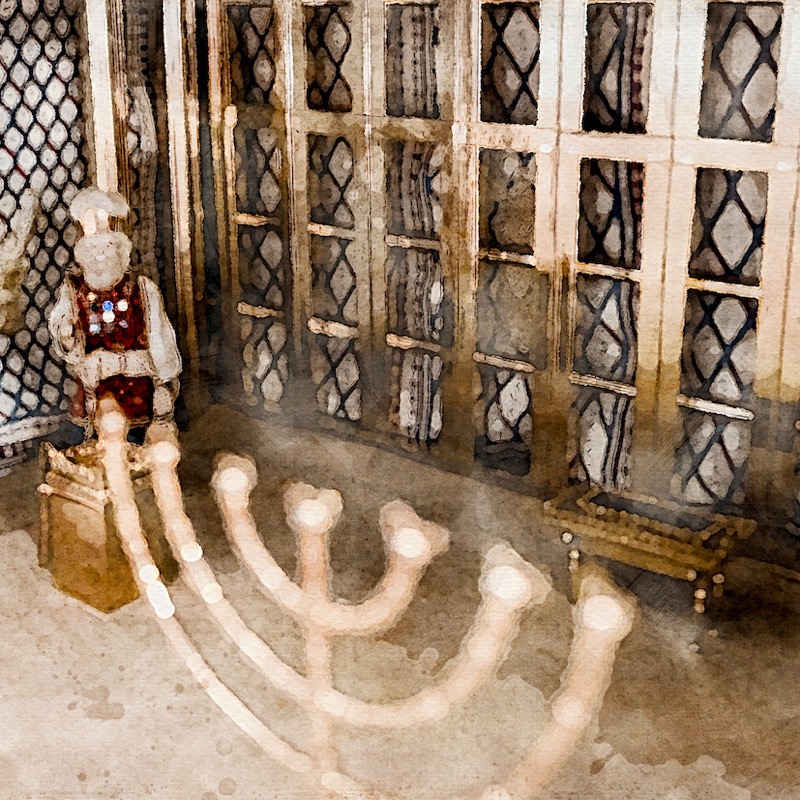
And if you prefer to listen with your eyes shut, I give you full permission so to do. In my university, often we had to attend lectures at four o'clock in the afternoon, and it's a deadly hour at which to have to listen to a lecture any time of the hour. I used to find it very convenient to get by behind somebody whose head obscured the sight of the lecturer and then listen with my eyes shut. If you want to do the same, do feel free so to do. So you won't upset me. If you're afraid of going to sleep, well then give me your name now, and when I see you going to sleep, I'll call it out. Or if you want to stand up halfway through rather than sit down to ease the penance, well, do that as well. I shall not mind. But now we come, we have come in our studies in the context of this weekend to the end of the journey we began last night. We have been so far pursuing the road that leads us from the outside place in towards the presence of God. And we have spent some time, perhaps out of proportion, considering the ark, but then pray let us remember the ark was the most important piece of furniture in the whole of the tabernacle. For that reason, it is the very first piece of furniture that God commanded Moses to be made, even before he gave him instructions as to the size and shape of the house in which that ark was to be housed. But now, as I say, we have completed our journey in towards the presence, and we turn around now to consider those pieces of furniture and other things that lie on one side or the other of the central path. And this afternoon we are to look at this vessel here that is called the lampstand. It formed a twin vessel with the table of the bread of presence standing over here on the other side. Both, of course, were vessels of presentation. The function of the lampstand was to have placed on it, on its six branches and its central stem, lamps filled with olive oil that they might shine before the Lord. And the lampstand has at its function the purpose of presenting those shining lamps before the Lord. Similarly, this table was a vessel of presentation. Its function was to hold up the twelve loaves of the bread of presence before the Lord and for the Lord's enjoyment. Now, we would not, uh, uh, claim that our reconstruction of the lampstand is exactly as the original was, and in this particular, that we have our central shaft coming up high above the branches. Josephus himself tells us in his rather late Roman history, our Jewish history, that the lampstand, the branches came up level with the central shaft. And on the Arch of Titus, as you have seen, the lampstand is depicted with the branches coming up level with the central shaft. And in modern Israel, in the menorah, that is their nat- one of their national symbols, the branches come up, uh, level with the central shaft. It is conceivable, therefore, perhaps possible, it might even be probable, that in the very ancient tabernacle, the branches also came up level with the central shaft. It's the fact that in some early graffiti of the lampstand, the branches do not come up to the same level as the central shaft. They are more in the fashion of a stylized tree, with the natural shape of the tree. So who can tell, already in the tabernacle, the lampstand may have developed stylistically into a stylized thing in which the branches come up level. But I shall not dispute the point with you, and as you have heard me say many times, so I say it again, while I hope I would find the courage to go to stake, to go to the stake for the word of God and its inspiration, I wouldn't go to the stake for my interpretation of the tabernacle. And in particular, I wouldn't go to the stake for my reconstruction of the lampstand. But its shape will not in any material way affect our interpretation of its symbolic meaning, nor yet of its typical meaning. Certain technical facts should be borne in mind as we come to consider it, so that I will mention them now, mention them now, and as we read through the passage of description, you may care to take notice of the actual text. The lampstand was beaten out of a solid lump of gold. It had a base which we have depicted here. Yes, again, on Titus's arch, the base is different from what we have it, but also it is notable for the fact that on Titus's arch, the panels of the base have upon them in bas relief, all sorts of animals and things. And if there is one thing certain about the tabernacle menorah, the lampstand, it didn't have any representation of animals on it anywhere. It had a base nonetheless. And strictly speaking, the lampstand is composed of this base and the central shaft. Those two things were the lamp stand, when the passage is talking in strict technicality. For you will read as we come through that out of the lamp stand there went six branches. That is, it's talking about the central shaft and its base as the lamp stand, and out of that central shaft there proceeded six branches. So it is really technically incorrect to refer to this as a seven-branched lampstand. There weren't seven branches, there were six branches coming out of a central trunk. Finally, you will notice from the text as we read it through, that in both the central trunk, the the the stand itself, and in the branches, there were decorative motifs formed of knobs, that is, buds, and blossoms, and as I read it, fruit. The knobs, the blossoms, the the knobs, the buds, the blossoms, and the fruit being those of the almond. So now, with that in mind, just let us read the passage together of simple instructions. They occur in, uh, put the lamps down. They occur in Exodus, chapter twenty five beginning in verse thirty one. And thou shalt make a lampstand. But once more, I have been brought up so rigorously on the King James Version, which, as you know, reads not lampstand but candlestick, that I shall get horribly confused more than usual. And sometimes I shall talk about it as a candlestick, and sometimes I shall talk about it as a lampstand. It was, as you know, not a candlestick. There were no candles inside the tabernacle. It was a lampstand. Please understand that when I say candlestick, I mean lampstand. And that will set me free from any inhibitions. Exodus twenty five and verse thirty one: and thou shalt make a lampstand of pure gold. Of beaten work shall the lampstand be made, even its base and its shaft. Its cups, its knobs, and its flowers shall be of one piece with it. And there will be six branches going out of the sides thereof, three branches of the lampstand out of the one side thereof, and three branches of the lampstand out of the other side thereof. Three cups made like almonds in one branch, a knob and a flower, and three cups made like almonds in the other branch, a knob and a flower, and so for the six branches going out of the lampstand. And in the lampstand, that is in the central shaft, four cups made like almonds, the knobs thereof, and the flowers thereof. And a knob under two branches of one piece with it, and a knob under two branches of one piece with it, and a knob under two branches of one piece with it, for the six branches going out of the lampstand. Their knobs and their branches shall be of one piece with it, the whole of it one beaten work of pure gold. And thou shalt make the lamps thereof seven, and they shall give light, and they shall light the lamps thereof to give light over against it. And the tongs thereof and the snuff dishes thereof shall be of pure gold. Of a talent of pure gold shall it be made with all these vessels, and see that thou make them after their pattern which hath been showed thee in the mount. And so this afternoon I want to discuss with you the lampstand itself. We shall not have time to discuss the lamps that went upon the lampstand, nor the oil by which those lamps gave their light. I want now to study with you the lampstand itself, which formed the vehicle of that light, the stand which presented those lamps to burn before the presence of the Lord. Now we are to notice, uh, the function, therefore, of the lampstand. And you will say, how are we to interpret it at our Christian level? Well, if the lampstand was the vehicle of the light in the tabernacle of God, it points us straight, doesn't it, to our Lord Jesus Christ, who said, I am the light of the world. It is so that I want to take it this afternoon. Afternoon. The lampstand in the tabernacle began life as one solid piece of gold. And here once more we meet a vessel that is made of one material only, not of two. It is the interesting phenomenon, whatever it symbolizes or points to, uh, is another thing. But in each department of the tabernacle, there was one vessel that was made simply of one material. In the court, the big altar was made of two materials, wood and copper, but the laver was made only of one material, of metal. There was no wood in it. Inside the holy place, the lampstand was made of one material, gold, there was no wood in it, though the other two vessels, the table and the altar of incense, were made of wood plus gold. And in the most holy place, the ark was made of wood and gold, but the other piece, the mercy seat, the propitiatory, was made of solid gold. There was no wood in it. An interesting phenomenon that I just throw out in passing. Certainly then, if the symbolism is to be followed, when we come to the lampstand, it not only points us to our blessed Lord Jesus, but it's going to say things to us about the deity of him who was the vehicle of the light of God to men. What better place could we start our study then in the Gospel according to John and chapter one? And in as much as the lampstand originally began as a solid lump of gold, we appropriately start John chapter one, in the beginning. And if we go back to the remote beginning, what was our Lord, and what was he like then? In the beginning, says John, whenever that remote beginning was, in the beginning the Word was, already was, and the Word was with God, and the Word was God. Thus was he in the beginning. We have to grasp again and again and again, do we not, in these advanced days, particularly in theological circles, that our blessed Lord Jesus didn't begin his existence when he was born in Bethlehem. The New Testament does teach the pre-existence of the Son of God. In the remote beginning, he already was. Jesus Christ is not some bright, clever new prophet with a few world-shaking innovat- innovat- innovative ideas. God of very God. In the beginning, he was not only with God, he was God in all his essential. Thus far, the beginning. But now notice that having begun with a solid piece of gold, then the, the goldsmith so beat that gold that out from it began to emerge a central shaft or trunk, and out of the trunk eventually there came six branches. And it was so decorated that when he had finished, both in the central shaft and in the branches, there were representations of life. There were buds, knobs for buds, and flowers and almonds. Three stages, I suggest to you, of life all at once. You say that must be an imaginary world, surely. Ah. I've often thought so the same myself, you know. Wouldn't it be nice if here on this earth you could have all three stages of life at once? In my advanced old age, I look upon the little children with the bud of potential life, and I say, cool, look at that energy, tireless, aren't they? They can't sit still two minutes until they fall asleep. Uh, I used to have energy like that, alas, I don't have energy like that anymore. It's gone. Oh, I got a lot more sense than I had in those early days, I hope at least, but now I got the sense to use the energy I haven't got the energy to use, you see. And that is a bit frustrating, isn't it, what? If only you could have the energy of youth with the wisdom to use it of old age, we'd be high set up, wouldn't we? Yeah. I tell you something else. I grew up to about the age of twenty, and you consult ancient photographs if you don't believe it, I was handsome in those days. Well, at least I had a curl of two, you'll see. Even then, I didn't have all that wisdom to, to take advantage of the beauty. I understand, I understand why you find it difficult to believe what I'm telling you, because actually the winter time has come on and the frost has turned into permanent frost above. Yeah. Why do we have to grow less beautiful as we grow older? Oh, for a world where you can have all the stages of life at once and simultaneously. There's a rumor going about, my brothers, my sisters, there is such a world, and there is such a life, and it is called heaven, and it is called eternal life. But to come back to this lampstand, the interesting feature about it is that it was made to look as if it were alive, made to look as if it were a tree with all these three stages of growth within it. And so it was the only vessel in the holy place that was made to look so. For there was a lampstand, there was a table, there was an, uh, altar of incense, three vessels in the holy place. Only the lampstand was so decorated as to make it look as if it were a living tree, as though life were in it. And with that, we come back to our chapter of John, don't we? In the beginning was the Word, you start at the base, and the Word was with God, and the Word was God. All things were made by him, and without him was not anything made that was made. And you pause to think. If the whole of creation was made by him and nothing without him, let me ask, where did the pre-incarnate word of God get all the life from to make things? I mean, this world is astounding world, isn't it? When you begin to think about it, the innumerable forms of life with which our universe swarms. There are caterpillars, there are butterflies, there are elephants, there are monkeys, there are snakes, there are birds, there are human beings. Almost infinite, it seems to us, the varied forms of life that fill our world and universe. And there's a rumor going around that there are angels as well. Marvelous variety of life. Pray, I say to myself, where did the pre-incarnate Word, the Creator, get all this life from, with which to fill the universe? And the answer is he didn't get it from anywhere. In him was life. In the technical sense of that preposition, he is a source of life. He didn't have to go to any external fount in order to get the life to make things with. He is the source of life. And pray read it in its context. All things were made by him. We're talking about creation. All things were made by him. Without him was nothing made that was made. In him was life. We're talking about created life, of course, still. He is the source of it all. Then, says John, in him was life, and that life was the light, wasn't it? Well, of course it was, you say, if you know your tabernacle symbolism. In it was life, look at it, all forms of it, and that life was the light. But let us pause and expound it to ourselves. How is it true to say that in him was life, that life was the light of men? Well, I submit to you the following, that if you are walking down a dark country lane one night and it's absolutely pitch black, and suddenly coming through the hedge there's a shaft of light, and you turn and say to your friend, did you see that light? And he says, yes. You say, where is it coming from? What would you think of your friend's sanity if he said it isn't coming from anywhere? Light is just one of those things. It doesn't have to come from anywhere. You say, well, don't be so silly. You can't have light without a source. And when it comes to life, yes, it's a remarkable phenomenon in this universe, isn't it? Must I not ask, where does the life come from? I must, mustn't I? Because if ever I'm going to get light on the meaning of life, as we were saying in our first session, we shall have to trace created life to its source to discover the meaning of life. In him was life. That life was the light of men. Unfortunately, says John, the light shines in darkness. There is the history of our troubled universe, that creatures who derive their life from the word of God, the eternal creator, chose to rebel against him and cut themselves off from him, with the inevitable result that they were plunged in ultimate darkness. I was required, as a matter of courtesy and respect, to attend a funeral of a colleague of mine in the university. I had known him as an atheist all his days, but I wasn't really prepared for an atheist funeral. It was the first downright atheist funeral I had attended. As we sat there in full view of the coffin, one and another of his university colleagues got up to pay a tribute, and one of the poems that was read at the request of the deceased was in the following terms, that being born is like coming out of a dark, dark forest when you can see neither beginning nor end, and for a few brief years we come out into the clearing of light that we call life, only soon to disappear in the endless and impenetrable darkness of the forest once more. Without God, without Christ, and utterly without hope or ultimate meaning in the world. You'll see in him was life. Trace that created life back to its source, and you will have light on the meaning and the purpose of life. Deny that ultimate source, and life itself turns to darkness, impenetrable and meaningless. Light shines in darkness, and the darkness has never been able to put it out, says John, nor alas oftentimes to comprehend it. But if creation was thus spoiled, God was not for giving up, was he? Look at this thing again, and see presently under the master goldsmith's hand the branches beginning to come out each side, six in number. Now, I haven't troubled you with the significance of biblical numerology, have I? Not very much yet. I'm going to trouble you now, and perhaps never again. For six, by explicit Jewish understanding, is the number of man, simply because man was made on the sixth day, wasn't he? It is mark. And when, uh, the revelation says in the language of the seer that the mark of the beast is a mark of a human. The number turns out to be triple six. Out from this central shaft, there comes six branches. And if the symbolism were consistent, it would seem to suggest, but then how can it suggest it? That in a symbol that was symbolizing the deity of the Lord Jesus, there should be branches numbering six, the number of a man. We better get ourselves to the Gospel of John once more to see whether he knows anything about it at his level, perhaps. So in the beginning was the Word, and the Word was with God. In him was life, and he made all things. Creation rebelled against him and plunged itself in darkness, but God wasn't for giving up, and eventually the world became flesh. And the Word tabernacled among us. He came to his own, and his own received him not. He was in the world, and the world was made by him, and the world knew him not. But as many as received him, to them gave he power to become children of God, even to those that believe on his name. And we pause before that word children of God. What does it mean? We shall, of course, have to clear our heads of the inaccuracies of popular theology. Sentiment will tell us that all human beings, without exception, are children of God, and isn't it a nice kind of a thought? It is true, I suppose, insofar as God the Creator cre- treats all his creatures in a fatherly fashion. But in the technical terms of the writings of John and of the New Testament, it is not true to say that all men and women are children of God, for they are not. They are creatures of God. All men and women without distinction, creatures of God, made in the image of God. But not all men and women are children of God, as these very verses indicate. For notice what they say, if you would become children of God, you can't become something you already are, can you? To become children of God, you have to do something, namely to receive Jesus Christ our Lord as Savior. Let us therefore ponder the distinction, because it is exceedingly important. What you say is the difference between a child of God and a creature of God. The late and lamented C. S. Lewis used to illustrate it by a familiar analogy. He said, suppose you have here a cabinet maker, and the good man has skillfully made a chair. It wouldn't be true to say exactly, would it, um, that he created it, but let that do for the moment. He made the thing, he created its design, and there it stands, a beautiful specimen of his handiwork. And as you look at the chair, you get a good idea of the ca- the cabinet maker's mind. You can see his sense of proportion, his sense of design. You can judge his efficiency. The chair is a bit of his handiwork. It's a creation of his art. And presently the cabinet maker gets married, and in due time begets a son, and you go to visit him, and there is the stately chair with its beautiful carvings and its ornate polish and so forth and so forth. It looks a splendid and majestic thing. And then you're introduced to his son, and it looks a horrible little thing, to tell the truth. I mean, of course you say how lovely and all that, but it's got a screwed up old face and scarce a hair, and it's doing all sorts of unmentionable things, and the ma apologizes and whisks it away, and you'd never dream that it is more important than the chair, would you, if you didn't know? But there is an enormous and unbridgeable chasm, chasm between the chair and the child, for the chair is merely a creation of the carpenter. But the child has been begotten by the carpenter, and the child has the very life of the carpenter. Thus does God announce the great wonder of his creation. He made us as creatures, put us on planet Earth, in order that he might come to us and offer us the next step in his design, which was to rise from becoming, from being mere creatures into becoming children of God, who were born not of the will of the flesh, but of Of God. God. When we read the Epistle to the Ephesians, Paul tells us that that had always been God's design. You will remember his famous words, won't you? He said, blessed be the God and Father of our Lord Jesus Christ, who has blessed us abundantly, uh, in heavenly places in Christ Jesus, even as he chose us before the foundation of the world, that we should be holy and without spot before him in love, having predestinated us unto adoption as sons unto himself in Jesus Christ. Yes. He chose us before the foundation of the world, says Paul. You say that's a long time ago, isn't it? Well, considerably, I suspect. But the point of the passage is not merely to tell us how long ago God chose us, is it? Before the foundation of the world is a before of logic. Long before there was a world, God's ultimate objective was to have us as children, as sons, before him in love. And because that was his ultimate objective, he set in motion all the intervening steps that were necessary for him to attain his objective. You'll see, so one of these days you'll penetrate the kitchen, maybe. And having discovered where the kitchen is, you'll see your wife busy with all sorts of wonderful instruments. There are gadgets going round and making horrible whirring sound. There are ovens with electric lights and buttons and clocks and electronics and all sorts of wired, uh, things wired up to do wonderful tasks. And when you'll find out what they are, what is that, my dear? And she says, that's the oven. And what is that, my dear? Well, that's the mixer, that is. And what is this thing here that's whirring away and saying, whoa, whoa, whoa, whoa, whoa? Oh, well, that is, and she'll tell you what it is, you'll see. And then you get round to saying, and my dear, what might you be doing with all that messy looking stuff in that big bowl with the whisker thing going round in the middle? And she say, you've forgotten, haven't you? What have I forgotten? Well, in two months time, our daughter Katie is having her twenty-first birthday party. And I can't let the occasion go by without marking it, and so I'm making an enormous birthday cake, you'll see, here in this mixing bowl, see? You'll see Mama, being very wise and foreseeing, she thought first of her daughter Kate and the birthday party about to come up. And then she said to herself, what must I do about that birthday? And so she thought, I must have a cake. So having thought of the objective, now she comes backwards to think of the necessary steps that she's got to take. And having thought about a cake, oh, you say, now I see why she pestered me to have a new oven. You'll say, I wonder what all the fuss was about, but she was thinking of the world's best cake for Katie, and therefore she felt she had to have a new oven, and then sure she pestered her husband until she got a new oven, you'll see. You'll see all the steps, having decided the objective, then she filled in backwards all the necessary steps to take. And so did God, didn't he? If we may talk of God as thinking in, uh, progressive terms. He set his mind first upon the great objective that we should one day be his sons in glory, adopters of sons in Christ Jesus. So what must he do? You see, you can't be born a son of God, can you? Not by physical birth. You can be born a creature of God, and nobody has to ask your permission. I don't know about you. Did anybody ask your permission whether you would care to be born into this world by physical life? Nobody asked me. I suddenly found I was here. You'll see I had been born physically a creature of God, nobody asked my permission. But you can't, uh, become a child of God without anybody asking your permission, can you? How did you become a child of God? Why, because the blessed Savior came to you and offered himself to you, and you had to decide whether you would receive him or you wouldn't receive him. You can't be born married, can you? I never heard of it anyway. If you could be born married, it would be a different kind of thing getting married, wouldn't it? In marriage, two independent people have got in the end to come to a situation where the proposition is put before them, and they are free to choose it or free to reject it. Thus it is with becoming a child of God. God comes and offers us the possibility and presents his son, and as many as receive him, to them gives he power to become children of God. But all the wonder of it, think for a moment. That was the objective, to have you as a child of God. How could it be done? Well, first of all, you had to be made as a creature of God. And how could God do that? Well, he had to make a world to put you on, so you could have somewhere to live and exist as a creature of God, and grow up and learn the principles of morality, and learn your sinnesship, and eventually be brought to the point where God could offer you the possibility of becoming a child of God. And all that God planned from the remote eternity. My dear brother, if you're ever feeling depressed and very small, go out one night and look at the great universe around you and ask, what did God have it all for? And know this, before he made it, he decided on the objective, and it was to have you as a child of God through Christ, and to obtain the objective, he was prepared, among other things, to fling the whole universe into space. And our little world is but the temporary stepping stone upon which we come for a few brief years in order to be given the option of rising to become children of God. But then, as we look at this object again, we find another thing, that the branches that come out of the side, they have the same buds, fruit, uh, blossoms and fruit as the central stem, which isn't surprising, is it? For if the central stem was almond, you would expect the branches to be almond branches as well and bring forth the same buds, blossoms, and fruit as the central stem. That may serve to illustrate to us, may it not, the wonder of our salvation. You say, I have received the Savior, I have become a child of God. How and by what technique shall I bring forth fruit to God? And our Lord prescribed it, didn't he, using a different tree, but the same principle. He enunciated the principle of fruit bearing in John chapter fifteen where he said, I am the branches, I am the vine, you are the branches. Whoever abides in me bringeth forth much fruit. It is on the principle that the branch in its central stem brings up the nourishment from the ground and transmits it through into the branches, and thus the branches bear fruit consonant with the nature of the vine. And when we have thought of that, we come finally to think of the kind of tree it was. It was an almond tree, which in Hebrew is called the waker tree. In our part of the world, it is one of the trees that wakes up soon after the winter and early in the spring. Fitting symbol of the fact that our blessed Lord is not only the source of all physical life, and therefore the source of light on the meaning of life. Not only has he come that in receiving him we might rise in the universe and become children of God with the very life of God now as our Father within us, but the life he gives is resurrection life. Ah. Says the Apostle Paul, therefore, my brothers, be always abounding in the work of the Lord, because since the Christ is risen from the dead, your labor is not in vain in the Lord. Our physical bodies fade, change and decay in all around we see. All praise God that we have met the Savior, and being joined to him, he has brought life and immortality to light through the gospel, and has assured us that there is a life beyond the grave, a life that will know no fading, and one day there shall dawn for us a day that shall never know sunset and shall last for God's eternity. The Lord bless this study of his word and give us thankful hearts and determination to work for him until the great day dawns. Shall we pray? Lord, take thy word, we beseech thee, and this ancient further symbol. Use it by thy spirit to open our eyes to the further glories of Jesus Christ, our Lord and Creator. We do bless thee that we can say that thou hast given us an understanding that we may know him that is true, and we are in him that is true. Grant it may increasingly be that the fruit of his spirit may be seen growing in the branches of our lives as we learn to abide in him who is the source of all life, of all light, and of all fruitfulness, for his greater glory through Jesus Christ. Amen.