Gooding, David: 9 - Peeling Back the Curtain on Reality
ID mfh_1087261981Date unavailableBefore 2.54Restored 4.45
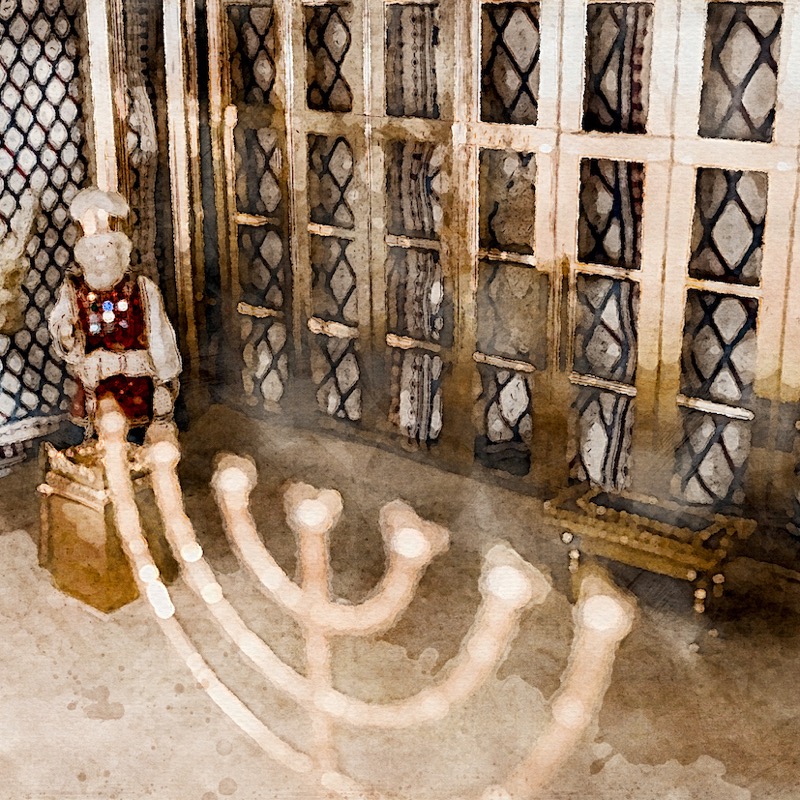
We have by now said a little something about each article of the tabernacle furniture, and we begin briefly this evening a consideration of the coverings and the curtains of the ancient building that formed the dwelling place of God. First, as you approach the building to look at it, you would have seen what was in fact a series of skin coverings. The outer covering was of an animal, the identity of which we are not these days absolutely sure. The series of skins sewn together, presumably, or lashed together. How many skins there were, we are not told, simply that the outer covering was made of the skin of this particular animal. The King James Version called it a badger. The Revised Version calls it seal skin. Some of the modern translations suggest it may have been dugong. About those matters we shall not argue. It has commonly been said in some of the commentaries that the outer skin was dull and drab, and therefore a fitting representation of our Lord, in whom the world saw no beauty that they should desire him. If you feel so about it, well, so be it, and you may be right. Just let me remind you, according to Isaiah the prophet, whatever animal it was or fish that gave the Israelites this skin, it was exceedingly expensive skin. So much so that the really high stepping ladies in society in Isaiah's day, amongst all the gowns, satins, and silks that they got from, uh, Chardin and all the other designers, we'll see, wore shoes made of the skin of this particular animal. I don't think those fashionable ladies with pots of gold at their disposal, able to buy the very latest and most brilliant fashions, would have worn shoes that looked very drab. I suspect they looked rather excellent. They were the best that money could buy. Anyway, the outer skins were made, whether a seal or dugong or what have you, obviously for the purpose of protecting the dwelling place of God. Inside there was another set of skins, how many skins, who knows? They were of ram skins dyed red, rather earthy kind of a red. Underneath the ram skins were much more elaborate. There was, coming from the outside inwards, a series of goat's hair, not goat's skin, goat's hair curtains. And they together were called the tent. I take them off now, but notice please the technicality, the technical term. This set of curtains is technically called the tent. It was formed of eleven curtains made of goat's hair, and, uh, it was made in two sets. There were five curtains, one, two, three, four, five. In that group, there were six goat's hair curtains in that group. The curtain are running this way on. They were, in fact, thirty cubits long, and they were four cubits broad, Six of them sewn into one group, and six of them sewn into another group, joined together by fifty loops down one selvedge and fifty loops down another selvedge, and fifty clasps of copper joining the two sets of curtains so that the tent might be one. The tent had as its function that it should go over the final set of curtains, the tent, over what in fact was called the tabernacle. Now, if ever a some occasion should arise in which you want to show off your specialist knowledge of the tabernacle of Moses to your friends, learn this little technicality that while in general terminology, the whole setup, the building and the furniture and everything else is referred to as the tabernacle, nonetheless, when the text is being explicit and exact and particular, the tabernacle is not these frames here, or the furniture, or the pillars. The tabernacle, strictly so called, is this inner set of curtains. They were made of linens. They had in them, either in tapestry or embroidered upon them, colors of blue, purple, and scarlet. On them also, perhaps in the tapestry or else embroidered, were cherubim. Now we have simply put large grown-up cherubim, so to speak, on there, just one or two of them, so that even you at a distance can perhaps see a smudge that you might eventually diagnose as being a cherub or two. Do see. Actually, I suspect the cherubim were all over these curtains, a mass of cherubim. What exact form they took, of course, the scripture doesn't tell us, whether they were hominoid or whether they were of the animal type, and we needn't stay to discuss the matter tonight. The tabernacle then, this set of curtains. In this set, there are not eleven as there were in the tent. In this set that formed the tabernacle, there were simply ten curtains. Once more, they are running this way on. They are twenty eight cubits long, they are four cubits wide. And here, in both sets, there are five. huh Five in this set here, five in that set there, sewn together, and then the two sets joined together by fifty loops of blue material running down the one selvage, and fifty loops of material running down the other selvage. And the two lots joined together with fifty clasps of gold. They formed God's dwelling place, Hamishkan, as the Hebrew calls it, the tabernacle. And when they were spread over the frames, the result, of course, was delightful, because, as now you can see, when you entered into the holy place, or on the Day of Atonement, the Most Holy, the beautiful colors of the tabernacle and the cherubim upon them appeared through the open ladder-like work of the frame. And the frames being covered with gold, the effect of paneling was magnificent, as you will see if we put up again the slide that we put up last evening. What a magnificent display of glory and color it was as the priests entered into the dwelling place of God, under whose wings I have come to trust, said Lu- said Ruth. With that in our mind, those technicalities in our mind, shall we turn to the book of Exodus once more and chapter uh twenty six and read the directions for the making of the tabernacle Exodus twenty six. Beginning in verse one. Moreover thou shalt make the tabernacle ten curtains of fine, fine linen and blue and purple and scarlet, with cherubim, the work of the cunning workman, shalt thou make them. The length of each curtain shall be eight and twenty cubits, and the breadth of each curtain four cubits. All the curtains shall have one measure. Five curtains shall be coupled together one to another, and the other five curtains shall be coupled one to another. And thou shalt make loops of blue upon the edge of the one curtain from the selvedge in the coupling, and likewise shalt thou make in the edge of the curtain that is utmost in the second coupling. Fifty loops shalt thou make in one curtain, and fifty loops shalt thou make in the edge of the curtain that is in the second coupling. The loops shall be opposite one to another. And thou shalt make fifty clasps of gold and couple the curtains one to another with the clasps, and the tabernacle shall be one. And you perceive what that last phrase means, don't you? Not the building of frames or anything else, but the tabernacle formed of those ten curtains, the tabernacle shall be one. With that emphasis standing in the text itself, our interest will concentrate tonight, particularly in a moment, on the means of attaining that oneness in the curtains that formed the immediate dwelling place of God. Now, I have no intention tonight of detaining you much longer. I offer you my sincere congratulations for your tremendous powers of endurance, not only the powers of endurance of your head, but the powers of endurance of that other part of the anatomy that has made contact with the seats for so many hours this day. The Lord, I trust, will reward you. I wish, therefore, merely to suggest a few outlined thoughts pertaining to the tabernacle itself, and putting these things into the pool of your thinking, leave you in peace tonight to work out for yourselves all the other details. The main function, then, of the tabernacle curtains was to form God a dwelling place in the ancient times. They point in their symbolism forward, of course. Whereas they were copies of things in the heavens, nonetheless they were shadows of the good things to come, and as such they pointed forward to that supreme dwelling place of God, which was our blessed Lord Jesus Christ. The writer of the fourth gospel, as you know, in his chapter one has a play on words. Behind the term mishkan is, of course, a Hebrew verb, SKN. And when John comes to compose his fourth gospel, he used a Greek verb that has those same sounds in it of SKN. And he says, the Word was made flesh and, uh, pitched his tent among us. Drawing the analogy by means of a play on words that our blessed Lord formed in reality what those curtains formed in the picture language of the Old Testament. And it is a delightful study, isn't it, to go through the Gospel of John and its record of the life of our blessed Lord Jesus, and to see how, at its various twists and turns, it was the reality of which this ancient tabernacle spoke. We have stood, for instance, by the altar, haven't we, and heard John the Baptist cry of our Lord, behold the Lamb of God that taketh away the sin of the world. We have heard our blessed Lord himself proclaim that except a man be born of water and of the spirit, he cannot enter the kingdom of God. We have heard our Lord announce, and it is recorded in John chapter eight, I am the light of the world, he that followeth me shall not walk in darkness. We have heard him say to the crowds, I am the bread of life, he that eateth of me shall never hunger. We have followed him into the upper room and to those sacred moments when, as his people's high priest, he lifted up his eyes to heaven and prayed his high priestly prayer on the behalf of his people. And we have followed John into the holiest of all, haven't we? Where at Calvary we watch until the soldier, knowing not what he did, with a spear pierced his side, and there came out the blood and water to stain the mercy seat of God's salvation. Yes, the Word became flesh and tabernacled among us. So in the first place, we take these, um, uh, curtains to be a picture of our blessed Lord. But we can hardly rest content, can we, interpreting the symbolism simply like that, because the merest glance at the tabernacle will show that it was formed of two groups of curtains, and of those two groups was the unity of the tabernacle made up. You shall join the two groups together, that the tabernacle may be one. Whether you think that was a divinely arranged type of another tabernacle about which we are now to think, or whether you think it wasn't a type. It makes no difference to the fact, as now we shall read, there is at this present time a dwelling place of God, isn't there? And when we read about it in the Epistle to the Ephesians, we shall find it is formed of two groups, is it not? I refer, of course, to Ephesians chapter five. Let me trouble you to read it with me. Ephesians chapter two rather, Ephesians chapter two. Having described how as Gentiles we were strangers from the covenants of promise, and thus, and thus, and thus, alienated from God and from the commonwealth of Israel, and having no hope and without God in the world. Paul says in verse thirteen of chapter two, but now in Christ Jesus, ye that once were afar off are made nigh in the blood of Christ. Not only so, but verse nineteen and twenty following are going to tell us that we are of the household of God, being built upon the foundation of the apostles and prophets, Christ Jesus himself being the chief cornerstone, in whom each several building fitly framed together groweth into a holy temple in the Lord, in whom ye also are builded together for a habitation of God in the Spirit. So the people of God form nowadays a dwelling place of God in the spirit. But let us look what the earlier verses have said. Look at verse fourteen: For he is our peace who made both one and break down the middle wall of petition, having abolished in his flesh the enmity, even the law of commandments contained in ordinances, that he might create in himself of the two, one new man, so making peace, and that he might reconcile them both in one body unto God through the cross, having slain the enmity thereby. It needs not me to point it out that the present dwelling place of God is made of two groups, and the genius of Christ, if I may point it, uh, po- phrase it that way, is this, that he has taken two peoples that were diametrically opposed. He has abolished the enmity that was between them and the separating walls of petition, and of those two, he has made a new thing. He has not just added Gentile to Jew, but taking Gentile and Jew, the two, he has made of the two one new man, thus making peace. Hence offer and very elementary lesson. I remain fascinated, however, by the fact that not only were there two groups, but there were, of course, five curtains in each of those groups, ten in all. So when you look at it more closely, the ancient tabernacle of God, and here I am not typologizing, but pointing out the fact, the ancient tabernacle of God was a plurality of curtains. ten curtains, no less. And yet it managed to be a unity, which is a fascinating idea, is it not? You heard the text saying that for all they were many curtains, yet they were to be so joined together that for all they were many curtains yet- curtains, yet the tabernacle should be one. Many curtains, one tabernacle. You say, how was it done? Well, as I said before, two groups together, but then there were fifty loops of blue down one selvedge, and fifty loops of blue down another selvedge, and then fifty casts of gold through the loops, joining them together so that these many curtains, though many, should form one cabinet. Let's have a look at that device on the color slide, please. Other way, up the other way round, Joe. Ah, we couldn't get the whole curtains on, do you see? So we have just shown you an edge of the curtain, and here is a loop, loop and golden clasp, number forty three this is, you can't see it from there, and this is number forty four, this is number forty five, forty six, forty seven, forty eight, forty nine, fifty. Joining the two sets of curtains here, uh, together, that the tabernacle may be one. And the numbers down the side, as you see, refer to cubits. They were four cubits there, and twenty eight cubits along here, extending into the distance. You'll see. Hm. Fifty loops of blue, plus fifty loops of blue, plus fifty clasps of gold. Interesting number, isn't it? Because, you know, one can't help thinking, the more one has things stores it stored in one's brain, of another place in scripture that talks of this number fifty, an exceedingly important place indeed. That was, of course, the day of Pentecost. And as every schoolboy knows, Pentecost gets its name from the Greek, Pentekonta is fifty and Pentecostos is fiftyth. The day of Pentecost is so called because on the fiftyth fiftieth day, the feast of the Jews began, that among the Jews is called the Feast of Weeks, Shavuot, but in Greek is called the Feast of Pentecost that begins on the fiftieth day. And I can already hear somebody saying, but wait a minute, Mr. Preacher, you're not going to tell us, are you, that those fifty loops and fifty cloths have anything to do with Pentecost just because they share the same number fifty? Well, actually, I was. You will say that's very fanciful of you, sir. Now you are taking flight into, uh, fancy. Well, I don't want to do that, so forget it. Let's forget all that business, those fifty loops, joining those curtains together, they might be one, forget it. And let's spend the rest of the evening talking about Pentecost anyway, because Pentecost had happened, didn't it? And it happened on the fiftieth day, so let's forget those curtains completely and think of what happened on the, uh, fiftieth day of Pentecost. And what was Pentecost remarkable for? Well, let's turn to the Acts of the Apostles to find out. And in chapter one of the Acts of the Apostles, our blessed Lord explains what is going to happen. Acts one and verse four: and being assembled together with them, he charged them not to depart from Jerusalem, but to wait for the promise of the Father, which, said he, you heard from me. For John indeed baptized in water, but you shall be baptized in the Holy Ghost not many days hence. And so it happened when the day of Pentecost was fully come, the risen Lord poured out his Holy Spirit, and the early believers were baptized in the Holy Spirit. Here then is the famous baptism in the Spirit, which John and prophesied of, which Christ here announces, which actually began to take place on the day of Pentecost, the fiftieth day on the feast of Shavuot. You say, pray, what was the significance of Pentecost and the baptism in the Holy Spirit? Well, many significances perhaps, but this evening I choose to read one of them, and I read now from one Corinthians chapter twelve, one Corinthians chapter twelve, where Paul is speaking to the believers about their use of their Christian gifts. And he says in one Corinthians twelve and verse twelve: for as the body is one and has many members, and all the members of the body, being many, are one body, so also is, and notice the translation, so also is the Christ. For now, Paul is not thinking merely of the individual person of our Lord. He is thinking of the Christ, that is Christ and his people. That great, uh, unity, that person of Christ and his people, the body of Christ, we are told then in verse twelve, the body is one. Nonetheless, it has many members. It is a plurality in a unity. And all the members being many, nevertheless, they are a pl- in spite of the fact they are a plurality, yet are they a unity, and being many, are one body in the Lord, of course. How, how you chance to say, how can it be that the body of Christ is formed of many members and yet is one body? Why, says Paul, the answer is to be found here? And we read in verse thirteen: for in one spirit we were all baptized into one body, whether Jews or Greek, whether bond or free, and were all made to drink of one spirit. Now you will observe that two operations are described. There is, in the first place, baptism in the Spirit. You were all baptized in one Spirit. And that is immediately followed by the other observation, you were all made to drink of one Spirit. Why the two operations, and what is the difference between them? Let us start with John the Baptist. He was the one that announced the baptism in the Holy Spirit, and he said it in these terms: I baptize you in water. There cometh one after me mightier than I, and he shall baptize you in the Holy Ghost. And the parallel is easy to see, isn't it? If you came to John for baptism, he got hold of you, and he put you in the water. If you come to the Lord Jesus, he gets hold of you, and he puts you in the Holy Spirit. Baptism in or with the Holy Spirit. So when I am baptized in the Holy Spirit, I go into the Spirit. But then, says Paul, you were all made to drink of the Spirit, and if we drink of the Spirit, the Spirit goes into us. Isn't that so? You say, it's late at night, Mr. Preacher, show us how it is. Well, here I have a glass of water. Ah. And if I baptize my finger in the water, watch what happens. My finger goes in the water. Yeah. Been baptized in the water, look. Of course, I have already, I assure you, been baptized a whole lot of me from head to foot in the water, because I am a Christian. But there you are. If my finger is baptized in water, my finger goes into the water. But if I am made to drink of the water, hmm. Did you see what happened? The water went into me. They are corresponding actions, aren't they? I into the water, the water into me. You were baptized in one spirit, and you were made to drink of one spirit. You went into the Spirit, and the Spirit went into you. So much is clear, isn't it? You say, please, what has that got to do with the unity of the body of Christ? I don't see the point, you say. Well, to illustrate it, let us use another illustration, not nearly so congenial this time. If you can bear it from where you sit, look at this human body that stands before you. I promise you, you needn't look too long. But if you look, you will see that this human body standing before you is one of these pluralities in a unity, and a unity of a plurality, isn't it? For this human being is made of many members, fingers and toes and arms and legs and things. For all that there are many members, they are one body. How would you account for that? What is it that keeps all the many members of my body stuck onto the body, so to speak, and stops them from disintegrating? You'll say, fancy you're not knowing that, old chap. Um, it is the muscles and the bones that keep you together. No, it isn't. And I can prove it to you, but I hope you won't prove it to me. For suppose you took me tonight and shot me through the head and laid me out on the floor. The muscles and the bones would still be there, wouldn't they? Come back in fifty five years, and not all the members would be together. They'd have come unstuck, wouldn't they? What is it that keeps all the varied mem- members of my body together? The simple answer is this, that I sta- as I stand before you, I am in the air, and the air is in me. Simultaneously, of course. You can't have one without the other, can you? I mean to say, suppose I was in the air, but the air wasn't in me. Suppose you barbarous people were to come up to me and throttle me by the throat so there was no air left within me. I was in the air, but the air wasn't in me. I should go blue in the face, and in five minutes would be dead. Ah, that's no good. All right, suppose the other thing. You take me to Cape Canaveral and put me on the top of a rocket without any protection. You say, goodbye, Gooding, you're now going out into outer space. Take a deep breath, my good man. Fill your lungs because there's not much air out there. See that you've got plenty of air inside you. So up I go on this rocket, and I come to where there's no air whatsoever. The air is in me, but now I'm not in the air, you'll see. I go pop, you see. So, you can't have it one way without the other. That's an utter impossibility. If you would have a human body, the body has got to be in the air and the air in the body simultaneously, at least after birth. Isn't that true? And how do you suppose the body of Christ is kept together? We, being many members, are one body. How is it done? Why, by two operations that must be present simultaneously. In one spirit you were all baptized. You went into the spirit and are in the spirit. And you were made to drink of the Spirit, and the Spirit went into you. Whatever our dear fellow believers mean, who sometimes talk of the baptism of the Holy Spirit as a thing which a true believer can, while being a true believer, not have experienced yet. It can't be what Paul is talking about here, can it? For if we haven't been baptized in the Holy Spirit, we're not in the body of Christ at all. And what is more, you cannot have the Holy Spirit in you without you being in the Holy Spirit either. And Paul elsewhere states categorically, doesn't he, this same truth in Romans chapter eight and verse nine. You are not in the flesh, he says. The flesh might be in you, but you are not in the flesh. You are in the spirit if the spirit is in you. Simultaneous, and must be, for this is the glorious secret of this still more glorious thing that God has formed within his universe. Sit open mouths at the wonder of it. There were centuries when no such thing existed. When the world saw Jesus Christ nailed to a tree, they thought it was the end of him. And principalities and powers laughed their gleeful, scornful laughter as they see- saw Jesus Christ spiked to Calvary and buried in a tomb. But God raised him from the dead and seated him in his own right hand, far above all principalities and powers and mights and dominions and everything that is named, both in this world and in that which is to come. And looking round, the highest intelligences have seen a new wonder in the universe that, as I say, wasn't there before. A new thing, a body. Well, that's the nearest term you could use, the nearest analogous term to describe it. It's a body because it is a plurality, and yet somehow it is a unity. It is formed of Christ and all his believing people. Their personality and individuality hasn't been taken away from them, and there is the wonder of it, isn't it? But with them still remaining individuals, and yet, and yet they have been brought together, so they are now literally members of a higher form of organism, which is the great new thing in God's universe, which is the body of Christ. If you want to talk about evolution, here's a fit subject, perhaps, but I ain't evolution, so sorry. But this is how God has been progressing. Who would have dreamed when Adam first walked in Eden what was hidden in the great counsels of God? That he was going to have an altogether new organism, such as the world had never seen before. Redeemed humanity, joined to the Lord Jesus, and one life flowing between them all. You say, how could I possibly be in the body of Christ? Christ is in glory, and I am here on earth. Well, yes, I know, but then, uh, if you wouldn't mind just tucking up your courage once more, and I promise it is the last time, to have a look at this body that's standing before you. Up here is the head, yes, it has meant to have a brain in, and down there are the feet, somewhere down there, about five foot nine below the head, you'll say. Would you say that those feet belong to the same body? You'll say, yes, that's possibly reasonable. Why? Because right from the bottom of my toe down there to the top of my head up here, the same oxygen circulates through the body, and the same life pulsates in all the members. And here you are sitting on very hard seats in Greenwood Hills, Pennsylvania, and your blessed Lord is in glory. And it remains true that between you and him there flows that same life of God's Holy Spirit that already joined you in one body with the Lord. Don't look so glum. I know it comes as a shock to you to think that you are eternally in the same body as I am, but there's nothing you can do about it, my good friend. Try how you will. And worthy though I am, I have received the Savior. I have been baptized in the Holy Spirit, and I have made the maid to drink of the Holy Spirit, and if you've gone and done that too, well, you're in the same body, whether you like it or not. Yes. Imperfect though we are, it is already true. But what will it be when at last we see the wonder of the thing unveiled before the universe. God's answer to the discord of earth. You see, individualism, individual personality is a lovely thing, isn't it? And our dear communist friends nonetheless have observed what chaos can arise if individualism is allowed to have its own way and care nothing for other human beings. So they've tried to produce a body politic that hangs together, but they do it by force and manage to achieve it largely by obliterating the individuality of each member. They've not found the secret yet, have they, of producing a paradise? Yes. And we've only begun because I know in some assemblies that have been somewhat less than paradise. But one day, one day at last, the wonder shall be unveiled as God has told it by maintaining the individuality of each individual member, still recognizable personality, yet members of something that is beyond personality. The great body of Christ. And then, and then, and then, what wonders are in it. Oh, allow me just to come back to these, uh, tabernacle curtains. Picture of Christ, you say. Yes, obviously, with the cherubim on. Executist of God's judgment. For all authority has been given him in heaven and in earth. The ascended Lord is above all principalities, powers, mights, and dominions. How could that be a symbol of me or of any other member of the church, you say? It is true, isn't it? For joined with Christ, you are already seated in the heavenlies with Christ, far above the principalities and powers. That's not your geographical position, but that is your spiritual rank. Know you not that the church shall judge angels one day? The church shall judge the world, and forever and forever, as Eve was made to complement Adam in the task of organizing earth and making something of it for God, for all eternity. Along with Christ, you shall pray his queen to the king and reign with him. Develop all those great schemes that the infinite wisdom of God has already full- foreseen to be fulfilled in the ages to come. You can scarce take it in, can you? Ah, but these are the true sayings of God. May God give us to understand them and live ever increasingly here on earth in light of the reality of the thing that is already formed, the unity of every believer in the Lord Jesus Christ. Shall we pray? Lest then once more we beseech thee thy holy word, O Lord, while by thy spirit we begin to perceive the wonder of it and see so little. Yet do we take comfort from this, that in the ages to come, thou wilt unfold to us the exceeding riches of thy kindness towards us in Christ Jesus. Yet with all, as we consider the wonder of it and our hearts are made glad, help us, Lord, to be realists, how grossly we have failed to express the unity of the body of Christ in this world below. Forgive us, Lord, we do beseech. Grant that in days to come, by the grace of thy spirit, we may more faithfully and truly represent, in practical terms, the great spiritual unity that thou hast created in Christ Jesus our Lord. And we thank thee for thy word. We thank thee for the grace and strength to study it so intensively today. And while we have forgotten much already of what we have heard, yet by thy spirit write it on our memories, we beseech thee, so that by thy spirit it may be reactivated in days yet to come. We ask it through Jesus Christ our Lord. Amen.